


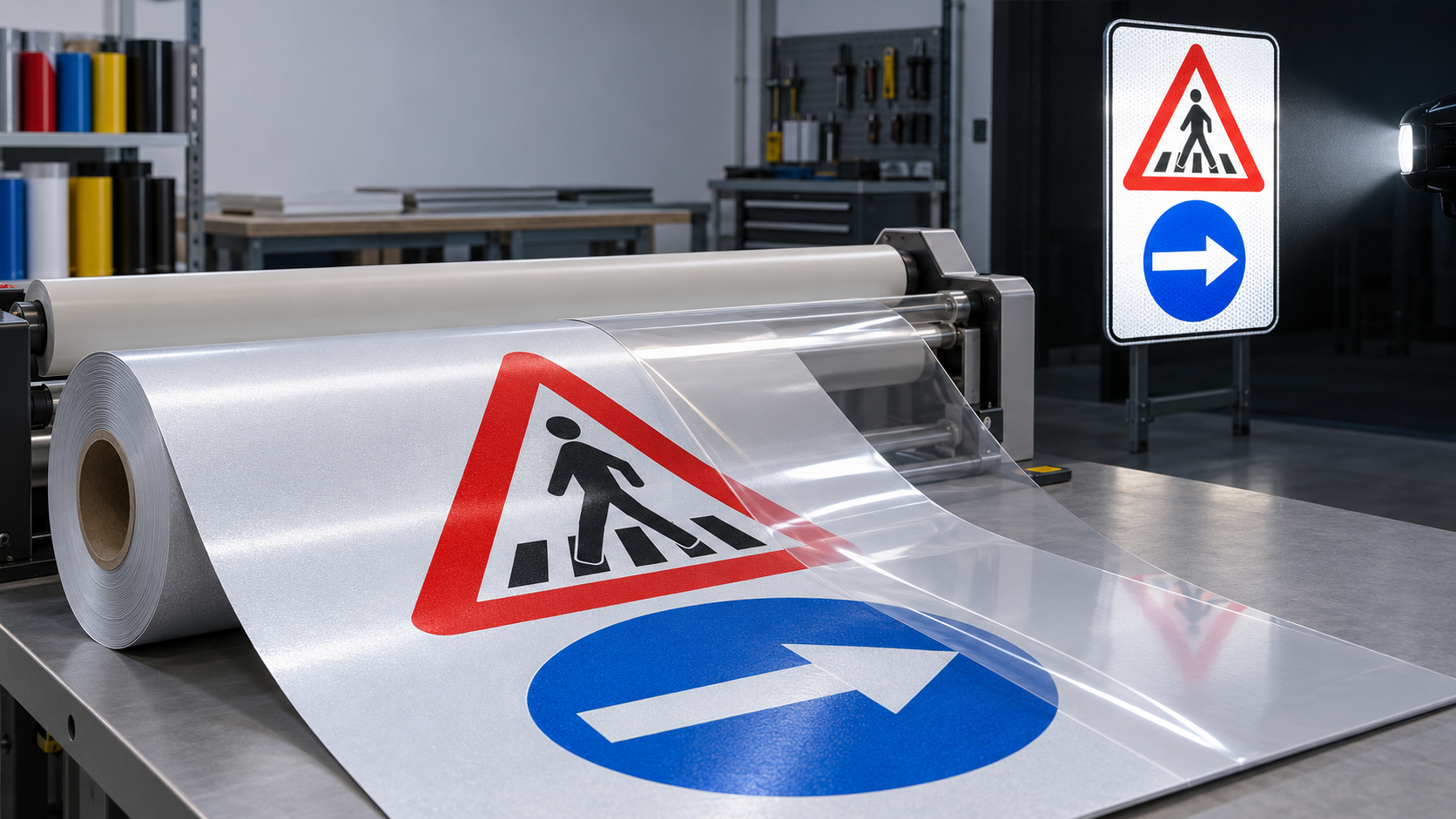
A roll of reflective sheeting may be described as suitable for three, five or even more years outdoors. Once the surface is printed, however, the performance of the finished graphic no longer depends on the reflective film alone.
Ink, curing, overlaminate, adhesive, substrate preparation, exposed edges, cleaning and installation conditions all become part of the finished system.
So, does printed reflective sheeting need lamination?
The short answer is: not always—but outdoor digital printing normally benefits from a compatible protective overlaminate, and some traffic-sign systems specifically require one.
Lamination may be optional for short-term indoor graphics, temporary outdoor advertising or an approved screen-printed system. It becomes much more important when the printed surface will face long-term ultraviolet exposure, abrasion, chemicals, frequent cleaning, high-pressure washing or graffiti.
For regulated traffic signs, vehicle markings and license plates, never make the decision from a general rule. Use the approved combination of reflective sheeting, ink, protective overlay, substrate and edge treatment specified for the project.
This guide explains when lamination is required, when it may be optional, how to choose an overlaminate, when edge sealing is necessary and how to evaluate the outdoor durability of the complete printed reflective system.
Quick Answer: Does Printed Reflective Sheeting Need Lamination?
Printed reflective sheeting should normally be laminated when the overlaminate is required by the material manufacturer, warranty system, traffic-sign specification or end-use environment.
Lamination is also generally recommended when the print requires protection against:
Ultraviolet exposure and ink fading
Scratching and abrasion
Water and frequent cleaning
Fuel, oil or chemicals
Road dirt and salt spray
Graffiti and aggressive cleaning
Repeated handling
Long-term outdoor exposure
Lamination may be optional when:
The graphic is used indoors
The application is short-term and easy to replace
The sheeting is unprinted and only plotter cut
The approved ink system is sufficiently durable without an overlay
The product specification explicitly permits unlaminated use
The customer accepts the shorter or less predictable printed-image life
A transparent film is not automatically a suitable reflective sheeting overlaminate. The exact film, ink and overlaminate combination must be tested.
Printed Reflective Sheeting Lamination Decision Matrix
Application | Overlaminate Recommendation | Edge Sealing Recommendation | Main Condition |
|---|---|---|---|
Indoor printed display | Usually optional | Normally unnecessary | Confirm handling and cleaning requirements |
Unprinted plotter-cut graphics | Usually unnecessary | Product-specific | Follow the reflective sheeting data sheet |
Short-term outdoor advertising | Optional to recommended | Usually optional | Compare protection cost with replacement interval |
Long-term outdoor commercial sign | Usually recommended | Consider for exposed edges | Use a UV-stable, compatible laminate |
Printed fleet or vehicle graphic | Usually recommended | Consider at vulnerable edges | Match flexibility, cleaning and surface geometry |
Permanent traffic sign | Use the approved system | Follow the approved fabrication method | Generic laminate must not replace a specified overlay |
Temporary traffic sign | Project-specific | Product-specific | Confirm the applicable standard and service period |
License plate material | Follow the approved plate system | Defined by plate construction | Do not improvise with an advertising laminate |
Industrial or equipment label | Usually recommended | Often advisable where chemicals reach the edge | Specify abrasion and chemical resistance |
Horizontal or upward-facing graphic | Only use a specifically rated system | Product-specific | A laminate cannot make a vertical-only product horizontal-rated |

Lamination vs Applying Reflective Sheeting to Aluminum
The word “lamination” is used for two different production steps.
1. Applying Reflective Sheeting to a Substrate
This means bonding self-adhesive reflective sheeting to an aluminum sign blank, painted metal panel or another approved surface.
The reflective sheeting is the face material, while the aluminum provides rigidity.
For this process, see our detailed guide to applying reflective sheeting to aluminum sign panels.
2. Applying a Clear Overlaminate to the Printed Surface
This means covering the printed reflective sheeting with a transparent protective film.
A typical construction becomes:
Clear protective overlaminate
→ Printed ink layer
→ Printable surface or topcoat
→ Glass-bead or microprismatic reflective layer
→ Pressure-sensitive adhesive
→ Aluminum or another application substrate
This article mainly discusses the second meaning: protecting the printed face with a clear overlaminate.
What an Overlaminate Can—and Cannot—Do
A properly selected overlaminate can improve the durability and cleanability of a printed reflective graphic.
What an Overlaminate Can Do
A compatible overlaminate may:
Reduce direct exposure of the ink to sunlight
Improve resistance to scratching and handling
Protect the print during cleaning
Reduce direct contact with water, road spray and dirt
Improve resistance to some chemicals
Provide gloss, luster or matte appearance
Support anti-graffiti performance when a specialty overlay is used
Reduce damage during transportation and installation
Help the printed image remain legible for longer
What an Overlaminate Cannot Do
An overlaminate cannot:
Repair weak ink adhesion
Complete the curing of undercured ink
Restore retroreflection blocked by opaque ink
Correct an unsuitable reflective sheeting surface
Compensate for poor substrate preparation
Prevent every form of edge lifting
Convert commercial reflective vinyl into traffic-sign-grade sheeting
Make a vertical-exposure product suitable for horizontal use
Automatically extend outdoor life by a fixed number of years
Create regulatory compliance unless the complete system is approved
Lamination protects a suitable print. It does not convert an unsuitable material and ink combination into a reliable outdoor system.
Why Printed Reflective Sheeting Is Different From Unprinted Sheeting
The original outdoor durability of reflective sheeting normally refers to the unprinted material under defined conditions.
Printing creates an additional surface layer that may fail before the reflective material itself.
The finished graphic is only as durable as its weakest component or interface:
Reflective face film
Printable topcoat
Ink
Ink-to-sheeting bond
Overlaminate
Laminate adhesive
Sheeting adhesive
Application substrate
Cut edges and seams
Installation quality
Service environment
For example, a reflective film may retain good retroreflectivity while the printed color fades or peels. Alternatively, the ink may remain intact while the laminate shrinks, curls or lifts from the edges.
This is why buyers should request durability information for the finished printed construction, not only the raw reflective sheeting.
For more information about printable surfaces and ink systems, read our Printable Reflective Sheeting for Digital Printing Buying Guide.
Does Lamination Depend on the Printing Method?
Yes. Each printing method creates a different ink film and requires a different lamination decision.
Printing Method | Is Lamination Normally Recommended Outdoors? | Main Risk Before Lamination |
|---|---|---|
Eco-solvent inkjet | Usually yes for medium- or long-term graphics | Trapped solvent, incomplete drying and soft ink |
Solvent inkjet | Usually yes where image protection is required | Residual solvent, plasticizer interaction and strong ink deposits |
Latex printing | Often yes, depending on the qualified system | Heat history, ink-media compatibility and insufficient cooling |
UV digital inkjet | Often yes for abrasion and chemical protection | Brittle ink, surface texture, silvering and poor ink adhesion |
Screen printing | Application-specific | Incorrect ink, excessive deposit or incomplete curing |
Thermal transfer printing | System-specific | Incompatible ribbon, resin or protective overlay |
Plotter-cut colored film | Usually no surface laminate | Edge lifting, wrong substrate or unsuitable film construction |
Eco-Solvent and Solvent Printing
Eco-solvent and solvent inks can provide practical outdoor performance on suitable printable PVC reflective vinyl.
However, residual solvent must leave the printed film before it is covered. Laminating too early can trap solvents between the ink and overlaminate.
Possible results include:
Bubbles
Odor
Ink softening
Laminate lifting
Curling
Adhesive interaction
Delayed ink failure
Reduced dimensional stability
Some graphics manufacturers recommend approximately 24 to 48 hours of drying for eco-solvent or mild-solvent prints, but this is not a universal production rule.
Required drying time depends on:
Ink formulation
Printer settings
Ink coverage
Ambient temperature
Humidity
Media construction
Winding method
Manufacturer instructions
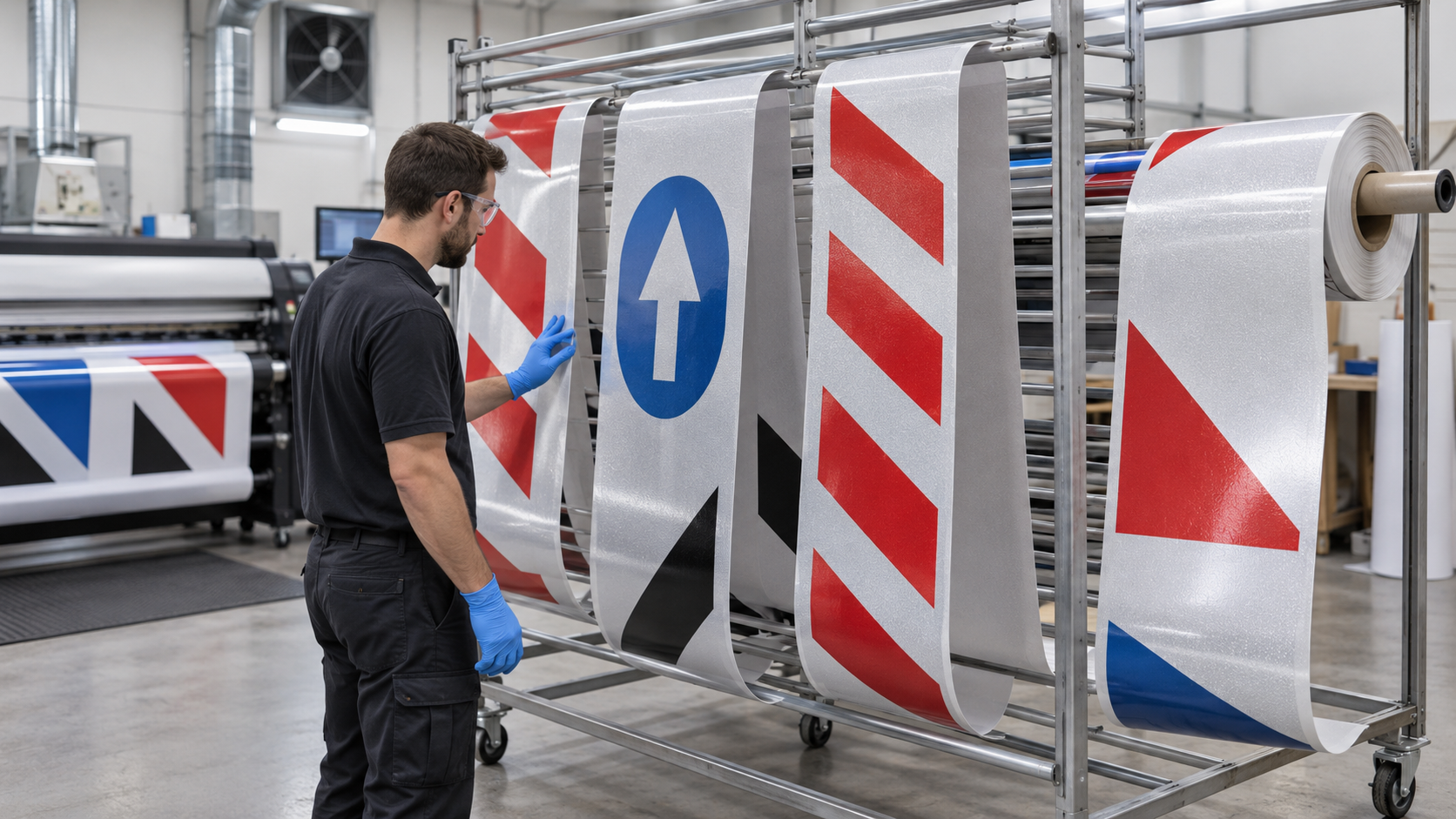
Do not keep a heavily printed roll tightly wound while it is outgassing. Follow the documented procedure for the exact printer, ink, reflective sheeting and overlaminate.
Latex Printing
Latex printing may leave the printer relatively dry, but that does not automatically prove that every reflective film and overlaminate combination is ready for immediate conversion.
Confirm:
The reflective sheeting is approved for the printer
Heater settings do not distort the media
The print has cooled sufficiently
Ink adhesion is acceptable
The laminate adhesive bonds to the printed surface
The completed construction remains flat
The required warranty or specification covers the combination
UV Digital Inkjet Printing
UV ink is cured by ultraviolet or UV-LED energy and does not require solvent evaporation in the same way as solvent ink.
Nevertheless, UV-printed reflective sheeting may still need lamination for:
Scratch resistance
Chemical resistance
Anti-graffiti protection
Frequent cleaning
Handling protection
Long-term outdoor image protection
UV printing creates several special challenges.
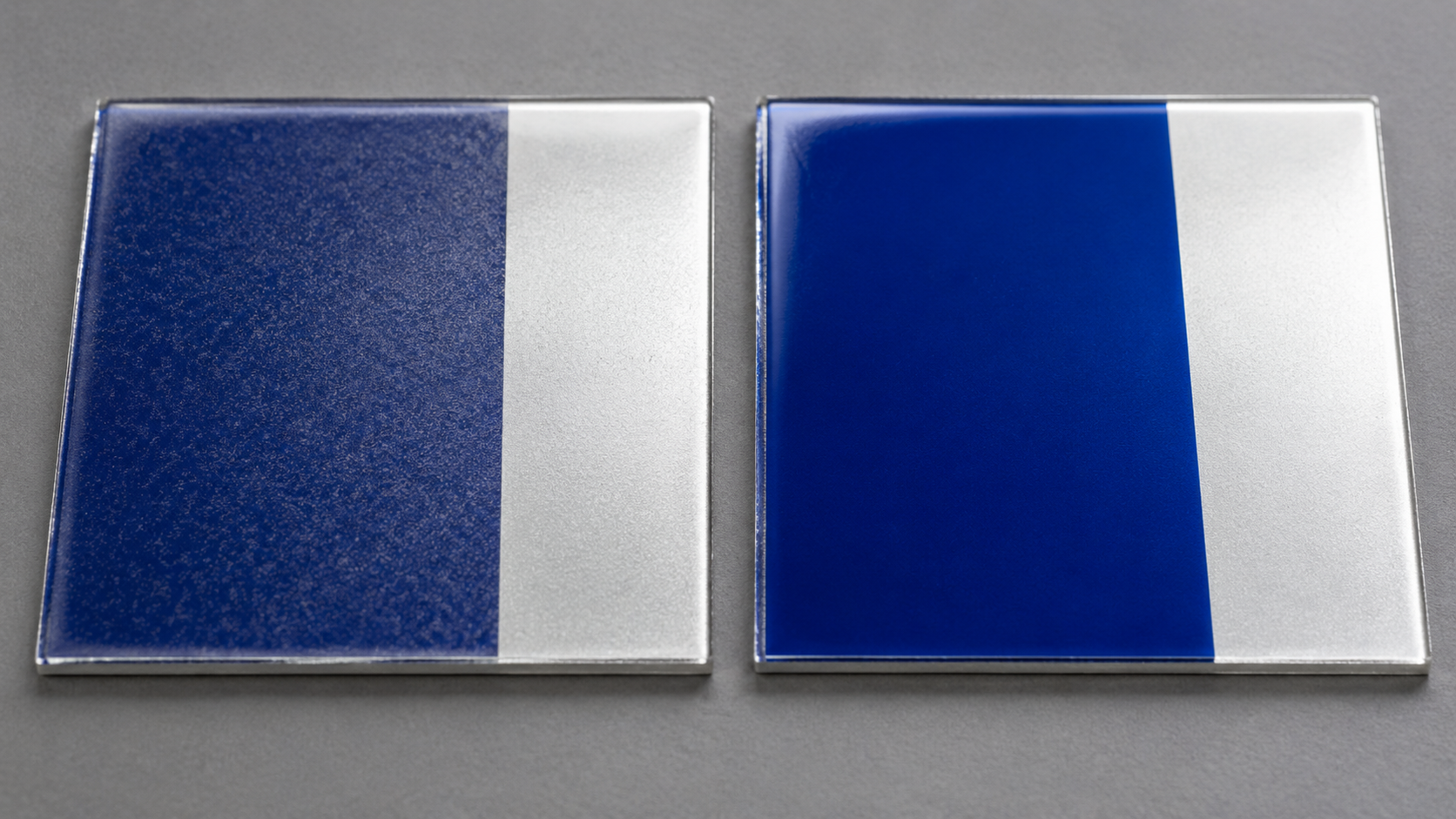
A heavy or textured UV ink layer can trap small air gaps below the laminate, producing a silvery or cloudy appearance known as silvering.
A rigid UV ink may also crack when flexible reflective vinyl is bent, stretched or applied to a curve.
Before laminating a UV print, verify:
Ink adhesion after full curing
Ink flexibility
Laminate adhesion
Laminator pressure and speed
Permitted roll temperature
Resistance to cracking after bending
Retroreflectivity after printing and lamination
For a detailed compatibility guide, see Can You UV Print on Reflective Sheeting?.
Screen Printing
Approved screen-printing inks can provide durable spot colors on reflective sheeting, and some systems are designed for use without a separate overlaminate.
However, this does not mean all screen-printed signs should remain unlaminated.
An overlay may still be required for:
A traffic-sign warranty system
Anti-graffiti protection
Severe abrasion
Chemical exposure
Frequent washing
A specific project specification
Ink type, mesh, deposit, drying and curing must be controlled before an overlay is considered.
Learn more in our Screen Printing on Reflective Sheeting Guide.
How PVC, PET, Acrylic and Prismatic Sheeting Affect the Decision
The correct overlaminate must match the mechanical and surface properties of the reflective film.
PVC Reflective Vinyl
PVC reflective vinyl is flexible and widely used for eco-solvent, solvent and compatible latex printing.
A laminate that is much stiffer or more dimensionally stable than the PVC base may create stress as the layers respond differently to heat and outdoor aging.
Possible problems include:
Edge curl
Tunneling
Shrinkage
Cracking on curves
Delamination
Lifting from vehicle contours
For commercial printed graphics, see ABLAZE Printable PVC Reflective Vinyl.
PET Reflective Sheeting
PET is generally more rigid and dimensionally stable than PVC.
The laminate must bond to the actual printable coating—not simply to a surface described as PET. Standard untreated PET may not accept every ink or laminate adhesive.
For flat safety signs, plotter cutting and suitable screen-printing systems, see ABLAZE PET Reflective Sheeting.
Acrylic Reflective Sheeting
Acrylic or PMMA reflective sheeting normally provides good weatherability and is frequently used for suitable UV and screen-printing applications.
However, acrylic material can be less conformable than PVC. The printed and laminated construction should be checked for cracking during cutting, punching, bending or installation.
See ABLAZE Acrylic Reflective Sheeting for UV and Screen Printing.
Microprismatic Reflective Sheeting
Microprismatic sheeting contains a controlled optical structure that may include sealed cells.
Excessive heat, pressure, flexing or an unsuitable overlay can affect:
Surface appearance
Prism-cell integrity
Nighttime uniformity
Retroreflectivity
Edge resistance
Dimensional stability
Use only a protective overlay and fabrication procedure approved for the exact prismatic product.
For a broader material comparison, read PET vs PVC vs Acrylic Reflective Sheeting.
How to Choose the Correct Overlaminate
Do not select an overlaminate only by price, thickness or whether it appears transparent.
Evaluate the following properties.
Selection Item | What to Confirm | Possible Failure if Incorrect |
|---|---|---|
Product approval | Exact sheeting, ink and laminate combination | Loss of warranty or non-compliant sign |
Optical clarity | Haze, tint and nighttime appearance | Reduced or uneven retroreflection |
UV stability | Rated exposure and climate limitations | Yellowing, cracking or fading |
Surface finish | Gloss, luster or matte | Unwanted glare, color shift or optical loss |
Film chemistry | PVC, polyurethane, polyester or acrylic construction | Shrinkage and mechanical mismatch |
Conformability | Flat, simple curve or compound curve | Lifting, wrinkling or cracking |
Laminate adhesive | Compatibility with the cured ink surface | Silvering, peeling or tunneling |
Chemical resistance | Fuel, cleaners, salt, solvents or graffiti | Surface softening or staining |
Abrasion resistance | Handling, brushes, washing and road debris | Scratched or unreadable print |
Outdoor rating | Exposure direction, climate and tested pairing | Premature failure |
Processing range | Permitted pressure, speed and temperature | Curling, distortion or optical damage |
For traffic signs, use an overlay approved as part of the complete imaging system. A generic advertising laminate should not be substituted merely because it is clear.
Does Clear Laminate Reduce Retroreflectivity?
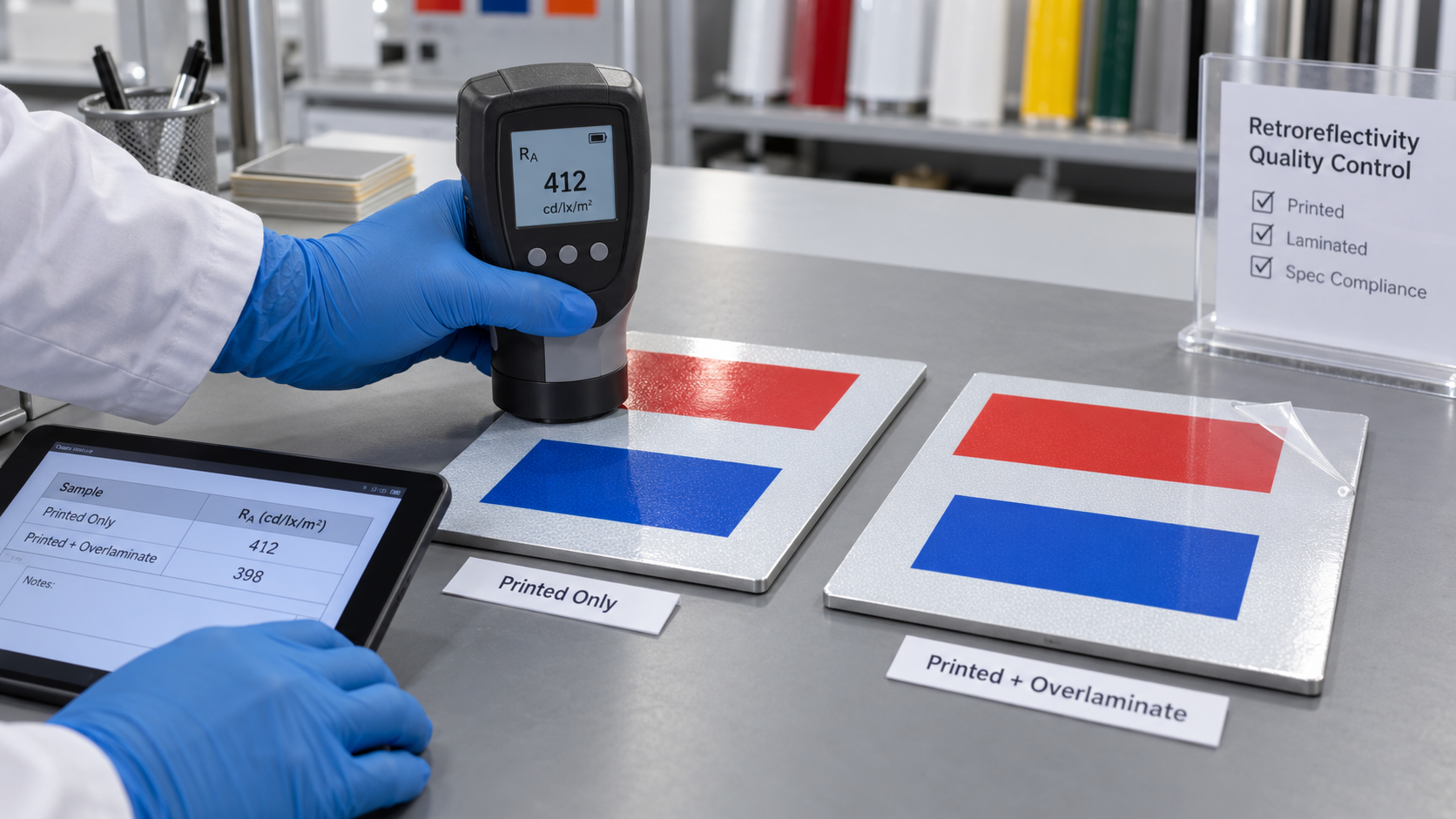
A clear overlaminate can change measured retroreflectivity.
The amount of change depends on:
Optical clarity
Surface gloss or texture
Adhesive clarity
Film thickness
Haze
Ink opacity
Printed color
Reflective technology
Observation and entrance angles
Laminating pressure and temperature
The printed ink usually has a larger effect than the clear laminate, especially where dense or opaque colors cover the reflective surface. However, the overlay still adds optical interfaces and must be evaluated.
Use four measurements where possible:
Unprinted reflective sheeting
Printed reflective sheeting before lamination
Printed and laminated reflective sheeting
Printed, laminated and environmentally aged material
All measurements must use the same color, observation angle, entrance angle, orientation and test method.
For an explanation of these conditions, read Coefficient of Retroreflection Explained.
A daytime visual check or camera-flash photograph cannot replace a calibrated retroreflectometer for contractual acceptance.
Drying, Curing and Outgassing Before Lamination
Never laminate simply because the print feels dry to the touch.
Before applying the overlaminate:
Follow the ink manufacturer’s curing or drying instructions
Allow sufficient outgassing for solvent-based systems
Avoid tightly winding prints that must release solvent
Record print time and lamination time
Keep the surface free from dust, oil and fingerprints
Check adhesion after the defined curing period
Inspect heavy-ink areas separately
Confirm that UV ink is fully cured, not only surface-hardened
Allow printed media to reach a stable temperature
Do not laminate a cold or moisture-condensed roll
Laminating too early may temporarily hide weak ink. The failure can appear later during cutting, rolling, installation or outdoor exposure.
Recommended Production Workflow
Use the following workflow for a new reflective sheeting, ink and overlaminate combination.
Step 1: Define the Finished Application
Identify:
Country and applicable standard
Indoor or outdoor use
Required service life
Flat, curved or flexible surface
Vertical, horizontal or inclined exposure
Expected UV, water and temperature conditions
Cleaning and chemical exposure
Abrasion and handling level
Step 2: Select a Printable Reflective Sheeting
Confirm the exact product code, face material, reflective technology, printable coating, adhesive and liner.
Do not assume that every white reflective film is printable.
Step 3: Confirm the Ink System
Record:
Printer brand and model
Ink brand and series
Ink type
Color profile
Heater or curing settings
Ink limits
Number of passes
Step 4: Produce a Controlled Test Print
Include:
Light and heavy ink coverage
Solid colors
Fine text
Gradients
Unprinted reflective areas
Areas that will be cut or bent
Step 5: Complete Drying or Curing
Follow the documented production conditions for the ink system. Do not use a universal waiting period without checking the manufacturer’s instructions.
Step 6: Test the Unlaminated Print
Check:
Ink adhesion
Surface cure
Scratch resistance
Color
Nighttime appearance
Retroreflectivity
Flexibility where relevant
Step 7: Apply the Qualified Overlaminate
Use the approved:
Laminator type
Nip pressure
Speed
Web tension
Temperature
Roll alignment
Most pressure-sensitive overlaminates are applied by cold roll lamination. Certain qualified UV-printing systems may use a warm upper roll to reduce silvering, but temperature settings must come from the relevant technical instructions.
Step 8: Allow Laminate Adhesion to Develop
Do not immediately stretch, bend, cut or install a new combination unless the system permits it.
Pressure-sensitive laminate adhesives may require dwell time to develop their final bond.
Step 9: Convert and Mount the Graphic
Complete cutting, trimming, application to the substrate and perimeter re-rolling according to the product instructions.
Step 10: Edge-Seal Where Required
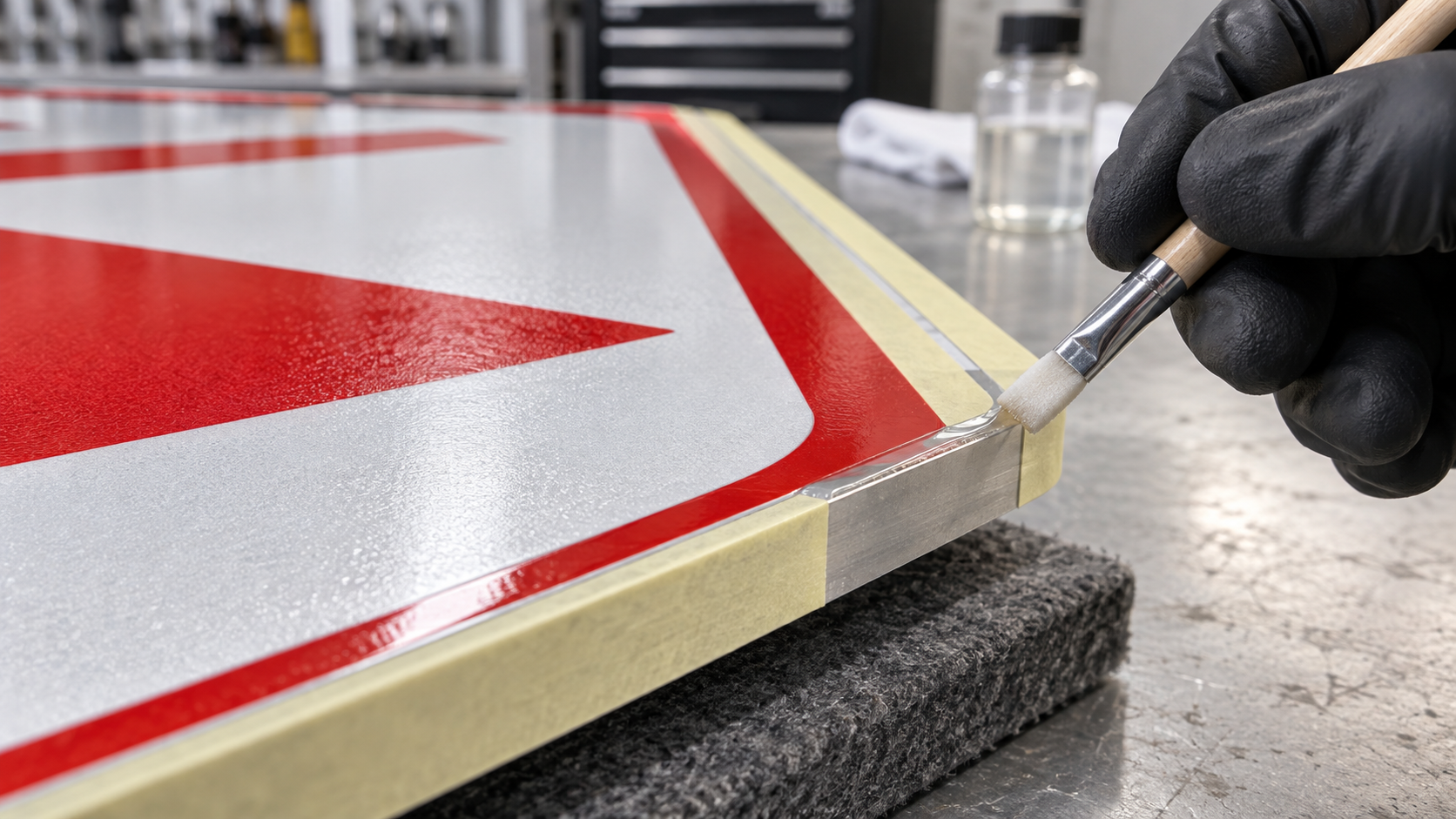
Use only a compatible liquid sealer, edge-sealing tape or factory sealing process specified for the product.
Step 11: Complete Final Inspection
Inspect:
Bubbles
Wrinkles
Silvering
Curling
Edge lifting
Ink lifting
Cracking
Color shift
Dark reflective areas
Nighttime uniformity
Correct orientation of prismatic sheeting
Common Lamination Defects and Solutions
Defect | Likely Causes | Corrective Action |
|---|---|---|
Silvering | Air trapped over textured UV ink; insufficient pressure or unsuitable settings | Verify compatible laminate and adjust pressure, speed or permitted temperature |
Bubbles | Residual solvent, contamination, trapped air or moisture | Allow full drying, clean the surface and review laminator setup |
Wrinkles | Misaligned rolls, unequal tension or excessive speed | Realign rolls and stabilize web tension |
Edge lifting | Dirty edges, stretched laminate, poor trimming or insufficient pressure | Clean, trim correctly, re-roll and edge-seal if specified |
Curling | Shrinkage mismatch, excessive tension or incompatible film stiffness | Match constructions and reduce processing stress |
Tunneling | Adhesive incompatibility, solvent retention or dimensional movement | Requalify the material combination |
Ink lifting with laminate | Weak ink-to-sheeting adhesion or incomplete cure | Correct the printing process before laminating |
Cracking after bending | Rigid ink or laminate on a flexible base | Use a flexible ink and mechanically compatible laminate |
Dark reflective areas | Excessive pressure, heat, opaque ink or optical damage | Inspect settings and measure retroreflectivity |
Color shift | Laminate tint, finish or unsuitable color profile | Evaluate the laminated color and adjust the ICC profile if appropriate |
For layer-by-layer failure diagnosis, use our Reflective Sheeting Defects and Troubleshooting Guide.
Does Printed Reflective Sheeting Need Edge Sealing?
Edge sealing and overlamination are not the same process.
An overlaminate protects the main printed surface. Edge sealing protects the exposed perimeter where the laminate, reflective film and substrate meet.
Edge sealing is product- and application-specific.
It may be recommended when the graphic is exposed to:
Fuel or oil spills
Aggressive chemicals
High-pressure washing
Severe abrasion
Salt spray or marine conditions
Repeated brushing or mechanical contact
Vehicle panel edges and vulnerable seams
Moisture-sensitive reflective constructions
Project specifications that explicitly require sealed edges
Edge sealing may not be necessary when:
The product data sheet states that it is not required
The reflective film has a construction designed to resist edge ingress
The graphic is used indoors under mild conditions
The edge is protected by an approved fabrication design
The complete qualified system permits exposed cut edges
Some metallized or single-layer prismatic constructions are specifically designed for use without edge sealing. Other reflective products may contain sealed optical cells or layers that require special treatment after cutting.
Never decide from “glass bead” or “prismatic” alone. Check the exact product code.
Edge-Sealing Methods
Method | Typical Use | Important Limitation |
|---|---|---|
Compatible liquid edge sealer | Signs, vehicles and exposed graphic edges | Must be approved for the face film and substrate |
Edge-sealing tape | Selected vehicle and graphic applications | Adds a visible strip and must bond continuously |
Factory heat or RF sealing | Certain flexible prismatic tapes and fabricated markings | Requires specialized equipment and product construction |
No added edge seal | Products designed with edge-stable or single-layer construction | Must be explicitly permitted by the product manufacturer |
Ordinary silicone, household clear coat or an unidentified adhesive is not a technical substitute for an approved edge sealer.
How to Edge-Seal Reflective Graphics
When edge sealing is required:
Complete printing, curing, lamination and installation first.
Remove application tape or premask where required.
Re-squeegee or re-roll the graphic perimeter.
Trim the laminate and reflective film cleanly.
Ensure the edge and substrate are dry and contamination-free.
Mask both sides if a straight sealer line is required.
Apply the compatible sealer so it bridges the film edge and substrate.
Cover the complete perimeter without gaps.
Give additional attention to corners, joins and exposed seams.
Allow the sealer to cure before washing, packing or outdoor service.
Do not specify a generic sealing width, temperature or curing time. Use the instructions for the selected edge-sealing product.
Edge sealing reduces exposure at the perimeter, but it cannot correct poor adhesion, trapped contamination, excessive stretching or an incompatible laminate.
What Determines Outdoor Durability?
There is no universal formula stating that lamination adds two, three or five years to printed reflective sheeting.
Outdoor durability depends on the complete construction and the conditions under which it is used.
Material Variables
Reflective sheeting grade
Face-film chemistry
Printable coating
Ink formulation
Ink color and deposit
Overlaminate construction
Adhesive system
Substrate
Edge treatment
Environmental Variables
UV intensity
Temperature
Humidity
Rain
Freeze-thaw cycling
Salt exposure
Air pollution
Chemicals
Abrasion
Cleaning method
Installation Variables
Substrate cleanliness
Application temperature
Roller pressure
Film tension
Edge finishing
Surface geometry
Orientation
Time allowed for adhesive build
Vertical vs Horizontal Exposure
Many outdoor durability ratings are based on vertical exposure.
A horizontal or upward-facing surface receives more direct sunlight, retains more water and dirt and often experiences higher surface temperatures.
A product rated for vertical signs must not automatically be used on:
Vehicle roofs
Horizontal equipment surfaces
Floor graphics
Upward-facing panels
Sloped surfaces with prolonged water retention
Adding a laminate does not change the approved exposure direction unless the complete laminated system has been tested and rated for that use.
Climate Matters
The same printed graphic may age differently in:
Tropical heat and humidity
Desert sunlight
High-altitude UV exposure
Coastal salt environments
Cold climates with freeze-thaw cycles
Industrial areas with chemical contamination
Durability values should therefore be linked to a defined exposure condition rather than presented as an unconditional lifespan.
Pre-Production Test Plan
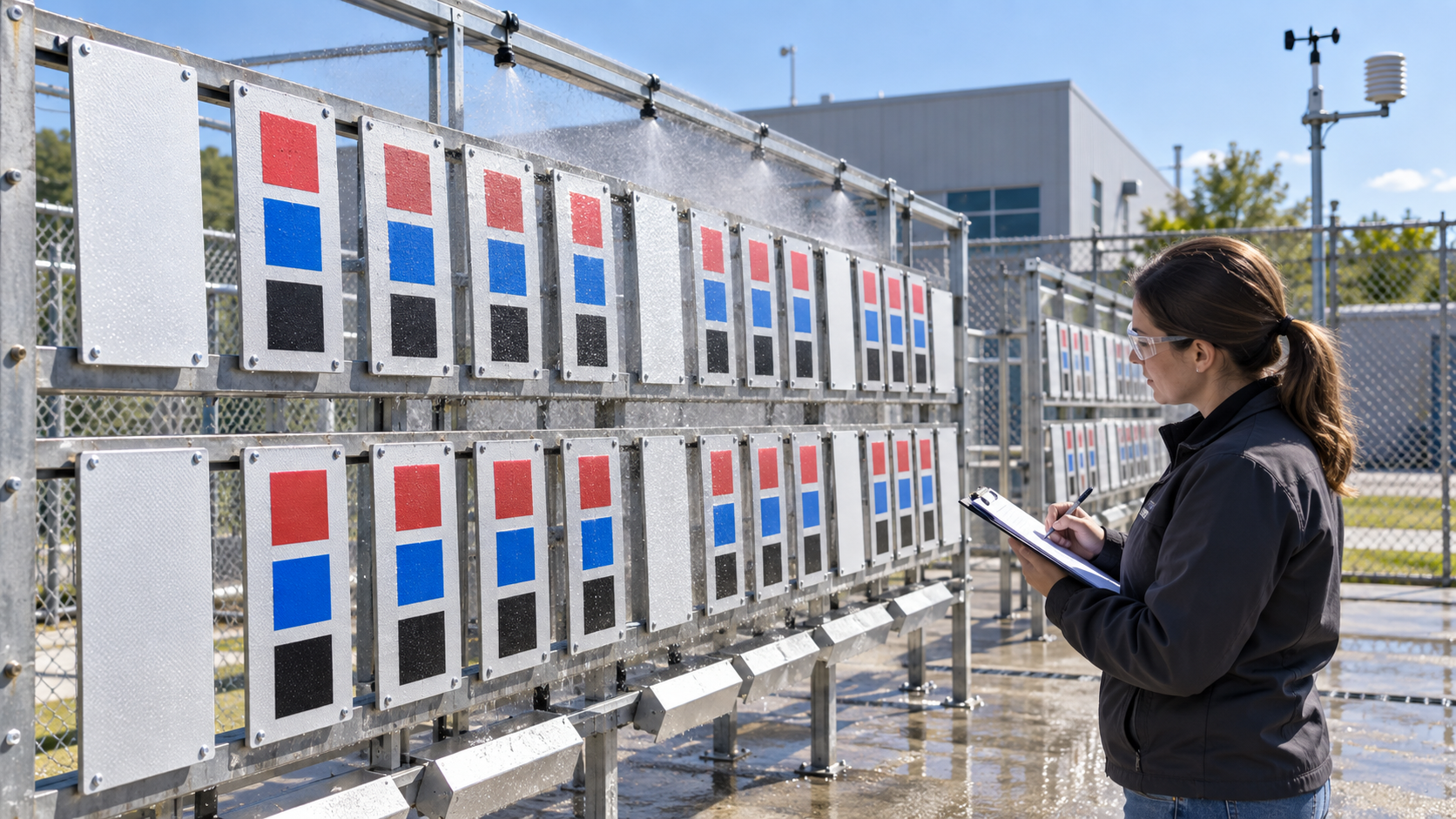
Before approving a bulk order, prepare four comparable constructions:
Sample A: unprinted reflective sheeting
Sample B: printed reflective sheeting without laminate
Sample C: printed reflective sheeting with overlaminate
Sample D: printed, laminated and edge-sealed reflective sheeting
Use the actual production materials and settings.
Recommended Evaluation Items
Test Item | What It Reveals |
|---|---|
Visual inspection | Bubbles, silvering, wrinkles, color shift and surface defects |
Ink adhesion after curing | Strength of the ink-to-sheeting interface |
Laminate adhesion | Strength and uniformity of the protective overlay bond |
Retroreflectivity | Effect of ink and laminate on nighttime performance |
Color measurement | Daytime color and laminate-related color change |
Dimensional stability | Shrinkage, curl and layer mismatch |
Flexibility or bend test | Cracking of ink, film or laminate |
Water or humidity exposure | Moisture-related edge and layer failure |
Heat and cold cycling | Differential movement and embrittlement |
Abrasion testing | Resistance to handling, cleaning and road wear |
Chemical testing | Resistance to the actual cleaners, fuels or solvents |
Edge challenge | Lifting or ingress at cut perimeters |
Outdoor or accelerated weathering | Longer-term color, RA and adhesion retention |
Testing conditions and pass/fail limits must come from:
The applicable standard
The project specification
Product technical data
An agreed customer-supplier test protocol
Do not invent test temperatures, exposure times or acceptance limits from an unrelated material.
For a more complete procedure, read How to Test Adhesion, Shrinkage and Weather Resistance of Reflective Sheeting.
ABLAZE Recommendations by Application
Changzhou Zhenghe New Material Technology Co., Ltd. is the manufacturer of ABLAZE reflective materials.
With more than 20 years of reflective-material manufacturing experience, we supply glass-bead and microprismatic reflective sheeting for commercial printing, traffic signs, industrial safety, vehicle identification and license plate production.
Commercial Eco-Solvent or Solvent Printing
Start with an ABLAZE printable PVC reflective vinyl developed for commercial graphic printing.
Then qualify:
Printer and ink
Drying time
Overlaminate
Substrate
Required outdoor life
Flat or curved application
UV-Printed Flat Signs
Evaluate an ABLAZE UV-printable acrylic reflective sheeting with the actual UV ink, curing energy, laminate and final sign substrate.
Test both ink adhesion and retroreflectivity before bulk production.
Screen-Printed or Plotter-Cut Flat Signs
ABLAZE PET reflective sheeting can provide dimensional stability for compatible screen-printing, cutting and flat-sign applications.
Confirm whether the selected ink system requires a protective overlay.
Regulated Traffic Signs
Begin with the required reflective grade and national or project standard.
Select the correct ABLAZE engineering-grade or High Intensity Prismatic sheeting, then define the complete approved imaging and fabrication system.
Commercial printable reflective vinyl should not be substituted for regulated road-sign sheeting.
Information to Send Your Reflective Sheeting Supplier
To receive an accurate material and lamination recommendation, provide:
Final application
Destination country
Applicable standard or tender specification
Reflective sheeting type, color and product code
Required coefficient of retroreflection
Printer brand and model
Ink brand, series and chemistry
Approximate ink coverage
Desired gloss, luster or matte finish
Overlaminate brand and product code, if already selected
Flat, curved, riveted or corrugated surface
Application substrate
Vertical, horizontal or inclined exposure
Target outdoor life
Cleaning method
Abrasion, fuel or chemical exposure
Edge-sealing requirement
Roll size
Order quantity
Required test reports
OEM packaging requirements
This information allows the supplier to evaluate a complete system instead of guessing from a request such as “reflective vinyl for outdoor printing.”
Contact ABLAZE to request product recommendations, technical data, samples or a bulk quotation.
Frequently Asked Questions
Does All Printed Reflective Sheeting Need Lamination?
No.
Lamination depends on the reflective material, ink, application, required outdoor life and applicable specification. Outdoor digitally printed graphics commonly benefit from a compatible overlaminate, while some approved screen-printed or short-term systems may be used without one.
Does Eco-Solvent Printed Reflective Vinyl Need Lamination?
Lamination is generally recommended for medium- or long-term outdoor eco-solvent graphics when protection from UV exposure, abrasion, water and cleaning is required.
The print must be fully dried and outgassed before lamination.
Does UV-Printed Reflective Sheeting Need Lamination?
UV ink does not automatically eliminate the need for lamination.
An overlaminate may still be required for scratch, chemical, cleaning or anti-graffiti protection. Ink adhesion, flexibility, silvering and retroreflectivity must be tested.
Can I Use Ordinary Clear Cold Lamination Film?
Not without testing.
A general-purpose cold laminate may have unsuitable optical clarity, adhesive chemistry, shrinkage, rigidity or outdoor durability. Regulated signs require a qualified protective overlay rather than an unidentified clear film.
Does Clear Laminate Reduce Reflectivity?
It can change measured retroreflectivity.
The effect depends on the overlay, adhesive, surface finish, ink and reflective construction. Measure the printed and laminated sample at the required observation and entrance angles.
Is Gloss or Matte Laminate Better for Reflective Sheeting?
Neither finish is universally better.
Gloss usually provides higher clarity, while matte finishes can reduce surface glare but may alter color and optical appearance. Use the finish approved for the application and verify retroreflectivity after lamination.
How Long Should a Print Dry Before Lamination?
Follow the instructions for the exact ink and media system.
Some manufacturers recommend approximately 24 to 48 hours for eco-solvent or mild-solvent printing, but ink coverage, temperature, humidity and winding conditions can change the required time.
Does Reflective Sheeting Always Need Edge Sealing?
No.
Some products and constructions do not require it. Edge sealing may be required or recommended for fuel exposure, chemicals, high-pressure washing, severe abrasion or moisture-sensitive edges.
Does Edge Sealing Make a Graphic Waterproof?
Not completely.
It helps protect the perimeter but cannot compensate for gaps, poor adhesion, damaged film, contaminated substrates or an unsuitable reflective construction.
Can Lamination Double the Outdoor Life of Printed Reflective Vinyl?
There is no universal multiplier.
The result depends on the tested combination of sheeting, ink, overlaminate, substrate, exposure direction, climate and maintenance. Use documented system durability rather than a general promise.
Do Printed Traffic Signs Need an Overlaminate?
Use the approved imaging system required by the agency, standard, warranty or project specification.
If a matched protective overlay is specified, it must be used. A generic laminate should not be substituted without formal approval and testing.
What Should Be Tested Before a Bulk Order?
Test print adhesion, curing, laminate adhesion, retroreflectivity, color, dimensional stability, flexibility, water resistance, abrasion, chemical resistance, edge performance and the actual application substrate.
Conclusion
Printed reflective sheeting does not automatically require lamination, but the decision should never be based only on whether the ink appears durable.
Use a compatible overlaminate when the printed image needs protection from UV exposure, abrasion, moisture, chemicals, cleaning or graffiti—or when the approved traffic-sign or warranty system requires one.
Remember these four rules:
Qualify the complete sheeting, ink, laminate and substrate system.
Fully dry or cure the print before lamination.
Measure retroreflectivity after printing and lamination.
Edge-seal only when required by the product or service environment.
The outdoor life of a printed reflective sign is determined by the first component or interface to fail. Correct material matching and controlled testing are therefore more reliable than any general statement that reflective sheeting “always” or “never” needs lamination.
Changzhou Zhenghe New Material Technology Co., Ltd. can recommend suitable ABLAZE reflective sheeting based on your printer, ink, substrate, required reflective grade, climate and expected service life.
Send us your application details to arrange sample testing before bulk production.

