


Introduction: Why Reflective Sheeting Technology Matters
At first glance, reflective sheeting can look surprisingly simple. You see a colored film, shine a light on it, and it appears brighter.
But the technology beneath that surface can be very different.
Two of the most widely used optical technologies are glass bead reflective sheeting and microprismatic reflective sheeting. Both are designed to return incoming light toward its source, but they achieve that effect in different ways.
That difference influences:
Retroreflective performance
Nighttime visibility
Viewing angles
Surface appearance
Outdoor durability
Fabrication
Applications
Cost
In general, glass bead reflective sheeting offers a practical and economical solution for many commercial, general safety, and moderate-performance applications.
Microprismatic reflective sheeting is usually selected when higher retroreflectivity and more demanding traffic-safety performance are required.
However, that does not mean microprismatic sheeting is automatically the better choice.
The correct material depends on where the sheeting will be used, how much retroreflective performance is required, what standard applies, and how much the project can reasonably spend.
This guide explains the main differences between glass bead vs microprismatic reflective sheeting so buyers, distributors, sign manufacturers, and road-safety contractors can make a more informed choice.
What Is Reflective Sheeting?
Reflective sheeting is an engineered film designed to return incoming light toward approximately the same direction from which the light came.
This optical behavior is called retroreflection.
You experience it whenever you drive at night.
Your vehicle headlights illuminate a traffic sign. Even though the sign has no internal light source, it suddenly appears bright because its reflective surface sends part of the headlight beam back toward the vehicle.
Reflective sheeting is widely used for:
Traffic signs
Road construction signs
Parking signs
Property signs
Vehicle markings
License plates
Industrial safety graphics
Advertising signs
Directional signs
Safety stickers and markings
The optical elements inside the material determine how efficiently this light is returned.
How Retroreflection Works
Ordinary surfaces scatter incoming light in many directions.
Retroreflective materials behave differently.
Their optical structures capture part of the incoming light and redirect it back toward the source.
A useful analogy is a specially designed mirror system.
A normal mirror sends light away according to the angle at which it arrives. A retroreflective material is engineered to return much more of that light toward where it originally came from.
Glass bead reflective sheeting achieves this with microscopic spherical glass beads.
Microprismatic sheeting achieves it using microscopic geometric prisms.
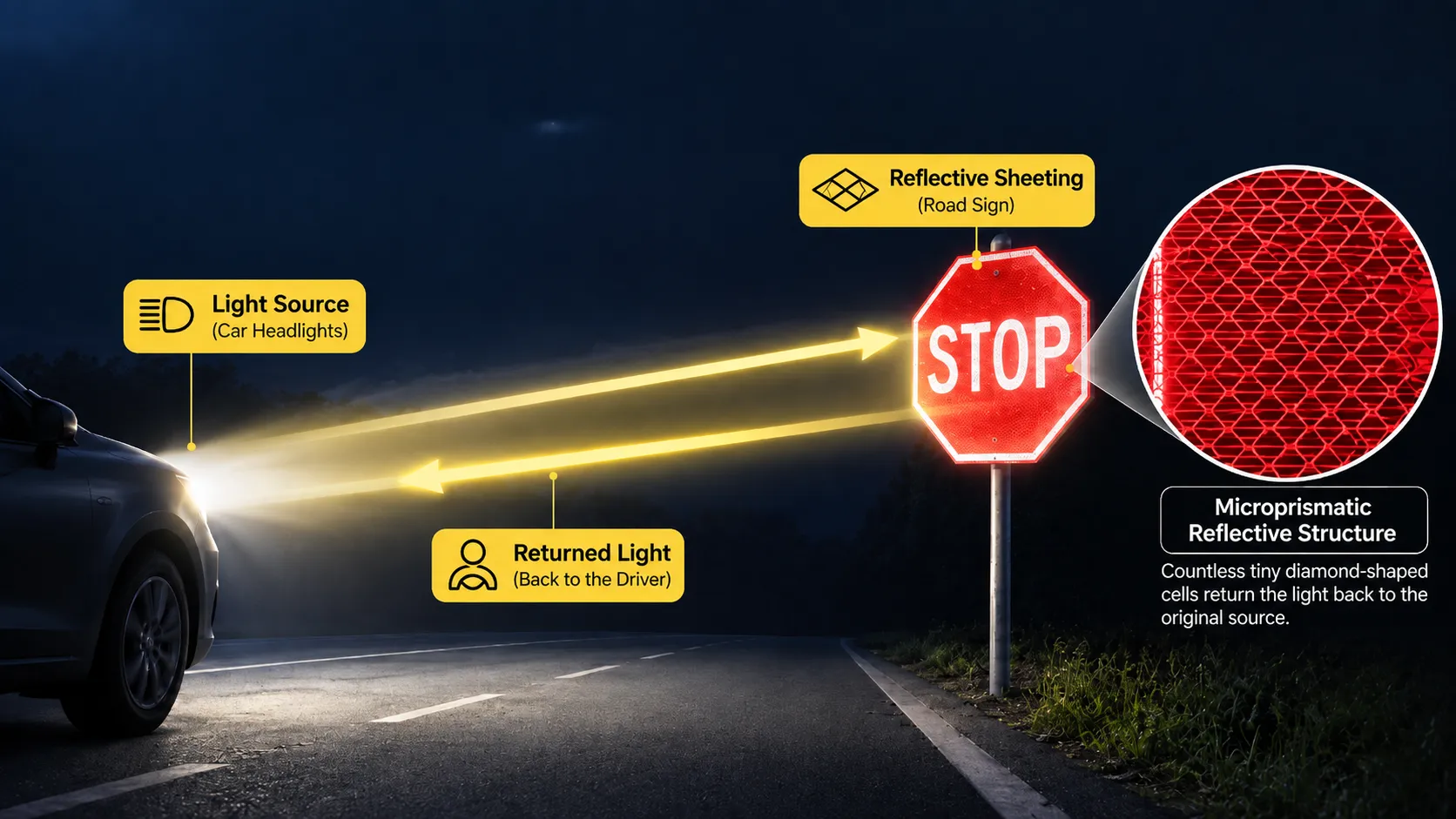
Why Reflective Sheeting Is Used for Traffic Signs and Safety Applications
Traffic signs must remain visible when natural light is limited.
Retroreflective sheeting improves nighttime visibility without requiring electricity inside every sign.
This becomes particularly important when:
Roads have limited street lighting
Vehicles travel at higher speeds
Signs must be recognized from longer distances
Drivers approach complex intersections
Construction zones change normal traffic patterns
Safety information must remain visible at night
Different situations require different levels of performance, which is why reflective sheeting is available in several technologies and grades.
What Is Glass Bead Reflective Sheeting?
Glass bead reflective sheeting uses millions of extremely small transparent glass spheres as its optical elements.
These microscopic beads function like tiny lenses.
Light enters the bead, changes direction, interacts with the reflective layer behind it, and is redirected back toward the light source.
Glass bead technology has been used for decades and remains widely used because it offers a useful balance of visibility, manufacturing cost, flexibility, and ease of processing.
It is commonly found in advertising-grade reflective products and traditional Engineering Grade reflective sheeting.
Structure of Glass Bead Reflective Sheeting
A typical glass bead reflective film may contain:
A protective face layer
Microscopic glass beads
A reflective or optical layer
Pressure-sensitive adhesive
Release liner
The exact structure varies between manufacturers and product types.
Some products use enclosed-lens technology, while others may use encapsulated optical structures.
From a buyer's perspective, the key point is simple:
The retroreflective effect is created primarily by glass beads rather than microprisms.
How Glass Beads Return Light to the Driver
When light reaches a microscopic bead, the curved surface refracts the incoming beam.
The light then travels toward a reflective layer behind the bead, where it is redirected.
It passes back through the bead and returns toward the original light source.
In a vehicle application, the headlights are the light source, while the driver's eyes are positioned close enough to that source to see the returned light.
Millions of beads perform this process across the whole surface.
What Does Glass Bead Reflective Sheeting Look Like?
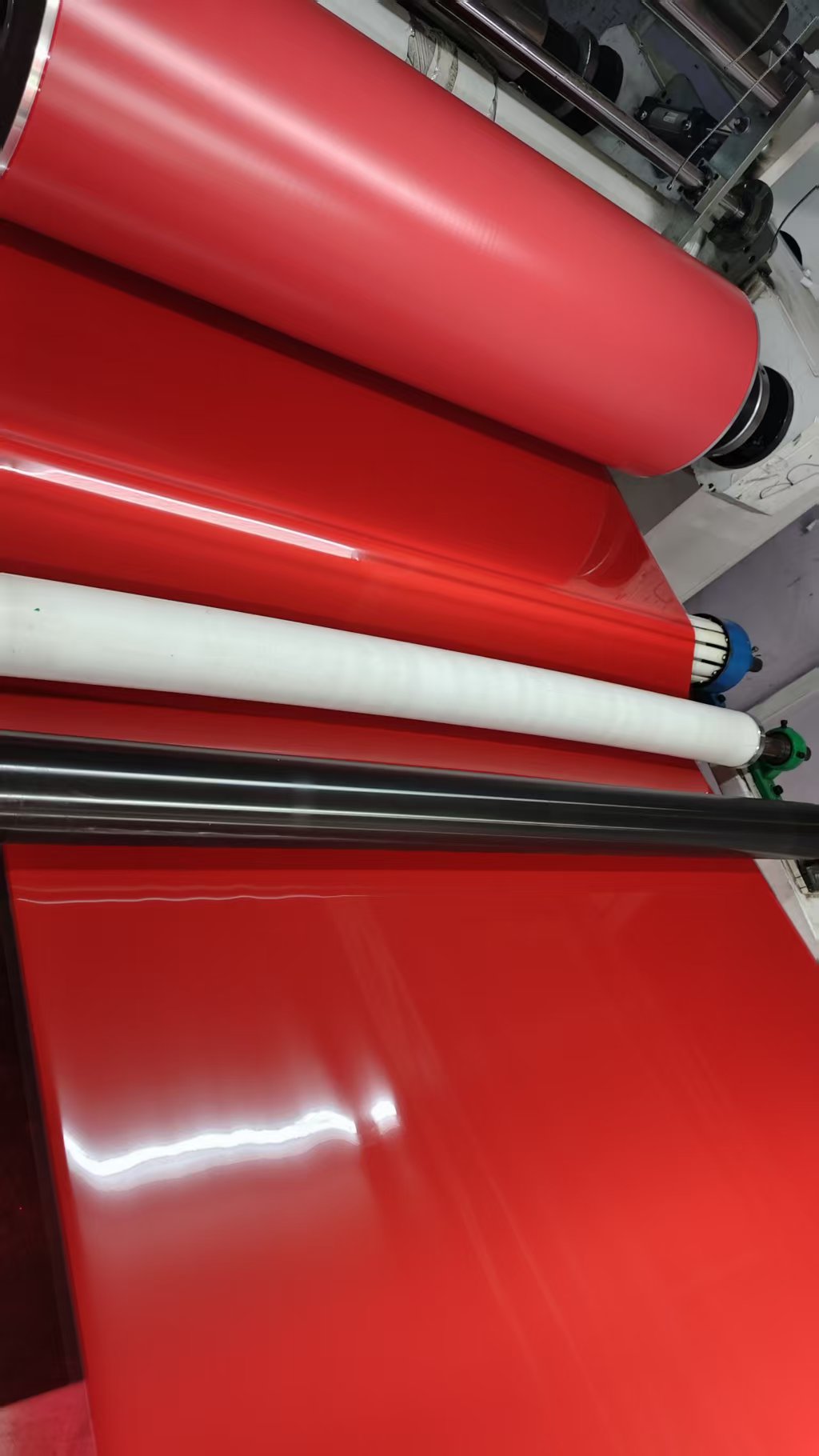
Glass bead reflective film usually has a relatively smooth appearance.
Depending on the product, the surface may show:
Fine grain
Soft sparkle
Uniform reflective texture
Smooth or slightly textured finish
What you normally do not see is the obvious repeating geometric structure found in many microprismatic films.
That visual difference can be useful when comparing physical samples.
Common Types of Glass Bead Reflective Sheeting
Advertising Grade Reflective Sheeting
Advertising-grade reflective film is primarily designed for commercial visibility rather than demanding traffic-sign specifications.
Typical applications include:
Shop signs
Promotional graphics
Reflective stickers
Advertising boards
Decorative vehicle graphics
General commercial signage
Buyers often choose advertising-grade material because it combines reflectivity with relatively low cost and good processing flexibility.
However, simply being reflective does not make a material suitable for regulated traffic signs.
Engineering Grade Reflective Sheeting
Traditional Engineering Grade reflective sheeting, often abbreviated as EG, is generally associated with glass bead technology.
Typical applications can include:
Parking signs
Property signs
Safety signs
Directional signs
Lower-demand traffic-control applications where permitted
Engineering Grade is popular because it provides practical nighttime visibility while remaining relatively economical.
What Is Microprismatic Reflective Sheeting?
Microprismatic reflective sheeting uses tiny geometric prism structures instead of glass beads.
These prisms are engineered to redirect incoming light efficiently back toward its source.
Because the geometry can be precisely controlled, microprismatic technology can generally achieve higher retroreflective efficiency than traditional glass bead systems.
This is one reason microprismatic materials are widely used for modern traffic-sign and road-safety applications.
Structure of Microprismatic Reflective Sheeting
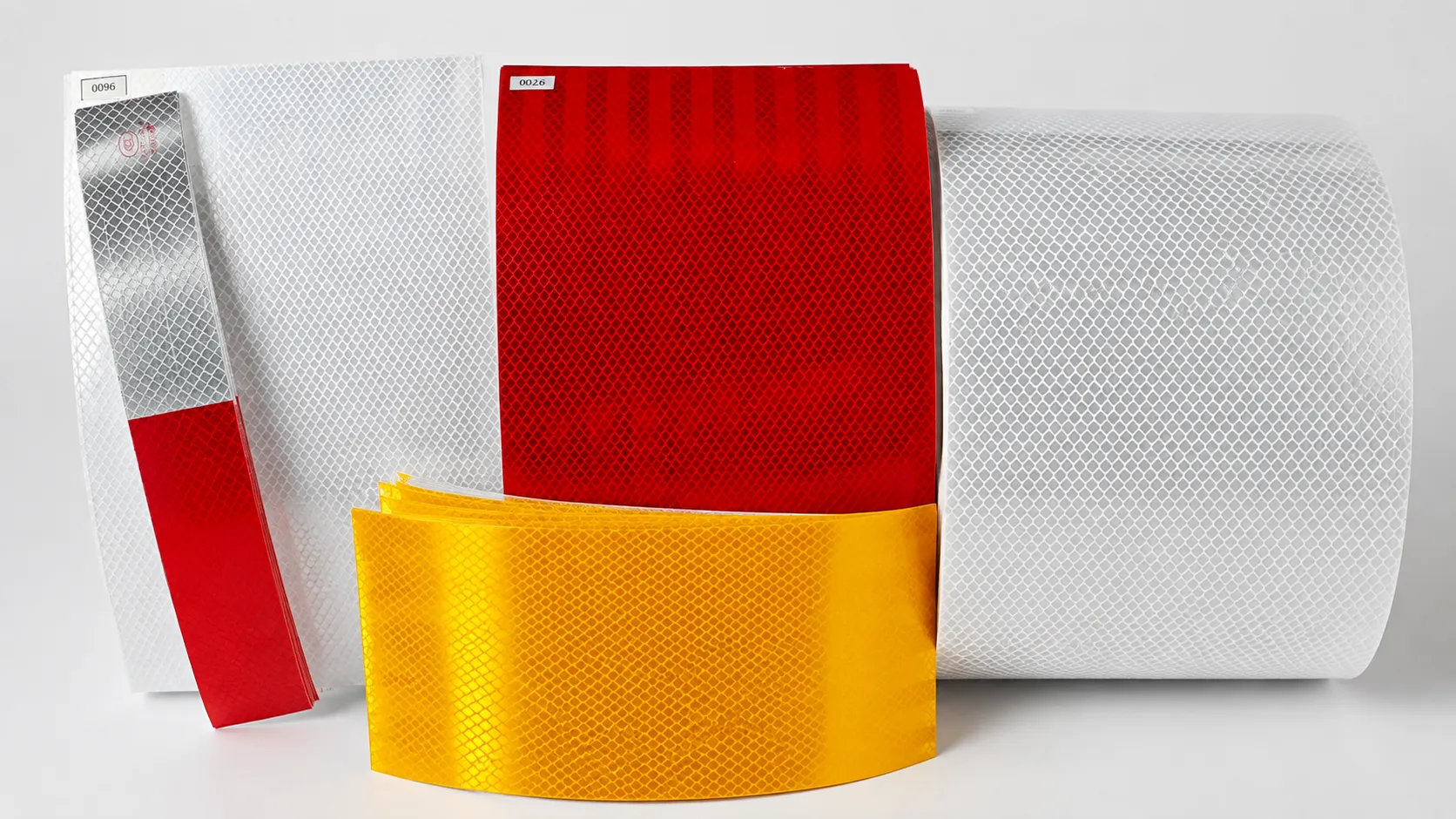
Microprismatic sheeting contains repeating arrays of microscopic prisms.
Depending on the product design, you may see:
Diamond-like patterns
Honeycomb structures
Geometric cells
Repeating prism patterns
The visible surface pattern does not by itself determine performance.
Actual performance depends on factors such as:
Prism geometry
Optical design
Material quality
Manufacturing consistency
Adhesive system
Product construction
How Microprisms Return Light
Microprismatic technology relies on carefully controlled internal reflection.
Incoming light enters the prism structure and interacts with several surfaces before being redirected toward the source.
Because this process can reduce some of the optical losses associated with traditional bead systems, well-designed microprismatic films can return more usable light.
Why Microprismatic Sheeting Can Be Brighter
The main advantage of microprismatic technology is optical efficiency.
Compared with many conventional glass bead films, microprismatic sheeting can provide:
Higher coefficients of retroreflection
Stronger nighttime visibility
Better performance in demanding traffic applications
Greater visibility at longer distances under suitable conditions
But one important point should not be overlooked:
Not every microprismatic product performs at the same level.
Prismatic technology describes the optical method, not a guaranteed performance class.
Common Types of Microprismatic Reflective Sheeting
High Intensity Prismatic (HIP) Reflective Sheeting
High Intensity Prismatic reflective sheeting, commonly known as HIP, is widely used in traffic and road-safety applications.
Typical applications include:
Warning signs
Regulatory signs
Guide signs
Construction signs
Urban traffic signs
Road-safety signage
HIP usually provides substantially higher retroreflective performance than traditional Engineering Grade glass bead film.
High-Performance Microprismatic Reflective Sheeting
Higher-performance microprismatic films are designed for more demanding visibility requirements.
They may be used for:
High-speed highways
Large guide signs
Overhead signs
Critical warning signs
Major transportation infrastructure
A terminology distinction is important here.
Diamond Grade™ is a 3M product-family name rather than a universal generic name for all high-performance microprismatic reflective sheeting.
When comparing products from different manufacturers, buyers should focus on measurable technical performance rather than marketing names alone.
Glass Bead vs Microprismatic Reflective Sheeting: Key Differences
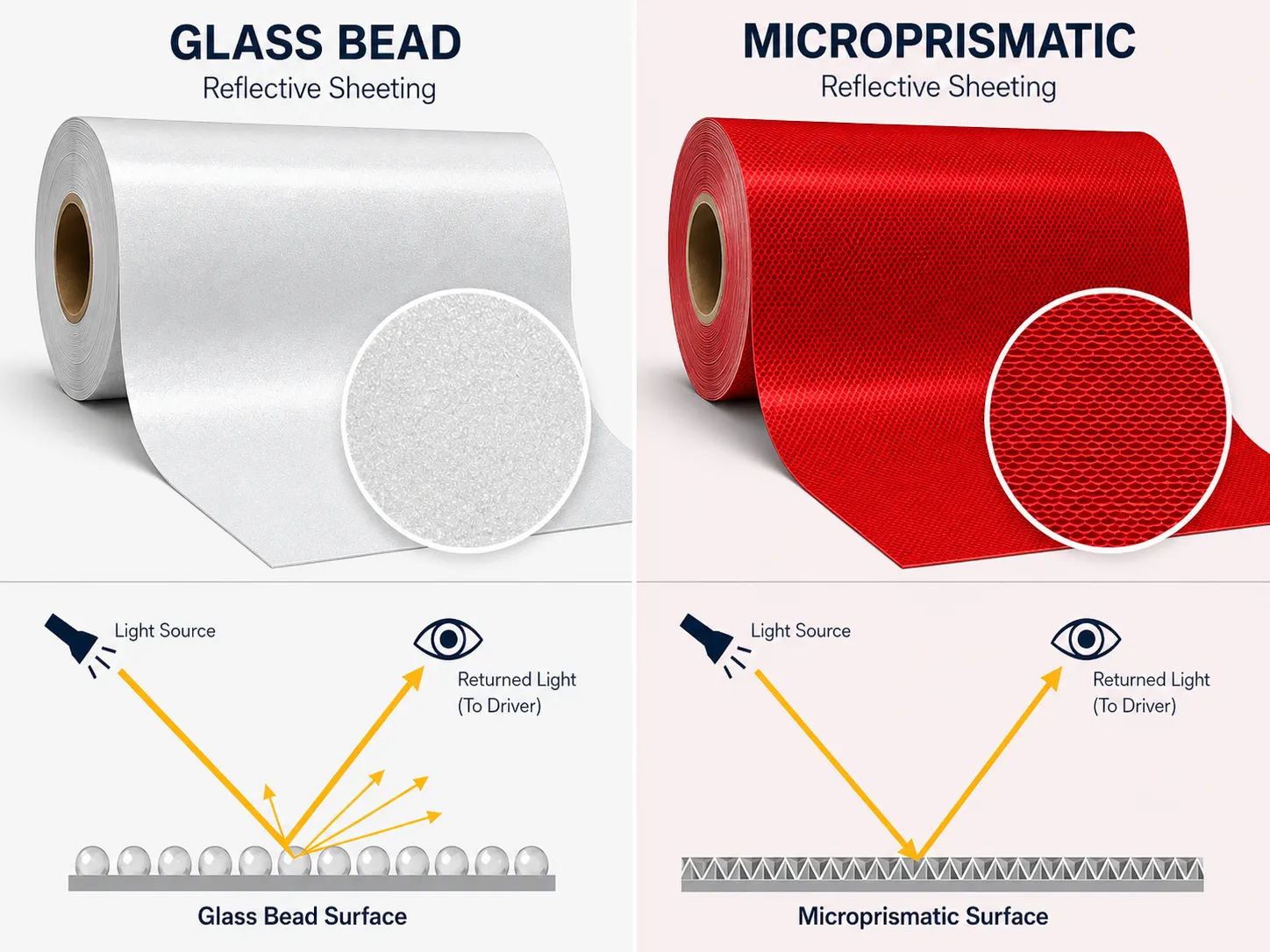
1. Optical Structure
Glass bead sheeting uses microscopic spherical beads.
Microprismatic sheeting uses geometric prisms.
This is the fundamental difference that influences the rest of their performance characteristics.
2. Retroreflective Performance
Microprismatic sheeting generally delivers higher retroreflective performance.
A common technical value used for comparison is the coefficient of retroreflection, often expressed as RA.
However, RA should never be viewed as a single isolated number.
Performance depends on the measurement conditions.
3. Observation and Entrance Angles
Two angles are particularly important when evaluating reflective sheeting.
The observation angle relates to the angle between the incoming light and the observer.
The entrance angle relates to the direction at which the light reaches the sign surface.
These angles change in real driving situations.
A sign mounted close to the road, an overhead sign, and a sign viewed from several lanes away may all create different viewing geometry.
Therefore, buyers should compare technical performance at the relevant observation and entrance angles instead of simply asking:
“Which film is brighter?”
4. Nighttime Visibility
Nighttime visibility is often where the difference becomes easiest to see.
If a traditional EG glass bead sample and a suitable HIP sample are illuminated from the correct position, the HIP sample will generally appear noticeably brighter.
That extra brightness can matter when:
Vehicles travel faster
Drivers have less reaction time
Signs are viewed from farther away
Road lighting is limited
Sign information is safety-critical
5. Durability and Outdoor Performance
Optical technology alone does not determine service life.
Reflective sheeting used outdoors may be exposed to:
UV radiation
Rain
Heat
Humidity
Dust
Pollution
Cleaning chemicals
Temperature variation
Both glass bead and microprismatic products can be designed for long-term outdoor use.
Always check the technical specifications of the actual product.
6. Flexibility and Fabrication
Sign manufacturers also need to consider how the film behaves during production.
Reflective sheeting may need to be:
Cut
Plotter-cut
Printed
Laminated
Applied to aluminum panels
Applied to other substrates
Different product constructions can behave differently during fabrication.
7. Printing and Cutting
Advertising-grade glass bead films are often selected where graphic processing and cost are important.
Some traffic-grade microprismatic products may require specific printing systems, inks, overlays, or processing recommendations.
Always confirm compatibility before production.
8. Cost and Total Project Value
Glass bead reflective sheeting is generally less expensive.
Microprismatic sheeting usually costs more because of its more complex optical structure and higher performance.
However, roll price is not the only cost.
Buyers should also consider:
Production waste
Printing
Labor
Freight
Installation
Replacement cost
Project compliance
Product consistency
The lowest-priced roll is not necessarily the lowest-cost solution.
Glass Bead vs Microprismatic Reflective Sheeting Comparison Table
Feature | Glass Bead Reflective Sheeting | Microprismatic Reflective Sheeting |
|---|---|---|
Optical technology | Microscopic glass beads | Microscopic geometric prisms |
Typical surface appearance | Smooth or finely textured | Often visible geometric prism pattern |
Retroreflective performance | Low to medium depending on product | Medium to very high depending on product |
Nighttime visibility | Suitable for general applications | Generally stronger |
Typical categories | Advertising Grade, traditional Engineering Grade | HIP, high-performance microprismatic |
Common applications | Commercial signs, parking signs, general safety | Traffic signs, highways, construction zones |
Processing | Often flexible and easy to handle | Depends on product construction |
Typical price level | Lower | Higher |
Main purchasing advantage | Cost-effective visibility | Higher optical performance |
Which Reflective Sheeting Is Better for Traffic Signs?、
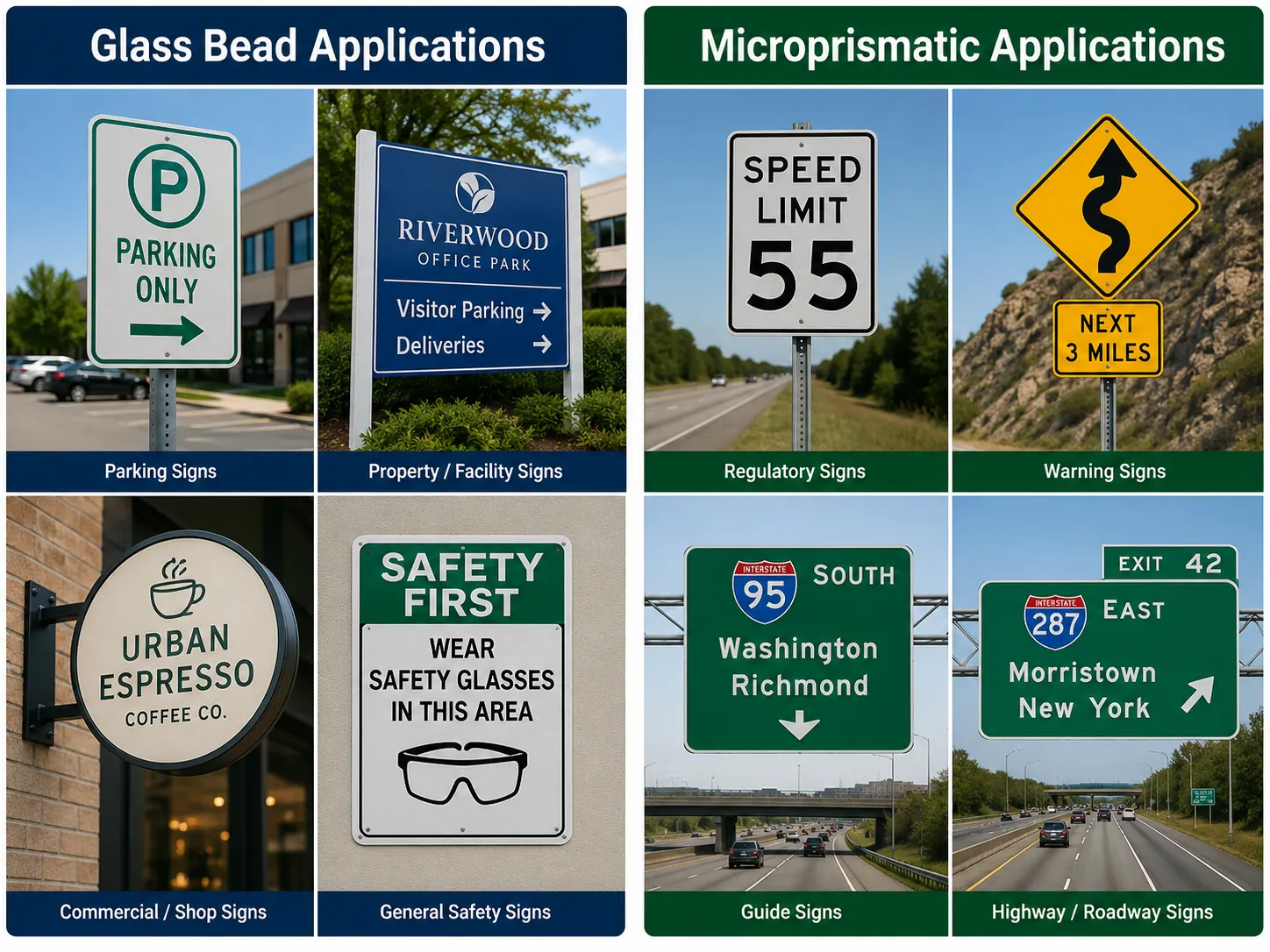
There is no universal answer.
A parking sign in a private facility and a guide sign above a high-speed motorway do not require the same performance.
When Glass Bead Reflective Sheeting Makes Sense
Glass bead materials may be appropriate when:
Moderate reflectivity is sufficient
Viewing distances are relatively short
Traffic speed is lower
The application is commercial or general safety
Cost control is important
The applicable specification allows the material
When Microprismatic Reflective Sheeting Makes More Sense
Microprismatic sheeting may be preferable when:
Higher nighttime visibility is required
Traffic speed is higher
Signs need to be recognized from longer distances
Professional traffic specifications apply
The application involves highways or critical road-safety information
The correct grade should always follow the actual project requirements.
Common Applications of Glass Bead Reflective Sheeting
Commercial and Advertising Signs
Glass bead reflective vinyl is widely used for advertising because it offers nighttime visibility at a relatively economical price.
Parking and Property Signs
Parking facilities, private roads, factories, warehouses, and properties often use reflective signage without requiring high-performance highway materials.
General Safety Signs
Glass bead materials can provide practical visibility for industrial and commercial safety applications.
Short- to Medium-Term Reflective Applications
Where extreme brightness or long-distance visibility is unnecessary, a suitable glass bead film can provide excellent value.
Common Applications of Microprismatic Reflective Sheeting
Permanent Traffic Signs
HIP and higher-performance microprismatic materials are commonly used for regulatory, warning, and guide signs.
Highway and High-Speed Road Signs
Higher speeds reduce the amount of time drivers have to detect, read, and respond to information.
Higher retroreflectivity can therefore become more valuable.
Construction and Work-Zone Signs
Temporary traffic patterns require highly visible instructions, particularly at night.
Vehicle and Transportation Safety Applications
Specific microprismatic products can also be designed for vehicle conspicuity and transportation safety.
Does Microprismatic Always Mean Better?
No.
Why Higher Reflectivity Is Not Always Necessary
Higher performance normally comes with higher cost.
Using premium traffic-grade sheeting for a short-term advertising board may provide little practical benefit.
It is similar to buying professional racing equipment for everyday commuting.
Technically better does not always mean economically better.
Match Reflective Performance to the Actual Application
A good purchasing decision balances:
Required visibility
Applicable standards
Service life
Processing requirements
Budget
The objective is not to buy the highest grade.
It is to buy the correct grade.
How Weather Affects Reflective Sheeting Performance
Rain and Wet Conditions
Rain reduces overall driving visibility and can change how light interacts with sign surfaces.
For outdoor applications, laboratory brightness should therefore not be the only consideration.
UV Exposure and Heat
Long-term sunlight and heat can affect:
Color
Surface condition
Adhesive stability
Optical performance
Markets with strong sunlight require careful attention to outdoor weather resistance.
Humidity
High humidity can challenge adhesive systems and poorly prepared substrates.
Installation quality becomes particularly important in humid climates.
Why Adhesive Quality Also Matters
The reflective face receives most of the attention, but the adhesive is equally important.
A highly reflective film offers little value if it begins lifting from the sign panel.
Buyers should evaluate reflective sheeting as a complete system rather than focusing only on brightness.
How to Choose Between Glass Bead and Microprismatic Reflective Sheeting
Step 1: Define the Application
Start with the actual use:
Highway sign
Urban traffic sign
Advertising sign
Parking sign
Construction sign
Vehicle marking
Safety sticker
License plate
Step 2: Check the Required Reflectivity or Standard
Determine whether the project specifies:
Minimum RA values
ASTM classification
EN or local standards
Color requirements
Durability
Specific observation and entrance angles
If a formal project specification exists, follow it first.
Step 3: Consider Outdoor Durability
Evaluate:
Climate
UV exposure
Rainfall
Temperature
Humidity
Expected service life
Substrate
Step 4: Compare Samples and Technical Data
Request:
Technical data sheets
Retroreflectivity values
Relevant test reports
Samples
Adhesive information
Processing recommendations
Compare different products under the same conditions.
Step 5: Calculate Total Cost, Not Just Roll Price
Consider:
Roll price
Roll dimensions
MOQ
Freight
Packaging
Processing waste
Installation
Lead time
Replacement risk
This gives you a much more realistic purchasing comparison.
Common Buying Mistakes to Avoid
Choosing Reflective Sheeting Only by Price
Low-cost material can be suitable.
The mistake is buying it before defining the performance requirement.
Comparing Marketing Names Instead of Technical Performance
Terms such as:
Premium Grade
Super Grade
Diamond
High Intensity
may be used differently across suppliers.
Technical data provides a more reliable basis for comparison.
Assuming All Prismatic Films Are the Same
They are not.
Different microprismatic products can vary considerably in:
RA performance
Viewing geometry
Durability
Adhesive systems
Manufacturing consistency
Using Advertising Grade for Traffic-Sign Projects
Advertising-grade reflective film is designed around different priorities.
Do not assume that it is suitable for regulated traffic signage simply because it reflects light.
What Should Buyers Ask a Reflective Sheeting Manufacturer?
Technical Specifications and Test Reports
Ask:
Is the product glass bead or microprismatic?
What is the recommended application?
What retroreflective values does it provide?
What standards or tests apply?
Sample Testing
Samples allow buyers to evaluate:
Surface quality
Color
Reflectivity
Adhesion
Cutting
Printing
Release liner
Application behavior
Roll Size and MOQ
Confirm:
Standard width
Standard length
Colors
MOQ
Custom-size availability
OEM and Private Label
Distributors may also require:
Custom cartons
Roll labels
Private branding
Core printing
Customized packaging
Packaging and Lead Time
Confirm packaging, production time, loading requirements, and delivery schedule before placing a bulk order.
FAQ: Glass Bead vs Microprismatic Reflective Sheeting
Is Engineering Grade Reflective Sheeting Glass Bead or Prismatic?
Traditional Engineering Grade reflective sheeting is generally based on glass bead technology.
However, buyers should always check the actual construction and technical specification of the product offered.
Is HIP Reflective Sheeting Glass Bead or Microprismatic?
HIP stands for High Intensity Prismatic, so it uses microprismatic optical technology.
Which Reflective Sheeting Is Brighter at Night?
Microprismatic reflective sheeting generally provides higher nighttime retroreflectivity than traditional glass bead materials.
The exact difference depends on the specific products and measurement conditions.
Which Type Is More Cost-Effective?
Glass bead sheeting is usually more economical for commercial, advertising, parking, property, and moderate-performance applications.
Microprismatic sheeting may provide better value when higher road-safety performance is actually required.
Can Glass Bead Reflective Sheeting Be Used for Road Signs?
Yes, when the specific product meets the applicable project or regulatory requirements.
Not every traffic sign requires the same level of reflectivity.
How Long Does Reflective Sheeting Last Outdoors?
There is no universal lifespan.
Service life depends on:
Product grade
Material construction
Climate
UV exposure
Installation quality
Substrate
Maintenance
Always refer to the technical documentation for the specific product.
Is Diamond Grade a Generic Name for Microprismatic Sheeting?
No.
Microprismatic describes the optical technology.
Diamond Grade™ is associated with a specific 3M reflective sheeting product family.
When comparing different manufacturers, terms such as high-performance microprismatic reflective sheeting are more technically neutral.
Conclusion: Glass Bead or Microprismatic — Which Should You Choose?
The difference between glass bead and microprismatic reflective sheeting starts with their optical structure, but the purchasing decision should never stop there.
Glass bead reflective sheeting remains a practical choice for advertising, commercial signage, parking signs, property signs, general safety applications, and projects where moderate retroreflectivity is sufficient.
Microprismatic reflective sheeting is generally better suited to more demanding traffic-safety applications requiring stronger nighttime visibility and higher retroreflective performance.
Neither technology is automatically right for every project.
A practical selection process is:
Application → Required Performance → Technical Data → Sample Testing → Total Cost
Following that sequence helps buyers avoid two common problems: paying for performance they do not need or choosing a cheaper material that cannot meet the application's requirements.
Looking for Glass Bead or Microprismatic Reflective Sheeting?

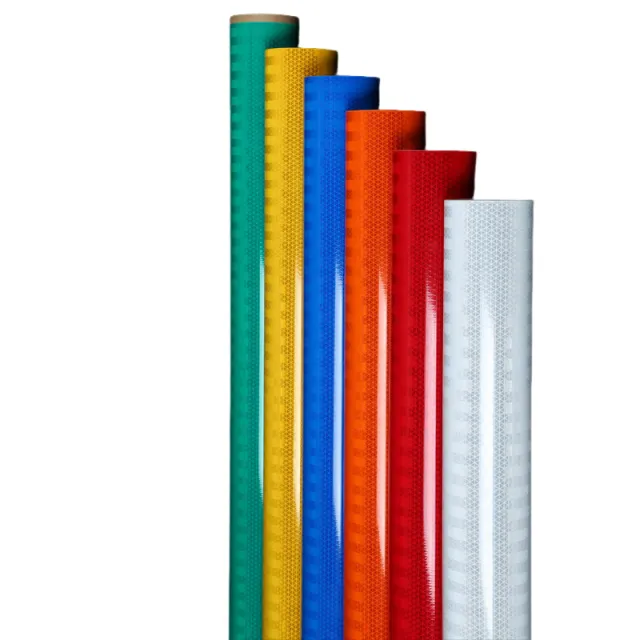
Changzhou Zhenghe New Material Technology Co., Ltd. supplies reflective materials for traffic safety, road signs, commercial signage, transportation, and other visibility applications.
Available product categories include:
Advertising-grade reflective sheeting
Engineering Grade reflective sheeting
High Intensity Prismatic reflective sheeting
Microprismatic reflective materials
Reflective marking films
Related functional reflective products
If you are an importer, distributor, road-safety supplier, or sign manufacturer, send us your application, required reflective grade, color, roll size, quantity, technical requirements, and OEM needs.
Instead of choosing a product based only on price or a grade name, you can first compare the appropriate specifications and samples for your actual application.
RELATED NEWS

Sun, Sand and a 50°C Container: Getting Reflective Sheeting Through a Hot Climate
In hot regions, reflective sheeting can start ageing before it reaches the sign shop. UV, heat, dust and humidity each attack a different part of the product, and each needs its own defence.Picture a distributor in a hot coastal city who receives a container of prismatic sheeting in midsummer. It si
