


When buyers compare reflective sheeting, color often looks like a simple design choice.
White, yellow, red, green, blue, orange—choose the color required by the sign and place the order.
In reality, color affects much more than appearance.
Different reflective sheeting colors can have different:
Retroreflective performance
Nighttime brightness
Daytime visibility
Color recognition
Contrast with printed or cut graphics
Suitability for different sign applications
A white reflective sheet and a red reflective sheet made with the same basic technology will not necessarily return the same amount of visible light.
This is not automatically a quality problem.
It is largely related to how colorants interact with incoming light.
For sign manufacturers, distributors, road-safety suppliers, and reflective material buyers, understanding these differences can help prevent incorrect product comparisons and unrealistic performance expectations.
This guide explains why reflective sheeting colors perform differently and what buyers should check before ordering.
Quick Answer: Does Color Affect Reflective Sheeting Performance?
Yes.
The color of reflective sheeting can affect how much visible light is returned toward the observer.
In general, lighter colors such as white can return a broader range of visible light, while strongly colored materials must selectively absorb parts of the light spectrum to create their color.
As a result, white reflective sheeting usually provides higher apparent brightness than darker or more strongly colored reflective materials within the same product family.
However, this should not be interpreted as:
White is always good and other colors are poor.
Each color is designed for a specific visual purpose.
A red sign does not need to look like a white sign. It needs to remain recognizably red while providing sufficient visibility for its intended application.
The important point is to compare reflective colors according to their intended function, not only according to the highest retroreflectivity number.
Why Does Color Change Reflective Performance?
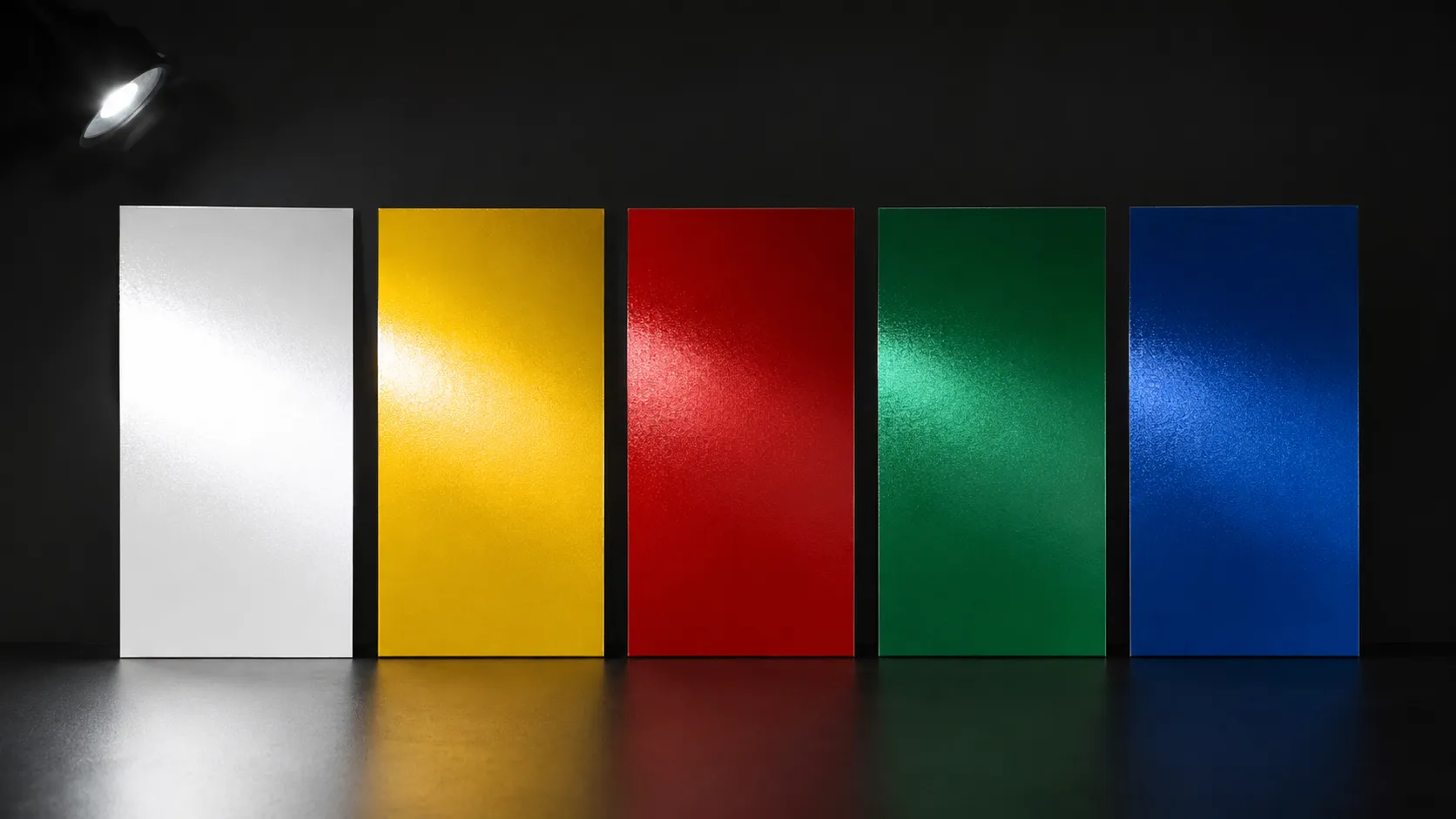
To understand the difference, it helps to look at what happens when light reaches reflective sheeting.
Retroreflective materials are designed to redirect incoming light toward its source.
For example:
Vehicle headlights → Reflective sign → Returned light → Driver
However, before the light returns to the driver, it must pass through or interact with the colored components of the reflective material.
A white reflective material can return a large portion of the visible spectrum.
Colored materials work differently.
A red material appears red because it reflects or transmits more light in the red part of the spectrum while absorbing more of other wavelengths.
A blue material does the same for blue wavelengths.
This selective absorption reduces the total amount of visible light available for retroreflection.
That is one reason different colors can produce different measured and perceived brightness.
Retroreflectivity and Color Are Not the Same Thing
One common purchasing mistake is treating color brightness and retroreflectivity as the same measurement.
They are related, but they are not identical.
Retroreflectivity
Retroreflectivity describes how effectively a material returns light toward its source under specified measurement conditions.
It is commonly expressed using the coefficient of retroreflection, often written as RA.
Color
Color describes the spectral appearance of the material.
It determines whether the observer sees:
White
Yellow
Red
Green
Blue
Orange
Another color
A reflective material must therefore perform two jobs at the same time:
Return enough light to remain visible.
Maintain the correct color appearance.
Producing strong retroreflection while preserving a specific color can require careful control of pigments, transparent color layers, optical structures, and film construction.
Why Is White Reflective Sheeting Usually the Brightest?
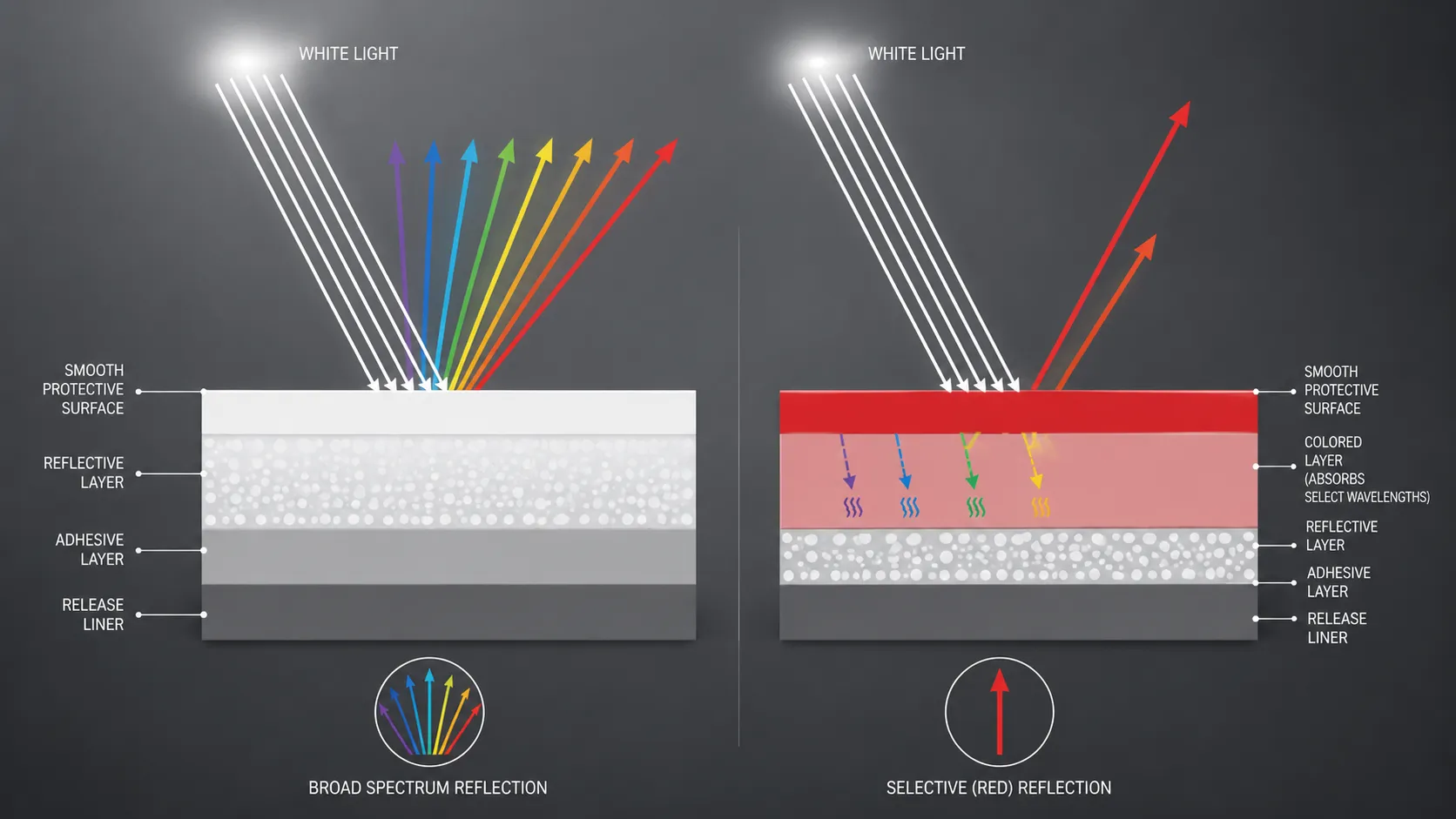
White reflective sheeting generally has an optical advantage because it does not need to strongly filter visible light into one narrow color range.
It can return light across a broad portion of the visible spectrum.
For this reason, white is commonly one of the highest-performing colors within a particular reflective sheeting series.
FHWA research on retroreflective sign materials found that white samples consistently showed the highest mean luminance within the tested material groups.
White reflective sheeting is commonly used for:
Regulatory signs
Directional signs
Commercial signs
Safety signs
Vehicle markings
General identification
Printed reflective graphics
Its high visual contrast also makes it useful as a background for black, red, blue, or other graphics.
However, buyers should still compare products within the same series.
A high-performance yellow microprismatic material may perform differently from a basic white glass-bead material.
Color alone does not determine overall product performance.
Yellow Reflective Sheeting
Yellow is another important reflective color.
It offers good visibility because it remains relatively bright while still providing strong color recognition.
It is commonly associated with:
Warning signs
Caution signs
Directional information
Construction applications
Safety marking
Traffic-control applications
Yellow often appears brighter than red, green, or blue reflective materials within the same sheeting family.
FHWA testing of multiple retroreflective materials also found yellow among the higher-luminance colors after white.
This combination of brightness and strong visual recognition is one reason yellow is widely used when attention is important.
However, buyers should not assume that every yellow product provides the same reflective performance.
Different yellow materials may use different:
Face films
Pigments
Optical technologies
Adhesive systems
Production processes
Always compare the actual product datasheet.
Red Reflective Sheeting
Red is visually powerful, but it normally returns less total visible light than white within the same reflective construction.
This happens partly because the material must absorb much of the non-red portion of incoming visible light to maintain a strong red appearance.
Red reflective sheeting is commonly used for:
Warning applications
Prohibition signs
Safety markings
Vehicle markings
Traffic-control signs
Hazard identification
The important question is not:
“Why is red not as bright as white?”
The better question is:
“Does this red reflective sheeting provide the required visibility for its application?”
That distinction is important when evaluating samples.
A buyer should not reject a red reflective sample simply because it produces a lower numerical value than the white version of the same product.
The two colors serve different visual functions.
Green Reflective Sheeting
Green reflective sheeting is widely used in directional, informational, commercial, and transportation-related applications.
Depending on the market, it may appear on:
Direction signs
Guide signs
Safety signs
Facility signs
Commercial identification
Wayfinding systems
Green materials must maintain recognizable color while still returning useful light.
As with red and blue, the color layer absorbs some wavelengths.
Therefore, green reflective sheeting may have lower retroreflective values than white from the same product series.
But again, lower does not mean defective.
The target is appropriate color plus sufficient retroreflective performance.
Blue Reflective Sheeting
Blue reflective sheeting is another color where buyers sometimes expect unrealistic brightness.
Blue can appear relatively dark compared with white or yellow because only part of the visible spectrum contributes to the perceived blue color.
FHWA research examining retroreflective sign colors found that blue and red were among the lower-luminance colors compared with white and yellow across the materials tested.
Blue reflective materials are commonly used for:
Information signs
Parking signs
Facility identification
Commercial signs
Directional systems
Service-related signage
For blue materials, color consistency can be just as important as maximum brightness.
If a blue reflective sheet becomes too pale in an attempt to maximize returned light, it may no longer provide the intended color appearance.
Manufacturers therefore need to balance optical performance and color.
Orange Reflective Sheeting

Orange is commonly used where strong attention and warning visibility are important.
Typical applications include:
Construction areas
Temporary warning signs
Work zones
Hazard markings
Industrial safety
Orange combines relatively high visual attention with a clearly recognizable warning color.
However, its exact reflective performance depends on the specific product.
Orange should not simply be treated as “yellow with a different pigment.”
Different pigment systems and optical constructions can change both daytime color and nighttime appearance.
What About Fluorescent Reflective Colors?
Fluorescent reflective colors deserve separate attention.
Examples can include:
Fluorescent yellow
Fluorescent yellow-green
Fluorescent orange
Fluorescent materials are designed to improve daytime and low-light conspicuity by absorbing some ultraviolet or short-wavelength light and re-emitting it at visible wavelengths.
This can make fluorescent materials appear especially vivid during:
Daytime
Dawn
Dusk
Overcast conditions
However, fluorescence and retroreflection are different optical effects.
A fluorescent material is not automatically more retroreflective at night simply because it looks brighter during the day.
At night, when the main illumination comes from vehicle headlights, retroreflective construction becomes especially important.
Buyers should therefore check both:
Daytime color performance
and
Nighttime retroreflective performance
instead of assuming they are the same thing.
Glass Bead vs Microprismatic: Does Color Affect Both?
Yes.
Color affects both major retroreflective technologies.
Glass Bead Reflective Sheeting
Glass-bead materials use microscopic glass spheres inside the optical system to help return incoming light.
Colored layers or pigments still influence the amount and spectrum of light that can pass through the system.
Microprismatic Reflective Sheeting
Microprismatic materials use small optical prism structures to redirect light.
These structures can provide stronger retroreflective efficiency, but the color layer still affects the final visible performance.
Therefore:
Microprismatic technology does not eliminate color differences.
A white HIP material and a red HIP material should not automatically have identical retroreflective values.
Technology determines how light is controlled.
Color determines which parts of that light remain available and how the material appears.
Both factors matter.
Why You Should Not Compare Different Colors Using One RA Number
Suppose a supplier gives you the following samples:
White
Yellow
Red
Green
Blue
You test them and find that the white sample gives the highest retroreflective reading.
It may be tempting to conclude:
“The white material is better quality.”
That conclusion may be incorrect.
The correct comparison is usually:
White Product A vs White Product B
or:
Red Product A vs Red Product B
under comparable measurement conditions.
Comparing white directly against red and deciding quality only from the numerical value ignores the optical effect of color.
This is especially important for importers comparing quotations from several reflective sheeting suppliers.
Measurement Geometry Also Matters
Color is not the only factor affecting the reported retroreflective value.
Measurement conditions matter as well.
Two important parameters are:
Observation Angle
This represents the relationship between the light source and the observer.
In real road use, it relates to the position of the driver's eyes relative to the vehicle headlights.
Entrance Angle
This describes the angle at which light reaches the reflective surface.
A sign facing the vehicle directly and a sign installed at a strong angle may produce different measured performance.
FHWA retroreflectivity guidance specifies measurement geometry when stating minimum retroreflectivity values, illustrating why a number without angle information is incomplete.
Therefore, when comparing reflective sheeting datasheets, do not compare only the largest RA value.
Check:
Color
Observation angle
Entrance angle
Product series
Measurement method
Without these conditions, the comparison may be misleading.
Daytime Color vs Nighttime Color
A good reflective material should not only look correct during the day.
The color should also remain recognizable when viewed under retroreflected light at night.
This can be challenging because daytime illumination and vehicle headlights are very different lighting conditions.
During the day, the material receives light from:
Sunlight
Sky illumination
Surrounding surfaces
At night, the dominant light may come directly from:
Vehicle headlights
Work lights
Flashlights
Because reflective materials interact differently with directional light, their appearance can change between daytime and nighttime.
This is why professional reflective sheeting evaluation may consider both:
Daytime color
Retroreflective performance
rather than choosing a material only from a daylight sample.
Does Darker Color Mean Shorter Outdoor Life?
No.
Color and outdoor durability should not be confused.
A red reflective film does not necessarily have a shorter service life simply because it has lower retroreflectivity than white.
Outdoor durability depends on factors such as:
Face-film material
UV stability
Pigment stability
Adhesive system
Climate
Installation
Exposure conditions
Some colors may fade differently under UV exposure depending on their formulation, but this must be evaluated for the specific product.
Do not predict service life only from color.
How Should Buyers Choose Reflective Sheeting Colors?
Start with the application.
1. Confirm the Required Sign Color
The sign design, customer specification, or local project requirement should determine the required color.
Do not replace a specified color simply because another color has a higher reflective value.
2. Choose the Appropriate Reflective Grade
Next, determine the required performance level.
Depending on the application, this may include:
Advertising Grade
Engineering Grade
HIP reflective sheeting
Other specialized reflective materials
Color and grade are separate decisions.
3. Compare the Same Color Between Suppliers
If comparing multiple manufacturers, try to compare equivalent materials.
For example:
Yellow Engineering Grade vs Yellow Engineering Grade
is more useful than:
White Engineering Grade vs Red HIP
4. Check Retroreflectivity Under the Same Conditions
Make sure the values being compared use compatible:
Observation angles
Entrance angles
Test methods
Units
5. Check Daytime Appearance
Retroreflective performance is not the only requirement.
Inspect:
Hue
Color consistency
Surface uniformity
Batch consistency
6. Test Samples
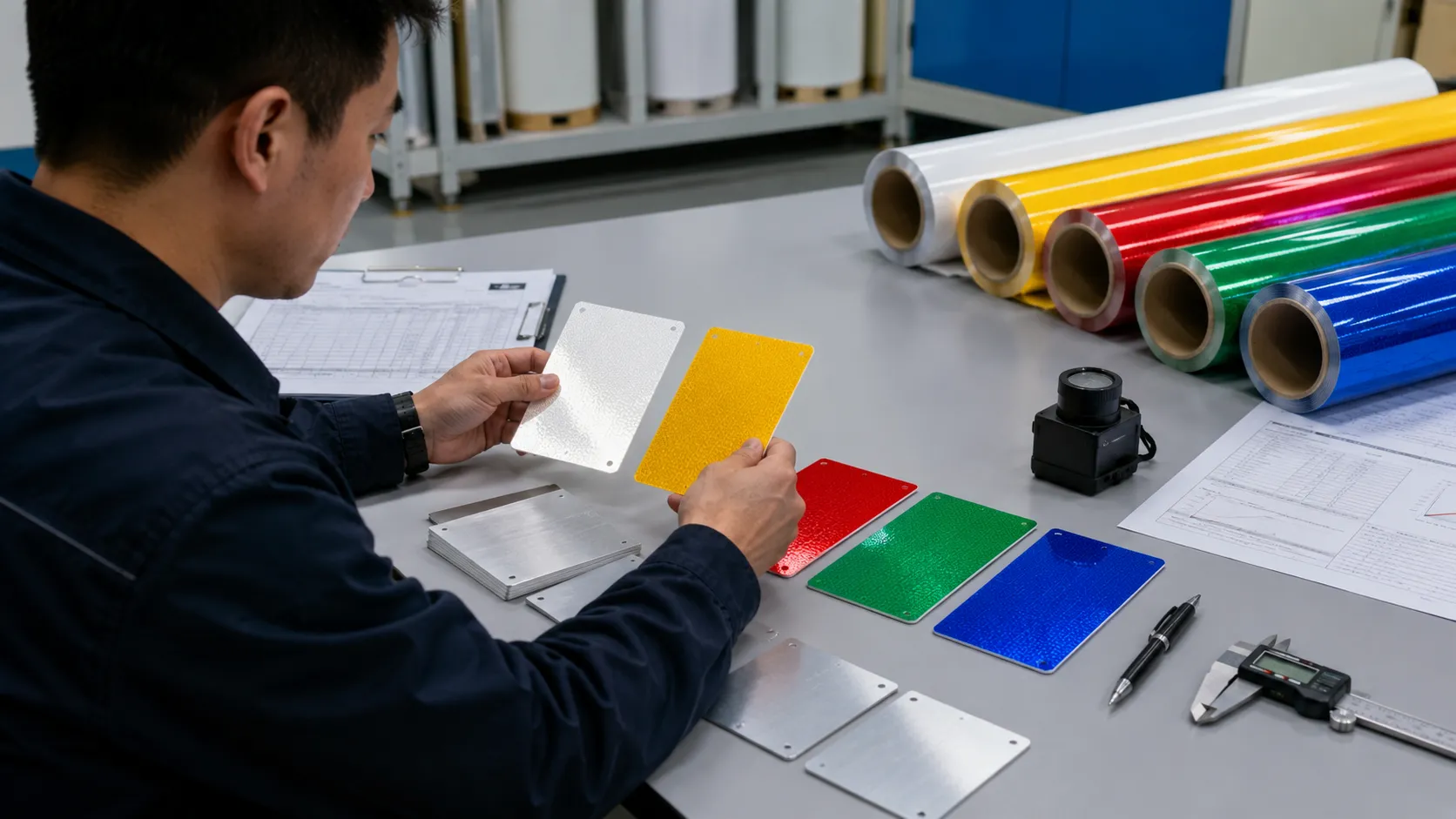
For large orders, sample evaluation is strongly recommended.
Test the actual colors you plan to purchase.
Do not approve white and assume red, yellow, green, and blue will behave exactly the same.
Common Mistakes When Buying Colored Reflective Sheeting
Mistake 1: Expecting Every Color to Have the Same RA
Different colors naturally interact with light differently.
Compare the specific color against the relevant product specification.
Mistake 2: Assuming Lower Brightness Means Poor Quality
A red or blue material may legitimately return less visible light than white while still being a correctly manufactured product.
Mistake 3: Choosing Only by Daytime Appearance
A beautiful color under office lighting does not tell you everything about nighttime performance.
Mistake 4: Comparing Different Product Grades
Do not compare a basic white material with a high-performance yellow material and attribute all differences to color.
Mistake 5: Ignoring the Application
A commercial sign, parking sign, warning sign, and road sign can have completely different requirements.
What Information Should You Send Your Supplier?
When requesting colored reflective sheeting, provide as much information as possible.
Useful details include:
Required color
Application
Reflective grade
Roll width
Roll length
Quantity
Substrate
Printing requirements
Expected outdoor use
Required reflective performance
For example:
White Engineering Grade reflective sheeting, 1.22 m × 45.7 m, for aluminum parking signs.
is much more useful than:
Send me your white reflective film price.
Better application information leads to better product recommendations.
FAQ
Which reflective sheeting color is the brightest?
Within the same product family, white commonly provides very high brightness because it can return a broad range of visible wavelengths.
Actual performance still depends on the specific product.
Why is red reflective sheeting less bright than white?
Red materials must selectively absorb or filter parts of the visible spectrum to maintain their red color, leaving less total visible light available for return.
Is yellow reflective sheeting highly visible?
Yellow generally provides strong visual conspicuity and is widely used in warning and safety applications.
Is blue reflective sheeting poor quality if its RA is lower?
No.
Blue often produces lower luminance than white within similar material systems because of its spectral characteristics.
Quality should be evaluated against the appropriate specification for that particular color.
Does HIP have the same reflective value in every color?
No.
HIP uses microprismatic technology, but color still affects the final retroreflective performance.
Should I test every color before placing a bulk order?
For large or important projects, yes.
Color, appearance, processing, adhesion, and reflective performance should ideally be checked using actual production samples.
Bottom Line
Reflective sheeting color is not only an aesthetic choice.
It directly influences how light interacts with the material and therefore affects nighttime brightness, measured retroreflectivity, and visual appearance.
In general:
White provides very strong light return.
Yellow combines good visibility with strong warning recognition.
Red provides important warning and regulatory color recognition but usually returns less total visible light than white.
Green and blue provide important directional and informational functions while generally producing lower brightness than white.
Orange and fluorescent colors are valuable for warning and high-conspicuity applications but should be evaluated according to their specific product design.
The most important purchasing rule is simple:
Do not compare reflective sheeting quality by color alone.
Instead, evaluate:
Color + Reflective Technology + Product Grade + Measurement Conditions + Application
That gives a much more accurate picture of product performance.
About ABLAZE Reflective Sheeting
ABLAZE, manufactured by Changzhou Zhenghe New Material Technology Co., Ltd., supplies reflective materials for traffic signs, commercial signage, safety marking, and other visibility applications.
Our product range includes:
Advertising Grade Reflective Sheeting
Engineering Grade Reflective Sheeting
High Intensity Prismatic Reflective Sheeting
Reflective Safety Materials
Photoluminescent Materials
Different colors and product constructions are available for different applications.
For distributors, sign manufacturers, and bulk buyers, we recommend confirming the application and testing samples before mass production.
If you need help selecting a reflective sheeting color or grade, send us your application, required color, roll size, quantity, substrate, and performance requirements.
Our team can recommend a suitable product and provide samples for evaluation.
RELATED NEWS

Sun, Sand and a 50°C Container: Getting Reflective Sheeting Through a Hot Climate
In hot regions, reflective sheeting can start ageing before it reaches the sign shop. UV, heat, dust and humidity each attack a different part of the product, and each needs its own defence.Picture a distributor in a hot coastal city who receives a container of prismatic sheeting in midsummer. It si
