


You may have noticed something interesting about reflective traffic signs at night.
From inside a car, a sign can look very bright under the headlights.
But if you stand several meters to the side of the car, the same sign may look much dimmer.
Nothing is wrong with the reflective sheeting.
This happens because reflective sheeting is designed to send light mainly back toward the light source.
For a road sign, that light source is usually the vehicle headlights.
Because the driver is sitting relatively close to the headlights, much of the returned light also reaches the driver’s eyes. FHWA describes retroreflection as light being directed back toward its source and notes that a target appears brighter when the observer is located close to that light source.
Reflective Sheeting Is Not Like a Mirror
A normal mirror sends light away at a matching reflection angle.
Reflective sheeting works differently.
Its internal glass beads or microprismatic elements redirect much of the incoming light back toward where it came from.
In a simple road situation:
Headlights → traffic sign → light returns toward the vehicle
That is why reflective traffic signs work well for drivers at night.
The material does not need electricity and it does not produce its own light.
It only returns the light that reaches it.
Why Does Your Position Matter?
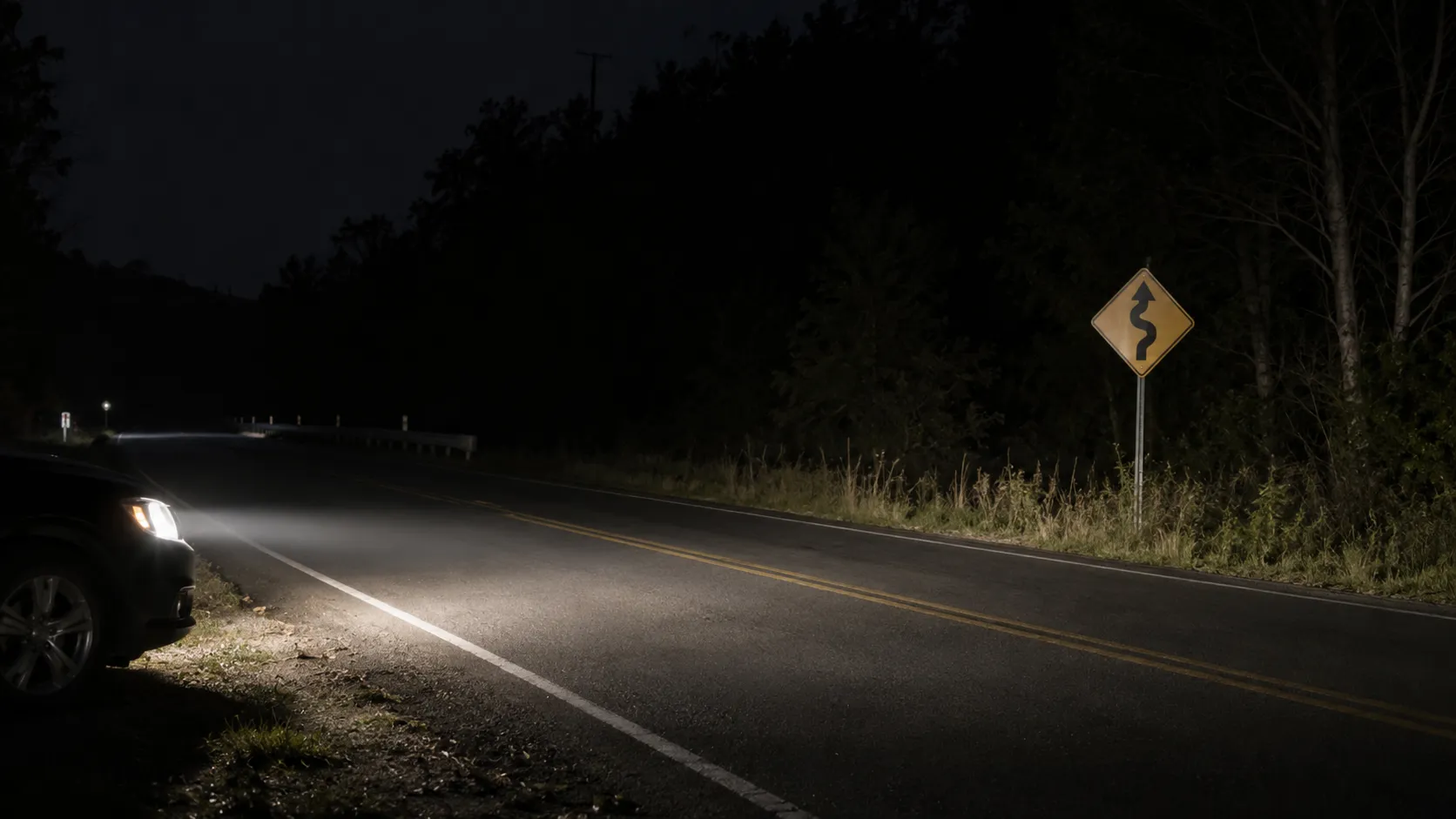
The important distance is not only between the car and the sign.
The relative positions of three things matter:
Headlight
Reflective sign
Driver’s eyes
The angle between the headlight direction and the driver’s viewing direction is called the observation angle.
When this angle is small, more returned light normally reaches the observer.
As the observation angle becomes larger, the visible brightness usually decreases. 3M and FHWA both describe this relationship when explaining traffic-sign retroreflectivity.
That explains a common real-life situation.
Imagine a car facing a reflective sign at night.
From the driver’s seat:
The headlights illuminate the sign.
The driver’s eyes are relatively close to the headlight position.
The sign appears bright.
Now move several meters sideways.
Your eyes are no longer close to the direction of the headlights.
Less of the returned light reaches you.
The sign can suddenly appear much darker.
Distance Changes Brightness Too
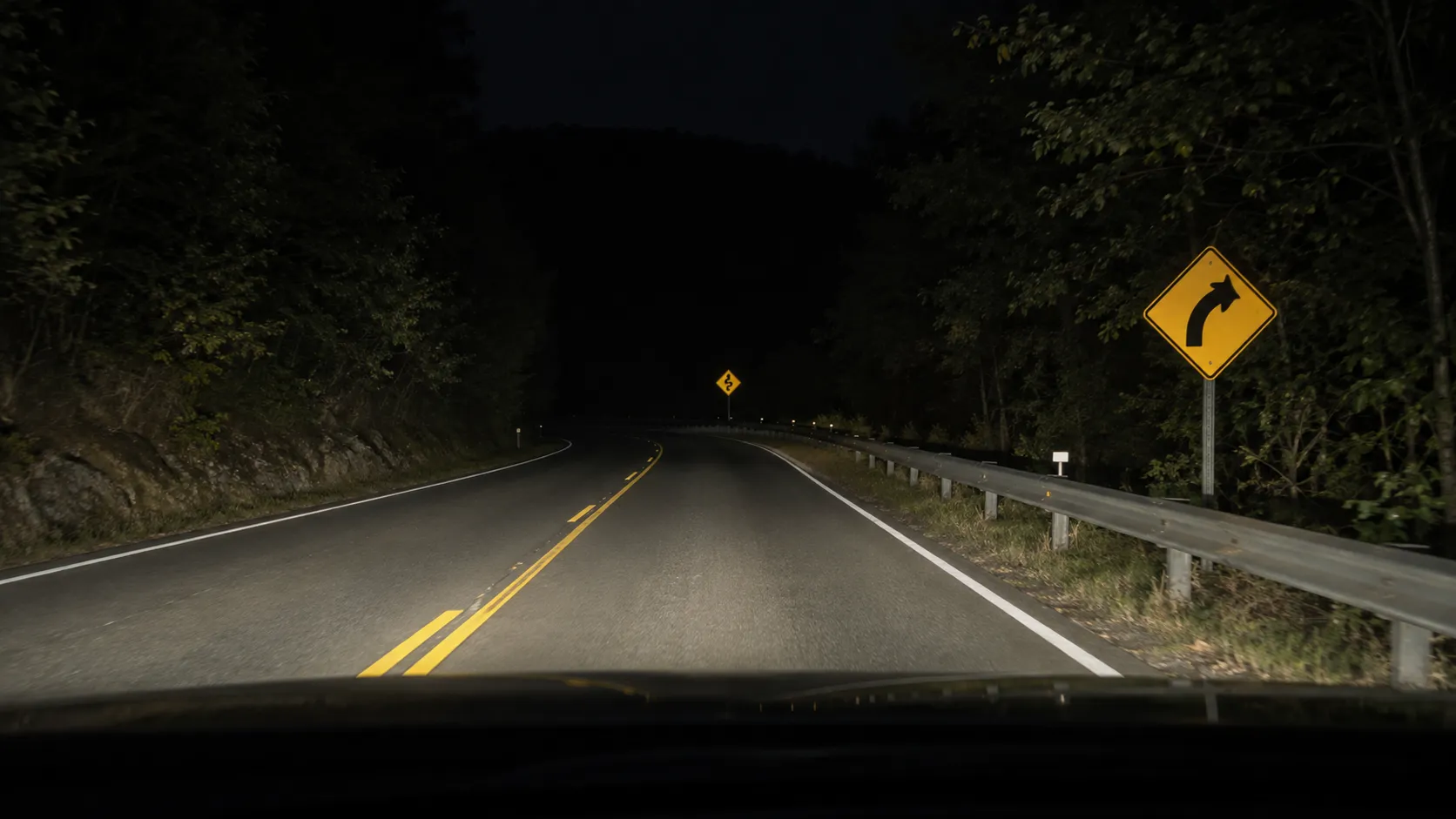
Observation angle also changes as the vehicle gets closer to the sign.
At a long distance, the driver’s eyes and headlights appear relatively close together when viewed from the sign.
As the vehicle approaches, the geometric angle becomes larger.
FHWA notes that observation angle generally increases as a vehicle gets closer to a sign, and reflective performance changes with that geometry.
This is one reason a reflective material cannot be described completely by saying:
“RA = one number.”
Retroreflectivity is measured at defined observation and entrance angles because the result changes when those angles change.
Why Can Different Vehicles See the Same Sign Differently?
A passenger car, SUV and truck do not place the driver’s eyes and headlights at exactly the same heights.
This changes the viewing geometry.
For example, a truck driver sits much higher above the headlights than a driver in a small passenger car.
That creates a larger observation angle.
Some reflective sheeting constructions maintain brightness better at wider observation angles than others.
3M notes that wider retroreflective performance can help drivers in SUVs, pickups and trucks where the observation angle is larger.
This does not mean one grade is automatically correct for every road.
The required reflective material should still be selected according to the road, sign position, project specification and applicable standard.
What About Viewing the Sign From the Side?
A second factor is the entrance angle.
This describes how directly the headlight reaches the face of the sign.
A sign that is nearly facing the vehicle receives light differently from a sign positioned far to the side or installed at a strong angle.
So a sign can look weaker because:
The observer moved sideways
The vehicle is very close
The sign is far off the road
The sign face is angled incorrectly
The reflective material has different angular performance
This is why traffic-sign installation angle matters as well as reflective grade.
A Simple Real-Life Test
You can see this effect without laboratory equipment.
At night, park a vehicle safely facing a reflective sign or reflective sample.
Turn on the headlights.
First, look at the sign from a position close to the vehicle’s normal driver position.
Then move several meters to one side.
The sign will usually appear less bright.
Move back toward the headlight position and the brightness increases again.
This is a normal characteristic of retroreflection.
It does not mean the material is switching on and off.
Why This Matters When Comparing Samples
This is especially important when comparing two reflective sheeting samples.
Do not compare one sample:
directly in front of the flashlight
and another:
from a different angle.
Small changes in viewing position can change the apparent brightness.
For a useful comparison, keep the same:
Condition | Keep Consistent |
|---|---|
Light source | Same headlights or lamp |
Distance | Same distance |
Viewing position | Same eye position |
Sign angle | Same orientation |
Sample size | Similar size |
Surface condition | Clean and dry |
For formal testing, use a retroreflectometer at the specified measurement geometry rather than judging only by eye.
Final Thoughts
Reflective sheeting looks brightest when the observer is close to the direction of the incoming light.
That is exactly why it works well on traffic signs.
For drivers at night:
headlights illuminate the sign → reflective sheeting returns the light → the driver sees a bright sign
If you move far away from the headlight position, the same sign can look much dimmer.
That is normal retroreflective behavior, not necessarily a quality problem.
If a sign still appears unusually dim from the normal driving position, inspect its nighttime condition before deciding whether the reflective sheeting has a problem.
RELATED NEWS

Reflective Sheeting Roll Converting Guide | ABLAZE
SEO Title: Reflective Sheeting Roll Converting Guide | ABLAZEMeta Description: Learn how reflective sheeting rolls are slit, rewound, matched to core size, inspected for width and length tolerance, and packed for export.Recommended URL Slug: reflective-sheeting-roll-converting-guidePrimary Keyword:

Why Does Reflective Sheeting Look Brighter From The Driver’s Seat?
Reflective sheeting does not look equally bright from every position. Learn why a traffic sign may appear bright from the driver’s seat but much dimmer when viewed from the side.