



A reflective sheeting product described as having “10-year outdoor durability” is not automatically backed by an unconditional 10-year warranty—and it does not mean every finished sign will remain usable for exactly ten years.
Service life is the actual period during which the installed reflective product remains fit for its intended purpose. Outdoor durability is a product performance expectation under stated conditions. Warranty is the manufacturer’s contractual responsibility if defined requirements are not met. Shelf life is the recommended storage period before the material is processed and applied.
These periods can be different.
The actual outdoor life of reflective sheeting depends on the complete system: face film, optical construction, adhesive, substrate, printing ink, overlaminate, fabrication, installation, exposure angle, climate, cleaning and maintenance. The useful life ends when the first performance-critical part of that system reaches its acceptance limit—not simply when a calendar date arrives.
If you first need a basic overview of reflective materials and their applications, read What Is Reflective Sheeting? Types, Uses and Buying Guide. For typical grade-by-grade lifespan ranges, see How Long Does Reflective Tape Last Outdoors?. This guide answers the more important procurement question: what do the published years actually mean, and what must be true for them to be relevant to your project?
Quick Answer: Is Reflective Sheeting Service Life the Same as Its Warranty?
No. Reflective sheeting service life and warranty are related, but they are not interchangeable.
A product may remain functional after its warranty expires.
A product may fail in service before the end of the stated durability period because it was used outside the rated conditions.
A long warranty may cover only replacement material, not sign fabrication, removal, transport or reinstallation.
A printed sign may have a shorter approved warranty than the unprinted base sheeting.
The warranty may apply only to a named combination of sheeting, ink, overlay, substrate and processing method.
The safest purchasing rule is simple: never compare two reflective sheetings by the number of years alone. Compare the definition, exposure conditions, retained-performance requirement, coverage, exclusions and remedy behind those years.
Service Life, Outdoor Durability, Warranty and Shelf Life Are Different
Term | What It Means | Typical Reference Point | What the Buyer Must Verify |
|---|---|---|---|
Service life | The actual time the installed product remains fit for its intended use | Installation or first outdoor exposure | The functional end-of-life criterion and inspection method |
Outdoor durability rating | A published expectation for performance under defined exposure and processing conditions | Usually outdoor exposure after correct fabrication and installation | Climate, orientation, color, substrate, printed or unprinted status and stated limitations |
Warranty period | The period during which a supplier accepts defined contractual responsibility | Purchase, fabrication or installation date, depending on the document | Covered failure, exclusions, required records, claim process and remedy |
Shelf life | The recommended period for storing unprocessed material before use | Manufacture or shipment date, depending on the data sheet | Packaging, temperature, humidity, roll position and remaining processing window |
What Is Reflective Sheeting Service Life?
Service life is application-specific. It is the time until the installed sheeting no longer meets the requirement that made it useful.
For a regulated traffic sign, end of service life may be reached when the sign no longer meets the required maintained retroreflectivity, color, legibility or physical-condition criteria. For a commercial sign, the customer may define failure as excessive fading, peeling or an unreadable printed message. For vehicle marking tape, edge lifting, abrasion or loss of conspicuity may determine replacement even if the central area still reflects light.
This means the same roll can have different practical service lives in different applications.
What Is an Outdoor Durability Rating?
An outdoor durability rating describes expected product performance under specific assumptions. A technical data sheet may limit that statement to:
Unprinted material
Professional processing
An approved substrate
Vertical outdoor exposure
A temperate or specified climate
A particular color
Normal cleaning and maintenance
Use within the recommended shelf life
Change one of these variables and the published period may no longer apply. Read the notes and definitions—not only the large number in the product table. Our guide to reading a reflective sheeting technical data sheet explains how to compare these conditions line by line.
What Is a Reflective Sheeting Warranty?
A warranty is a contractual promise with defined conditions and a defined remedy. Depending on the product and supplier, it may cover only manufacturing defects, deterioration of the unprinted sheeting, retained retroreflectivity, visual appearance, adhesive performance or a qualified finished-sign system.
The warranty document—not a salesperson’s summary—should state:
The exact covered product code and color
The country or market where coverage applies
The start date and warranty period
The approved end use
Required components and processing procedures
The performance threshold that constitutes failure
Exclusions
Claim documentation
Whether the remedy is replacement material, credit, sign-face restoration, labor or another defined benefit
What Is Shelf Life?
Shelf life applies before installation. It defines how long unused reflective sheeting should be stored under specified conditions before processing.
An unopened roll that has been stored too hot, too humid, under pressure or beyond its recommended shelf life may develop liner distortion, curl, adhesive changes or surface problems. A long outdoor rating does not cancel poor warehouse history.
Why a “10-Year Reflective Sheeting” Claim Is Incomplete
“Ten years” sounds precise, but it is incomplete unless the supplier answers the following questions:
Which exact product code and color does the claim cover?
Is the material glass-bead or microprismatic, and what is the complete face-film construction?
Is the period for unprinted sheeting or for the finished printed sign?
Which ink, overlay and processing system is approved?
Is the exposure vertical, inclined or horizontal?
For which climate or geographic zone is the period stated?
Which substrate and surface preparation are required?
What retroreflectivity, color, adhesion and appearance must remain at the end of the period?
When does the warranty clock start?
What is excluded?
What evidence is required to make a claim?
What will the supplier actually pay for or replace?
Without these details, one supplier’s “10-year durability” may describe a maximum expected period under vertical temperate exposure, while another supplier’s “10-year warranty” may cover a qualified finished-sign system with a measured retained-retroreflectivity threshold. The two offers are not equivalent.
What Determines Reflective Sheeting Outdoor Durability?
1. The End-of-Life Requirement
Durability cannot be discussed until failure is defined.
Does the product need to remain attractive, readable, securely bonded, compliant with a minimum coefficient of retroreflection, resistant to chemicals, or all of these at once? A small reduction in gloss may be acceptable on an industrial warning label but irrelevant to the nighttime performance of a highway sign. Conversely, a sign can remain firmly bonded while its nighttime visibility has fallen below the required level.
For a technical explanation of reflectivity measurements, see Coefficient of Retroreflection Explained: RA, Observation Angle and Entrance Angle.
2. Product Construction and Material Quality
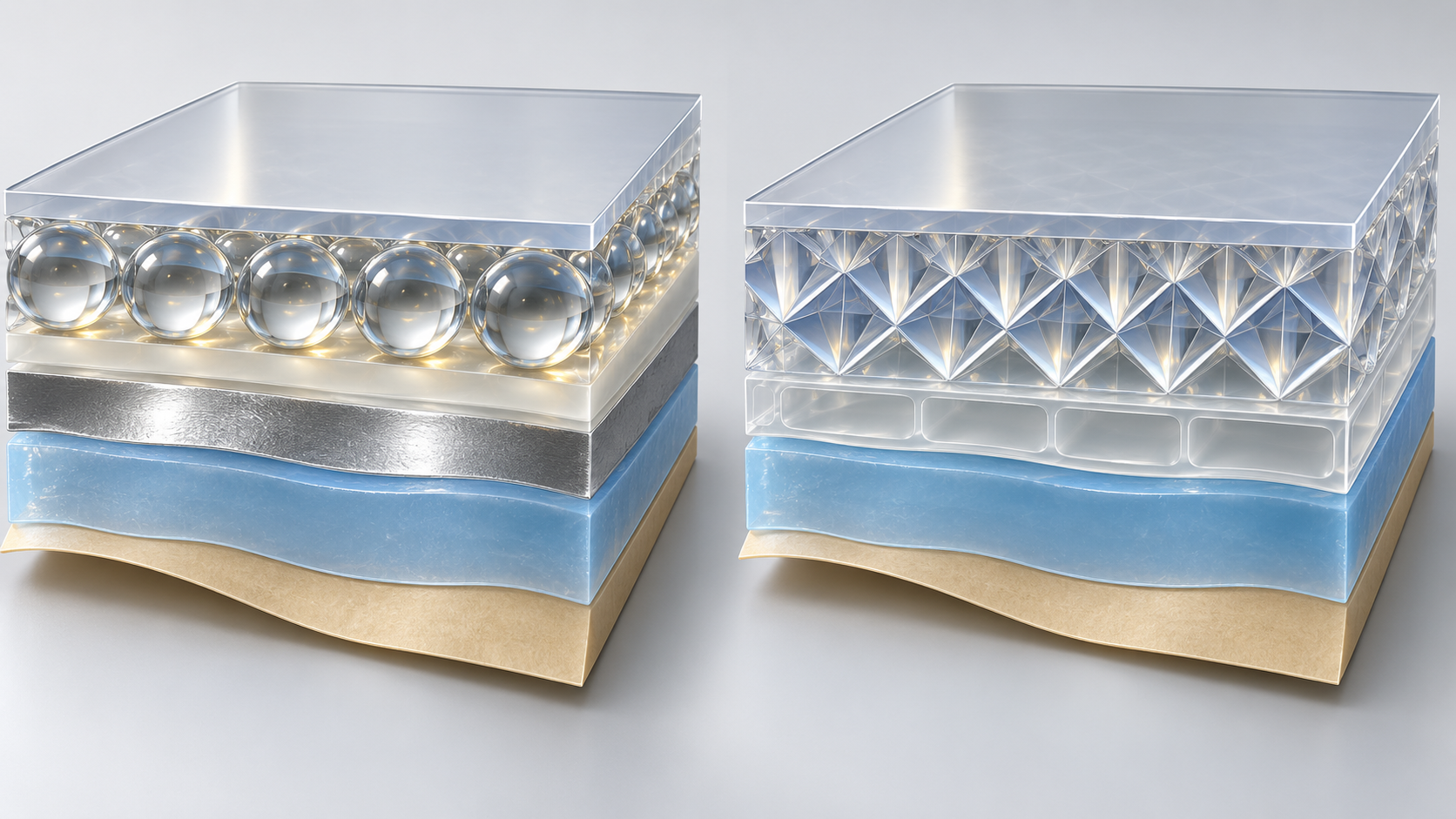
Reflective sheeting is a multilayer optical product, not a single plastic film. Depending on the grade, it may contain:
A protective or printable face layer
Glass beads or microprisms
A focusing, reflective or sealing layer
A carrier film
A pressure-sensitive adhesive
A release liner used before application
Resin selection, UV stabilization, pigment stability, optical-layer protection, coating uniformity, adhesive formulation and manufacturing control all affect aging.
However, glass-bead versus microprismatic technology does not by itself determine service life. Optical efficiency and weathering durability are different properties. A higher initial RA value also does not prove that a product will retain that performance longer. Compare the exact product specification and weathering evidence.
3. UV Dose, Climate, Altitude and Pollution
Sunlight is one of the main drivers of polymer and pigment aging. Outdoor damage depends on accumulated UV exposure together with heat and moisture—not simply the number of calendar years.
Important environmental variables include:
Latitude and solar intensity
High altitude
Hot and dry desert exposure
Hot and humid tropical exposure
Repeated rain, dew and condensation
Freeze-thaw cycles
Coastal salt spray
Industrial pollution and airborne particles
Long periods of surface wetness
A product evaluated in a temperate climate should not automatically receive the same expected life in a high-UV desert, tropical coastal city or polluted industrial area. Ask the supplier whether the durability statement changes by climate zone.

4. Vertical, Horizontal and Inclined Exposure
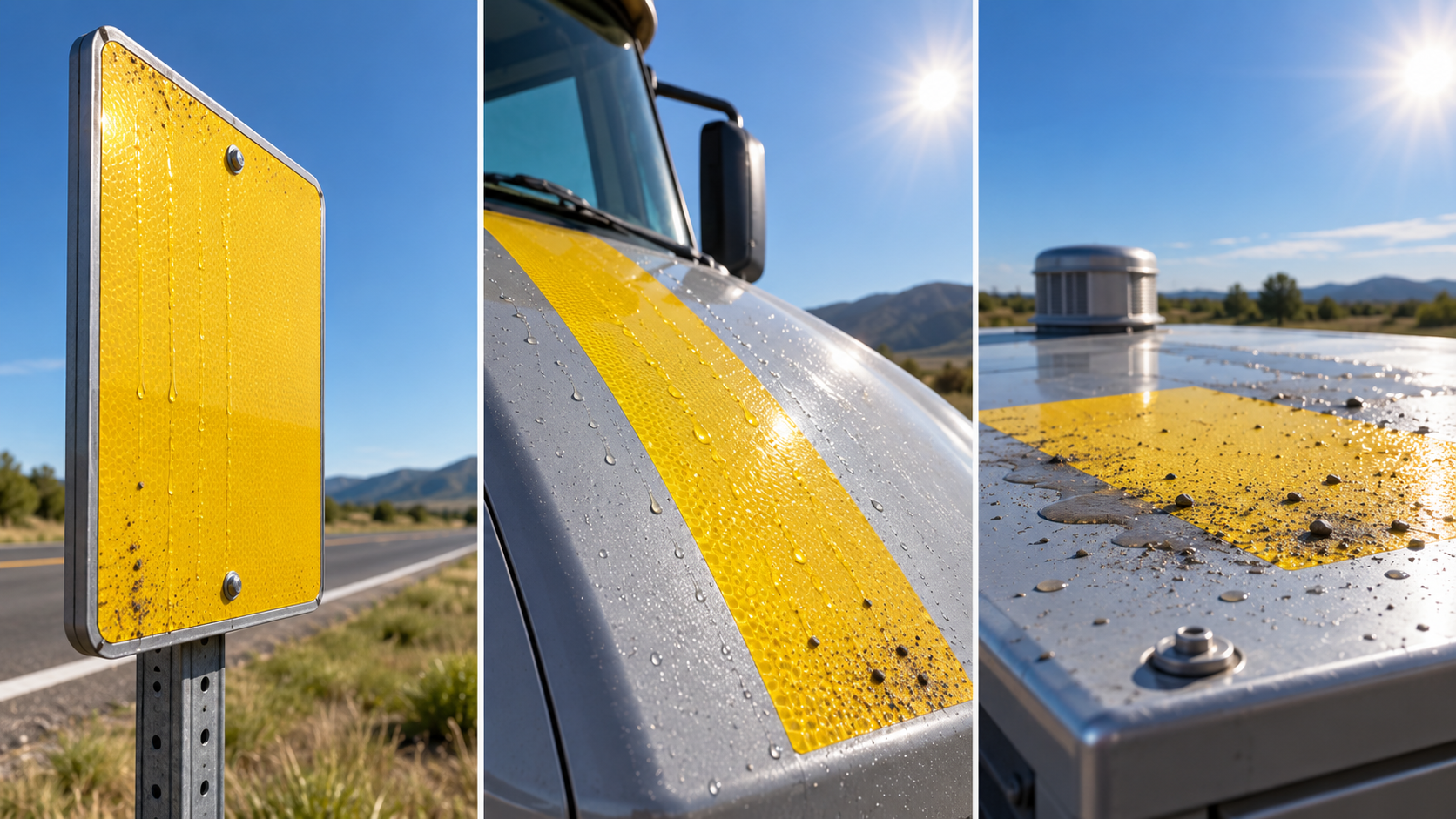
Published durability is often based on a near-vertical application. A horizontal or upward-facing surface usually receives greater solar load, retains more water and dirt, and experiences more severe temperature cycling.
Examples include:
A vertical roadside sign face
A reflective strip on the sloped hood of a vehicle
A decal on the top of equipment
A horizontally stored traffic device
These are not equivalent exposures. A clear overlaminate cannot automatically convert a vertical-only product into a horizontal-rated system. State the mounting angle when requesting durability confirmation.
5. Substrate and Adhesive Compatibility
The face film may remain in excellent condition while the bond fails underneath it.
Long-term adhesion depends on:
The adhesive chemistry and coat weight
Surface energy
Panel smoothness and stability
Paint or powder-coat chemistry
Oxidation, corrosion, wax, silicone, oil or dust
Outgassing from plastics, coatings or composite panels
Application temperature and pressure
Time allowed for the bond to develop
Thermal expansion differences between film and substrate
Initial tack is not proof of long-term outdoor durability. Test the actual production substrate after relevant heat, moisture and cleaning exposure. For a detailed material-selection framework, read our reflective sheeting adhesive guide.
6. Printing, Ink, Overlaminate and Color
Once reflective sheeting is printed, the printed construction becomes a new system. The base film may continue reflecting while the image fades, cracks, peels or becomes unreadable.
The result depends on:
Whether the surface is approved for the printing method
Ink chemistry and transparency
Ink deposit and color density
Drying, curing and outgassing
UV energy and process heat
Ink-to-sheeting adhesion
Overlaminate chemistry, clarity and flexibility
Laminate adhesive and application tension
Finished RA and color after printing and lamination
Fluorescent and printed colors may have different durability periods from standard unprinted colors. Do not apply the base white sheeting’s year claim to every finished color.
Lamination can protect a compatible print from UV, abrasion, water and cleaning, but it does not add a universal number of years. It also cannot repair weak ink adhesion, an unsuitable substrate or opaque ink that blocks retroreflection. Use our printed reflective sheeting lamination and edge-sealing guide to qualify the complete construction.
7. Fabrication and Installation Quality
Poor processing can consume years of potential service life before the sign is installed.
Common causes of premature failure include:
Applying material below its minimum temperature
Using insufficient or uneven pressure
Stretching film during application
Forcing rigid sheeting around unsuitable curves
Incorrect orientation of adjoining prismatic pieces
Trapping moisture or solvent
Using incompatible application fluid
Cutting or damaging the optical layer
Installing before paint or ink is fully cured
Mixing unapproved materials in a warranty-controlled system
For rigid sign production, follow a controlled procedure for applying reflective sheeting to aluminum sign panels.
8. Edges, Seams and Moisture Entry
Edges, corners, splices, rivets and cut cells are common starting points for failure. Water, dirt, fuel or cleaning chemicals can enter a damaged or poorly bonded edge and spread beneath the surface.
Edge sealing is not universally required. It depends on product construction, fabrication method and environment. Where a supplier or project specification requires edge sealing, use the approved sealer and procedure. A generic liquid or tape can create its own compatibility problem.
9. Abrasion, Chemicals, Washing and Maintenance
A stationary traffic sign, a construction machine and a truck graphic may use reflective material outdoors, but their mechanical exposure is very different.
Service life can be shortened by:
Road debris and sand
Loading and cargo contact
Brushes and abrasive pads
Pressure washing too close to edges
Fuel, oil and solvents
Aggressive alkaline or acidic cleaners
Salt and marine exposure
Graffiti removal
Repeated folding, flexing or impact
Dirt can temporarily reduce apparent nighttime brightness without permanent material failure. Clean according to the product instructions, then reinspect before deciding that the sheeting has reached end of life.
10. Storage and Processing Before Installation
Outdoor durability begins with indoor handling. Protect rolls from heat, moisture, direct sunlight, dust, crushing and incorrect roll support. Rotate stock by lot and date. Allow cold or hot material to acclimate before opening so condensation does not form on the surface or adhesive.
Keep traceability through slitting, printing, cutting and sign fabrication. If the lot number and processing history disappear, both quality investigation and warranty support become much more difficult.
The Finished Sign Is Only as Durable as Its Weakest Layer
A useful way to evaluate service life is to treat the finished product as a series of performance-critical layers and interfaces.
Component or Interface | Typical Failure | Effect on Service Life |
|---|---|---|
Face film and optical layer | Fading, cracking, chalking, cell damage or delamination | Lower RA, color change, loss of surface integrity |
Printed ink | Fading, peeling, cracking or excessive opacity | Message becomes incorrect, unreadable or insufficiently reflective |
Protective overlay | Yellowing, lifting, shrinkage, haze or cracking | Optical loss, exposed ink and edge stress |
Sheeting adhesive | Cohesive failure, softening or loss of bond | Bubbles, edge lifting or complete separation |
Adhesive-to-substrate interface | Clean peel, water entry or localized lifting | Premature detachment despite an intact face film |
Substrate | Corrosion, outgassing, coating failure or deformation | The complete sign face loses support or adhesion |
Edges and seams | Lifting, contamination or moisture ingress | Local damage spreads into otherwise sound material |
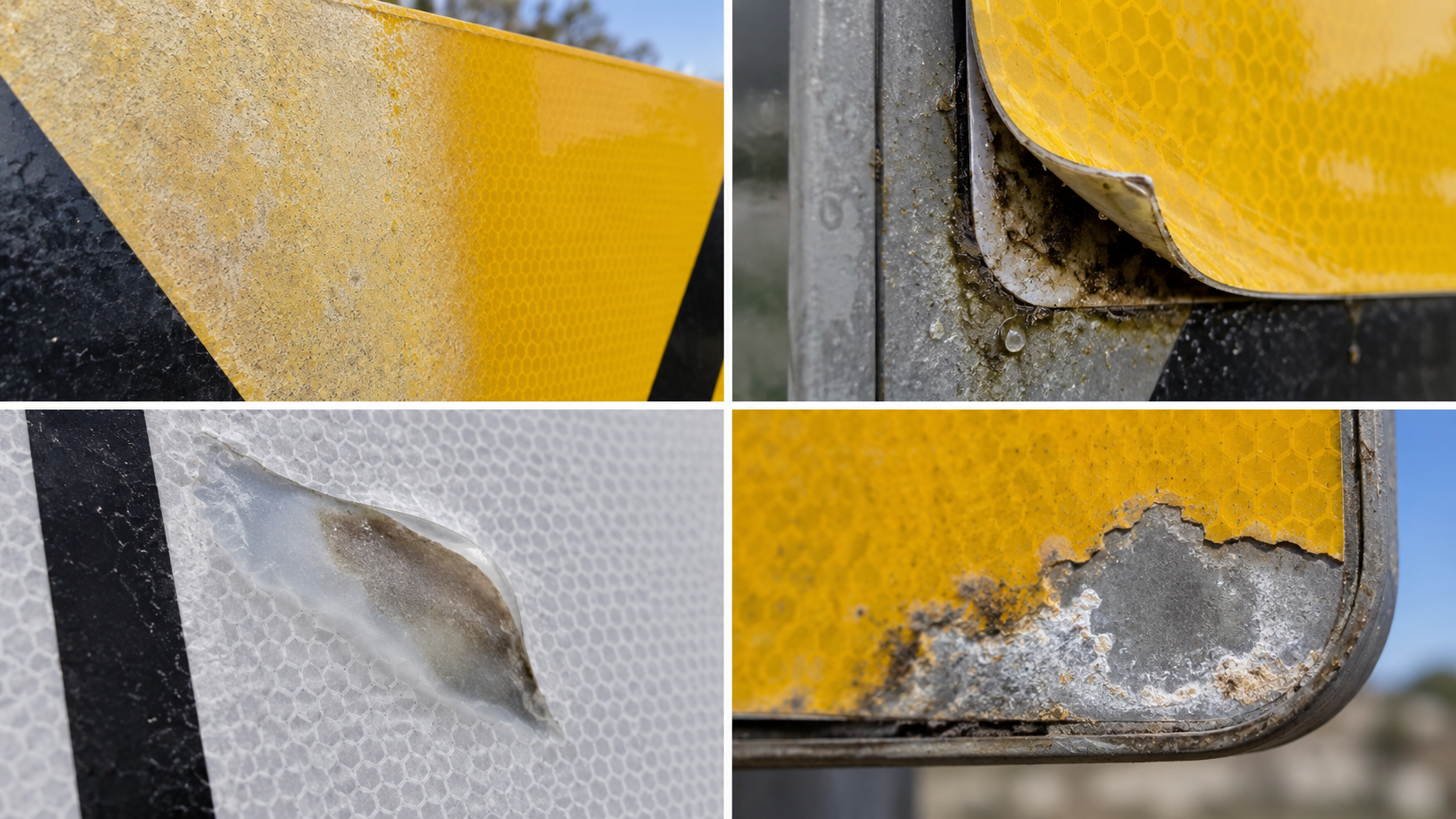
For troubleshooting, the first question should be which layer failed? Our reflective sheeting defects guide provides a layer-by-layer method for peeling, curling, cracking, bubbles, dark spots and ink failure.
How Is Reflective Sheeting Outdoor Durability Tested?
Reliable durability evidence combines a defined specification, controlled weathering, before-and-after measurements and relevant field experience. A single new-roll RA value or flashlight photograph cannot prove multi-year outdoor performance.
Natural Outdoor Exposure
Natural exposure places identified specimens at a documented site and orientation. It provides direct environmental relevance but requires time and careful records.
A useful report identifies:
Location and climate
Start and end dates
Mounting direction and angle
Substrate and application method
Product code, color, lot and orientation
Cleaning procedure
Control material and replicate count
Weather data where available
Measurements before, during and after exposure
Natural exposure in one location is valuable evidence, but it does not automatically predict performance in every climate.
Accelerated Weathering
Xenon-arc and fluorescent-UV equipment can expose materials to controlled light, heat and moisture. These methods are valuable for development, comparison and qualification when the exact cycle and evaluation criteria are defined.
However, a claim such as “passed 1,000 hours of UV testing” is incomplete. The report should identify the apparatus, lamp or filter, irradiance, control wavelength, temperature, humidity, spray or condensation cycle, specimen mounting, total exposure and pass/fail criteria.
Do not convert chamber hours into outdoor years with a universal formula. A meaningful acceleration factor requires correlation for the relevant material, failure mode and service environment.
For a complete test plan, see How to Test Adhesion, Shrinkage and Weather Resistance of Reflective Sheeting.
What Should Be Measured Before and After Weathering?
Property | What to Record |
|---|---|
Retroreflectivity | RA at the same observation angle, entrance angle, color, orientation and test method |
RA retention |
|
Daytime and nighttime color | Required color coordinates, luminance factor or color difference |
Surface condition | Cracking, crazing, chalking, blistering, pitting, gloss loss and abrasion |
Layer and edge condition | Delamination, tunneling, curling, edge lifting and moisture entry |
Adhesion | The same peel, static-load or other defined method used before exposure |
Dimensional stability | Shrinkage, gap growth, edge movement and distortion |
Printed system | Ink adhesion, fading, cracking, laminate integrity, legibility and RA through printed areas |
For regulated traffic signs, use the standard and edition required by the relevant road authority. A sheeting material standard may not cover the ink, overlay or finished imaging system, so confirm the complete sign requirement separately.

What Does a Reflective Sheeting Warranty Actually Cover?
There is no universal reflective sheeting warranty. Coverage differs by product, country, end use, color, exposure and finished construction.
Common Types of Coverage
Depending on the warranty document, coverage may include:
Freedom from manufacturing defects at the time of supply
Excessive natural deterioration of the base sheeting
Retention of a defined minimum retroreflectivity
Daytime or nighttime color performance
Excessive cracking, peeling, blistering or dimensional change
Adhesion on named, properly prepared substrates
Approved printed-sign performance using matched components
Never assume that all of these are included. A general material warranty can be much narrower than a performance or finished-sign warranty.
Common Warranty Exclusions
Product-specific terms often exclude failure caused by:
Improper storage, handling or processing
Application after the permitted shelf-life window
Unapproved substrates or poor surface preparation
Incorrect application temperature or pressure
Unapproved ink, laminate, primer, cleaner or edge sealer
Mixing incompatible manufacturers’ components
Non-vertical or severe-climate exposure not covered by the document
Chemical attack, abrasion, vandalism, impact or accidents
Substrate, paint or coating failure
Improper cleaning or pressure washing
Failure to maintain fabrication, lot and installation records
Minor changes may also be permitted before the condition is considered a warranty breach. Read the actual threshold.
Remedy Matters as Much as Warranty Length
Two warranties with the same period can have very different value.
Possible remedies include:
Replacement of defective raw sheeting
A prorated material credit
Replacement of sheeting, ink and overlay
Restoration of the sign face during an initial period
Limited labor coverage
Full-sign replacement under a specific approved program
Removal, posts, hardware, traffic control, freight, lost production and reinstallation may be excluded. Some warranties also change remedy after an initial restoration period. Compare the remedy schedule, not only the headline duration.
Records Needed for a Warranty Claim
Maintain enough information to connect a field sign to the supplied roll and the approved process:
Purchase invoice and supplier
Product code, color, lot and roll number
Manufacture or shipment information where available
Fabrication and installation dates
Sign location and exposure orientation
Substrate identification and preparation method
Printer, ink, profile, curing and overlaminate records
Application temperature and procedure
Cleaning and maintenance history
Photographs and nighttime inspection results
RA and color measurements where required
Retained control material from the same lot, when practical
A long warranty has little practical value if the required traceability is not maintained.
How to Compare Two Reflective Sheeting Durability Claims
Use this checklist before choosing between quotations.
Comparison Item | What to Request |
|---|---|
Product identity | Exact model, construction, color and current technical data sheet |
Intended use | Traffic sign, commercial print, vehicle, license plate, label or another defined application |
Published durability | Number of years plus every climate, orientation, substrate and processing condition |
Service-life criterion | Required RA, color, adhesion, legibility and acceptable physical condition |
Evidence | Applicable standard, natural exposure, defined accelerated weathering and relevant field history |
Printed construction | Approved printer, ink, curing, overlay and finished-performance requirement |
Warranty document | Current market-specific terms for the exact product and application |
Warranty start | Purchase, fabrication, installation or another stated date |
Coverage and exclusions | Exact covered failure and circumstances that void coverage |
Remedy | Material, credit, restoration, labor, full sign and whether the benefit is prorated |
Claim records | Lot traceability, process data, registration, photographs and measurements |
Trial approval | Sample made with the actual substrate, printer and production process |
A supplier who provides a clear five-year product-specific statement may be offering a more dependable solution than one who advertises “ten years” without conditions, evidence or a usable remedy.

How to Specify Service Life by Application
Do not start by asking for the longest-lasting material. Start with the application’s required performance period and end-of-life rule.
Application | Main End-of-Life Criteria | Durability Risks to Specify |
|---|---|---|
Temporary advertising and promotional signs | Legibility, appearance and bond for the campaign period | Ink fading, low-cost substrate, easy removal and weather exposure |
General outdoor commercial signs | Readable print, acceptable color, adhesion and surface condition | Printing system, laminate, UV, cleaning and substrate stability |
Permanent traffic signs | Maintained RA, required color, legibility, adhesion and physical integrity | Approved grade/system, orientation, climate, fabrication and inspection program |
Work-zone and temporary traffic devices | Required visibility for the deployment period and repeated-use condition | Abrasion, impact, folding, dirt, handling and storage between uses |
Truck, trailer and fleet markings | Conspicuity, bond, edge condition and cleanability | Curves, rivets, pressure washing, road debris, fuel and paint condition |
License plates | Plate-system compliance, RA, color, adhesion, cleanability and post-processing integrity | Printing, watermark/security layer, laminating, embossing and substrate treatment |
Industrial labels and equipment markings | Legibility, bond and resistance to the specified environment | Oils, solvents, heat, abrasion and high-pressure cleaning |
For road projects, review ABLAZE traffic sign reflective sheeting solutions. For printed commercial graphics, compare the constructions in our advertising grade reflective sheeting range.
How to Extend Reflective Sheeting Service Life
Define the application, climate, exposure angle and required service period before choosing a grade.
Use the exact product code approved for the substrate and processing method.
Store the roll within the specified temperature, humidity, packaging and shelf-life conditions.
Acclimate the material and substrate before printing or application.
Clean and prepare the actual substrate according to the approved procedure.
Apply within the specified temperature range using controlled, uniform pressure.
Use qualified inks, profiles, curing settings, overlays and edge treatments.
Avoid stretching, damaging optical layers or forcing rigid materials around unsuitable curves.
Protect edges and seams where the product or environment requires it.
Clean gently, inspect periodically and record material condition and nighttime performance.
Good installation cannot convert a short-term product into a long-term traffic material. Poor installation can, however, shorten the life of a well-designed product dramatically.
When Should Reflective Sheeting Be Replaced?
Warranty expiry alone is not a replacement criterion, and an unexpired warranty does not prove that a damaged product should remain in service.
Inspect or replace reflective material when:
Measured RA falls below the applicable maintained requirement
Nighttime visibility or legibility is no longer adequate
Daytime or nighttime color falls outside the required range
The face film cracks, crazes or becomes brittle
Layers delaminate or dark, non-reflective areas spread
Edges lift enough to admit water, dirt or chemicals
Adhesion failure threatens detachment
Printed information fades, peels or becomes incorrect
Abrasion, impact, vandalism or an accident causes functional damage
The substrate corrodes, deforms or fails beneath the sheeting
A daytime visual check is not enough for safety-critical traffic signs. Use a documented management method and measure retroreflectivity where required. See How to Inspect Reflective Traffic Signs at Night for a practical inspection sequence.

How ABLAZE Supports Durability Qualification
ABLAZE® is the reflective material brand of Changzhou Zhenghe New Material Technology Co., Ltd., a China-based reflective sheeting manufacturer with more than 20 years of industry experience.
Our product range includes glass-bead and microprismatic reflective materials for traffic signs, commercial printing, vehicle identification, industrial safety and license plate production. We believe a durability discussion should begin with the complete application—not the largest number of years printed on a quotation.
To recommend a suitable construction and qualification plan, our team will ask for:
Destination country and exposure climate
Final application and required standard
Vertical, inclined, horizontal, flat or curved installation
Aluminum, painted metal, plastic or other substrate
Printing and cutting process
Ink and overlaminate system
Required service period and end-of-life criteria
Color, roll size and order quantity
ABLAZE can prepare product-specific samples for adhesion, printing, converting and finished-system evaluation before a bulk order. For regulated projects, the governing specification and independent test or certification requirements should always take priority.
Contact Changzhou Zhenghe New Material Technology Co., Ltd. / ABLAZE to discuss your outdoor exposure, target service life and processing system.
Frequently Asked Questions
Is outdoor durability the same as a warranty?
No. Outdoor durability is an expected performance period under stated conditions. A warranty is contractual coverage with defined exclusions, evidence requirements and remedies.
Does a 10-year warranty mean reflective sheeting will last exactly ten years?
No. The material may remain functional longer, or the finished product may require earlier replacement because of damage, severe exposure, installation error or failure of another system component.
Can reflective sheeting service life exceed the warranty period?
Yes. Warranty expiration ends contractual coverage; it does not automatically end physical performance. Continue to judge the installed product against its functional and regulatory requirements.
Does higher initial retroreflectivity mean longer service life?
Not necessarily. Initial RA and RA retention are different properties. Compare performance at the required angles before and after weathering, together with color, adhesion and physical condition.
Does microprismatic sheeting always last longer than glass-bead sheeting?
No. Optical technology alone does not determine outdoor life. Face-film chemistry, UV protection, adhesive, construction, exposure and manufacturing quality also matter. Use the exact product data.
Does overlamination add a fixed number of years?
No. A qualified overlaminate may protect ink and improve resistance to UV, abrasion or chemicals, but there is no universal life-extension number. The complete sheeting–ink–laminate system must be tested or approved.
Why does horizontal exposure reduce durability?
Upward-facing surfaces generally receive more solar energy and retain more heat, water and dirt than vertical surfaces. Use a product and warranty specifically rated for the actual exposure angle.
Does 1,000 hours of UV testing equal a specific number of outdoor years?
Not by itself. The chamber type, spectral output, irradiance, temperature, moisture cycle, material response and correlation with the intended outdoor environment must all be known.
What is the best proof of reflective sheeting durability?
The strongest package combines a product-specific specification, defined natural and accelerated weathering results, retained-performance measurements, relevant field history and a written warranty for the exact application.
When should a traffic sign be replaced?
Replace or manage it according to the applicable road authority’s method when it falls below maintained retroreflectivity or other required performance, or when physical damage makes the sign unsafe or unreadable.
Conclusion: Buy a Defined Performance System, Not Just a Number of Years
Reflective sheeting service life, outdoor durability, warranty and shelf life answer four different questions. Treating them as the same number creates purchasing risk.
The actual life of a reflective sign or marking depends on its required end-of-life threshold and the complete installed system: reflective construction, color, ink, overlay, adhesive, substrate, edges, fabrication, exposure and maintenance. Warranty value depends on equally practical details—coverage, exclusions, records and remedy.
Before comparing suppliers, replace the question “How many years does it last?” with a better one:
“Under our climate, orientation, substrate and processing method, what performance will this exact finished system retain, what evidence supports the claim, and what remedy applies if it does not?”
That question leads to a more reliable product, a clearer specification and a far more meaningful warranty.
RELATED NEWS

Sun, Sand and a 50°C Container: Getting Reflective Sheeting Through a Hot Climate
In hot regions, reflective sheeting can start ageing before it reaches the sign shop. UV, heat, dust and humidity each attack a different part of the product, and each needs its own defence.Picture a distributor in a hot coastal city who receives a container of prismatic sheeting in midsummer. It si
