


Old traffic signs do not always need a new aluminum panel.
Before deciding to cover an existing sign, see whether new reflective sheeting should be applied over old sheeting.
If the aluminum is still flat and in good condition, the old reflective sheeting can often be removed and the panel prepared for new material.
The basic process is:
inspect the panel → loosen the old film → peel slowly → remove adhesive residue → clean and inspect the aluminum
The exact removal method depends on the reflective sheeting and adhesive system. Some films are designed to become easier to remove with heat, while permanent products may be much more difficult.
Always check the instructions for the specific material before starting.
Check the Sign Before Removing Anything
First inspect the aluminum panel.
Look for:
Heavy corrosion
Bent corners
Deep dents
Cracks around mounting holes
Sharp damaged edges
Severe surface oxidation
If the panel itself is badly damaged, spending time removing the old film may not be worthwhile.
If the aluminum is still structurally sound, refurbishment may be practical.
Also look at the old reflective sheeting.
A relatively intact film usually removes more easily than material that is already brittle, cracked or broken into small pieces.
Heat Can Make Removal Easier
Many pressure-sensitive films become softer when gently warmed.
Moderate heat can help soften both the face film and adhesive, allowing the material to peel away more smoothly.
This does not mean the sign should be made extremely hot.
Too much heat can:
Soften adhesive excessively
Leave more adhesive residue
Damage coatings
Distort some substrates
Make working conditions unsafe
Use controlled heat and follow the instructions for the exact reflective product.
Both 3M and ORAFOL publish removal guidance noting that heat can assist removal for suitable films, while also warning that removability depends on the adhesive, substrate and service history.
Peel Slowly Instead of Pulling Hard
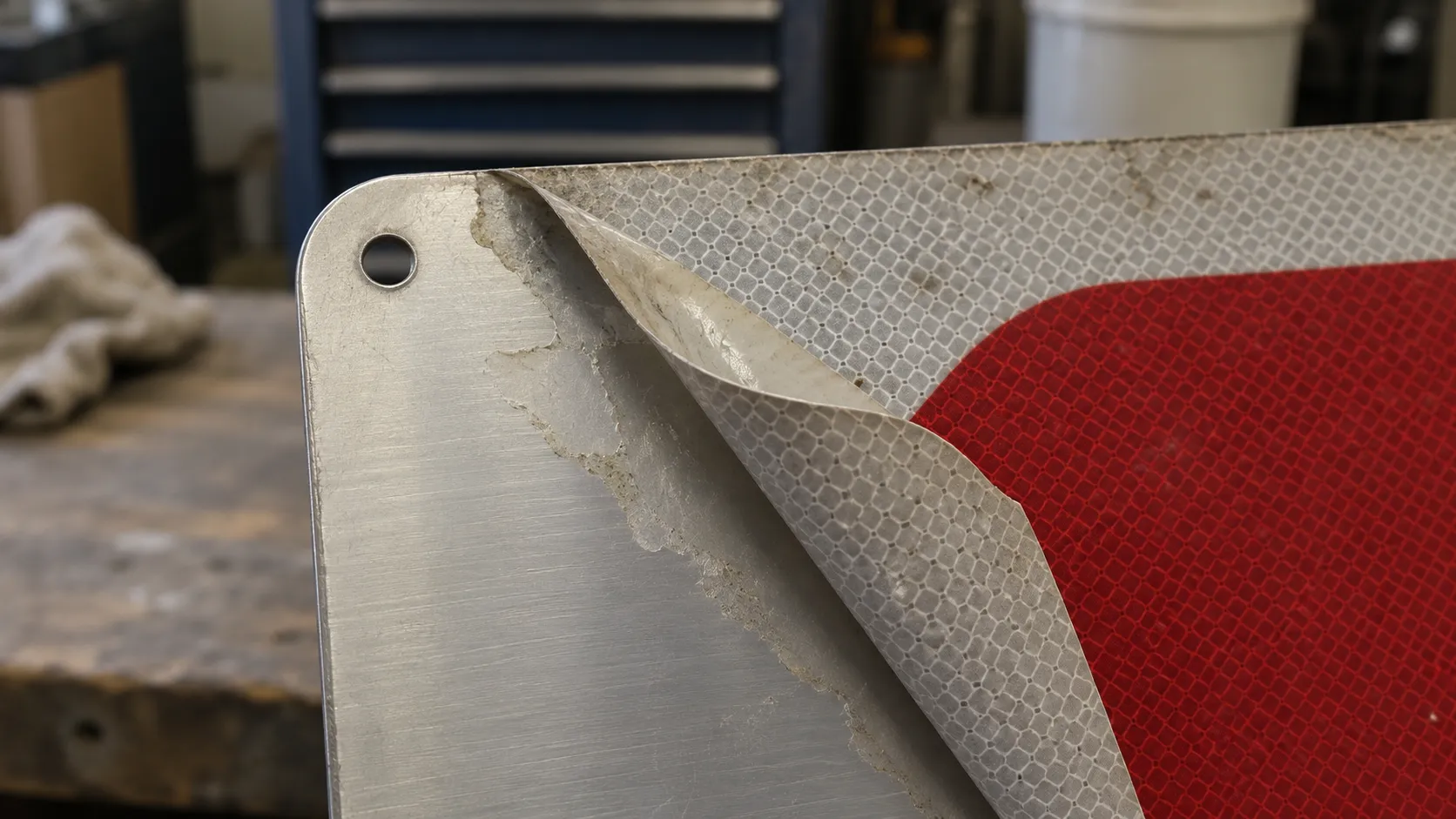
Once an edge has been loosened, peel the film at a slow, steady rate.
Fast pulling may cause an old reflective film to tear into small pieces.
That makes the job much slower.
Aged reflective sheeting can become brittle, especially after long outdoor exposure. If the material starts breaking:
Slow down
Warm a smaller area
Work section by section
Keep the pulling force even
Do not try to remove an entire large sign face in one aggressive pull.
The best removal angle can also vary by product. Manufacturer instructions should take priority rather than using one angle for every reflective film. 3M specifically notes that removal angle and speed can affect tearing and adhesive transfer.
Avoid Scratching the Aluminum
The goal is to remove the reflective film without creating a new problem on the aluminum panel.
Avoid aggressively scraping the surface with sharp metal tools.
A deep scratch, gouge or burr may later become visible underneath the new reflective sheeting or interfere with adhesion.
Where mechanical help is needed, use tools suitable for the substrate and work carefully around:
Corners
Mounting holes
Panel edges
After removal, run your hand visually and carefully over the panel and check that no sharp areas remain.
What About Adhesive Residue?
It is normal for some old adhesive to remain after film removal.
The amount depends on:
Adhesive type
Age
Outdoor exposure
Removal temperature
Removal speed
Aluminum surface
Previous printing or coatings
Do not apply new reflective sheeting directly over heavy adhesive residue.
The surface should first be cleaned according to the new film manufacturer's substrate-preparation requirements.
For difficult residue, use an adhesive remover that is compatible with the aluminum or its coating.
Always test it on a small area first.
ORAFOL, for example, notes that some removable products may leave residue that can be treated with an appropriate cleaner, while permanent films may require stronger removal work and are not guaranteed to remove cleanly.
Clean the Panel After Removal
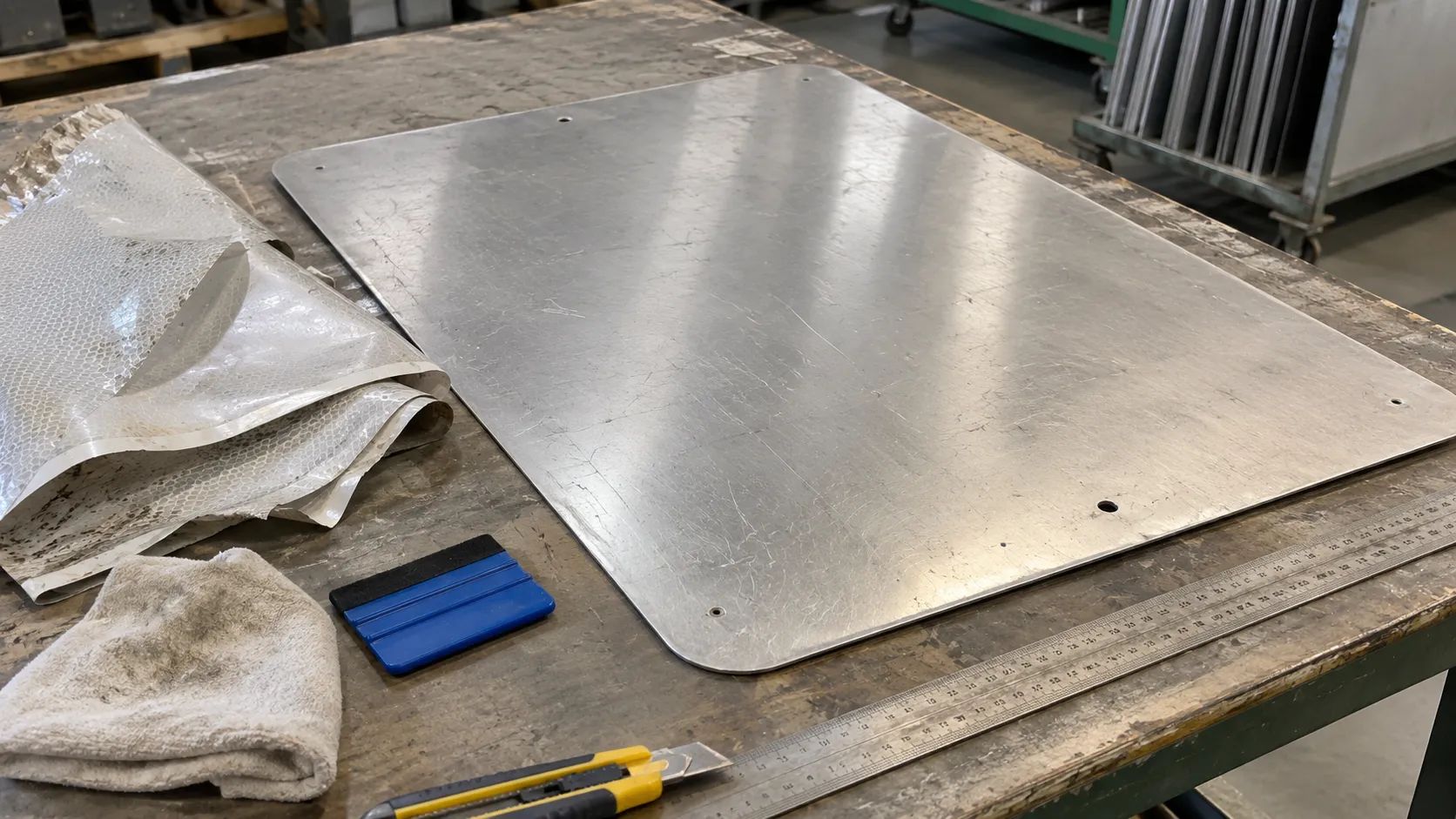
Once the old film and adhesive are gone, the panel still needs preparation.
The final surface should be:
clean, dry, smooth and free from contamination
Check carefully for:
Adhesive traces
Oil
Dust
Cleaning residue
Oxidation
Small film fragments
Do not rush directly from removal to laminating the new sheeting.
A clean-looking panel may still contain residue that affects the new adhesive.
Inspect the Aluminum Again
After the old film is removed, problems that were hidden underneath may become visible.
Check for:
Corrosion under the old film
Scratches
Bent areas
Damaged edges
Enlarged mounting holes
Uneven surface areas
Minor marks may be acceptable if the surface remains smooth and suitable for application.
If the panel is badly corroded or distorted, replacing it may be more reliable than trying to reuse it.
Before Applying New Reflective Sheeting
Do one final check.
The panel should be:
Flat
Clean
Dry
Smooth
Free from old adhesive
Free from loose oxidation
Compatible with the new adhesive
If you are using a new reflective sheeting product for the first time, a small adhesion test is useful before processing many reused panels.
The fact that the old material bonded successfully does not automatically mean the new adhesive system will behave exactly the same way.
Quick Refurbishment Checklist
Check | Before New Sheeting |
|---|---|
Old reflective film | Completely removed |
Adhesive residue | Removed |
Aluminum | Flat and stable |
Corrosion | No serious corrosion |
Surface | Clean and dry |
Edges | Smooth, no sharp burrs |
New material | Compatible with aluminum |
Test | Small adhesion test if needed |
FAQ
Can I use a heat gun to remove reflective sheeting?
Heat can help with many films, but the correct temperature and method depend on the product and substrate. Use controlled heat and follow the manufacturer's removal instructions.
Why does old reflective sheeting break into small pieces?
Long-term sunlight and weather exposure can make the face film more brittle. Cold conditions can also make some films harder to remove cleanly.
Can I reuse the aluminum after removing the old film?
Yes, if the panel remains flat, structurally sound and can be properly cleaned and prepared.
Final Thoughts
Removing old reflective sheeting is usually more about patience than force.
A slow process generally works better:
warm if appropriate → peel steadily → remove adhesive → clean the panel → inspect again
If the aluminum is still in good condition, it may be reused for a new reflective sign.
But the new sheeting should always be applied to a properly prepared substrate—not over dirt, adhesive residue or damaged old film.
RELATED NEWS

Sun, Sand and a 50°C Container: Getting Reflective Sheeting Through a Hot Climate
In hot regions, reflective sheeting can start ageing before it reaches the sign shop. UV, heat, dust and humidity each attack a different part of the product, and each needs its own defence.Picture a distributor in a hot coastal city who receives a container of prismatic sheeting in midsummer. It si
