


Choosing between PET, PVC, and acrylic reflective sheeting is not simply a question of which material is “best.” Each material behaves differently during printing, cutting, installation, and outdoor exposure.
A film that performs well on a flat aluminum sign may be difficult to apply to a curved vehicle panel. A material that accepts UV ink may not be the best option for eco-solvent printing. A film that resists tearing may not be suitable for embossing or stamping.
The right choice depends on five practical factors: your printer and ink, the application surface, the required converting process, the expected service environment, and whether the finished sign must meet a regulated traffic or identification standard.
This guide compares PET, PVC, and acrylic reflective sheeting from a sign manufacturer’s point of view so that you can select the correct material before production begins.
Quick Answer: Should You Choose PET, PVC, or Acrylic Reflective Sheeting?
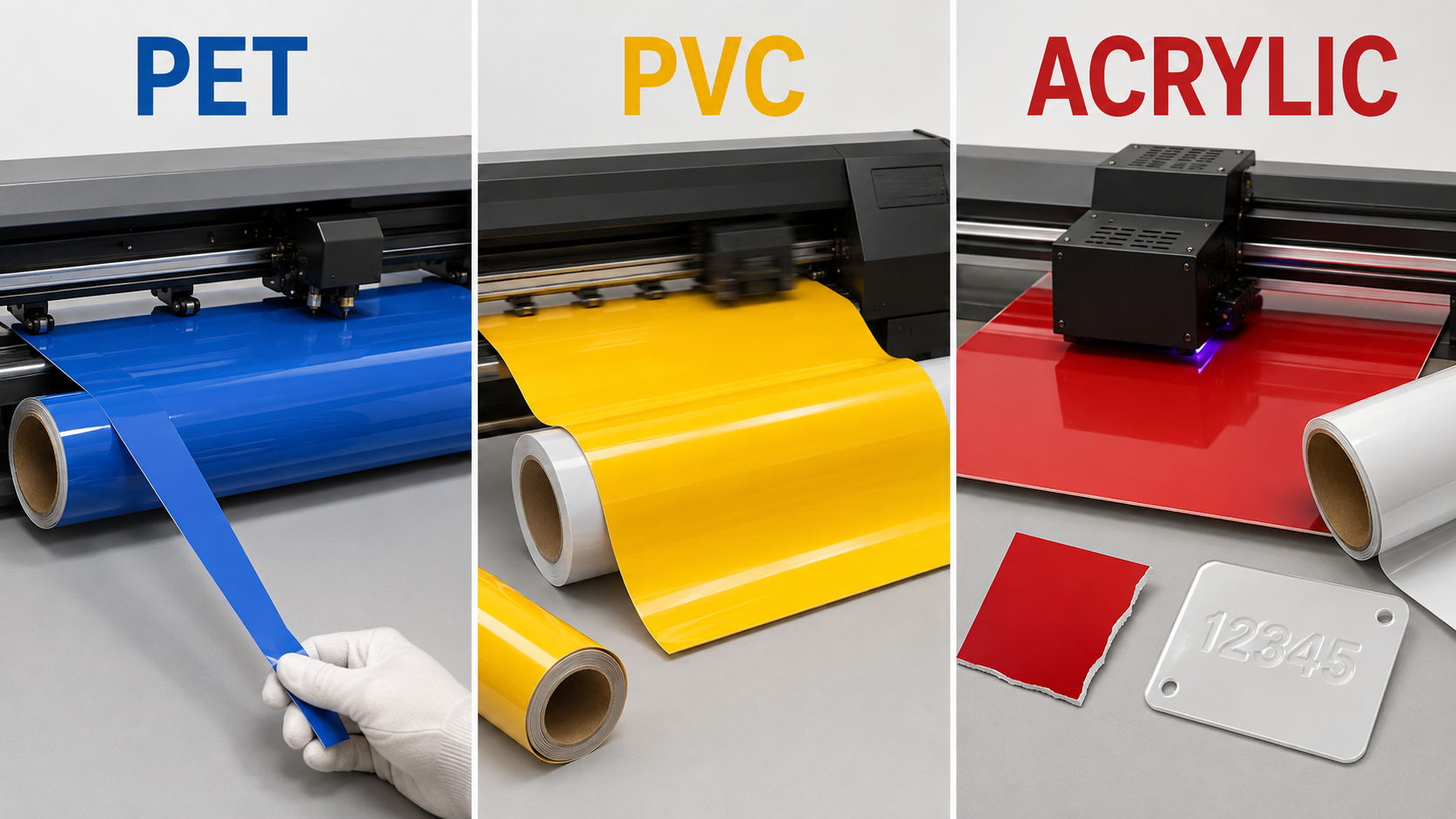
Choose PVC reflective sheeting for eco-solvent, solvent, or compatible latex printing and for signs or graphics that require flexibility.
Choose PET reflective sheeting for flat panels, plotter cutting, screen printing, and projects that need dimensional stability and tear resistance.
Choose acrylic reflective sheeting for compatible UV or screen printing, better weather resistance, and specialized applications such as stamped or embossed identification products.
These are general selection rules, not universal guarantees. The printable topcoat, reflective construction, adhesive, ink formulation, and finished-product standard must also be verified.
PET vs PVC vs Acrylic Reflective Sheeting at a Glance
Selection factor | PVC reflective sheeting | PET reflective sheeting | Acrylic reflective sheeting |
|---|---|---|---|
Material character | Soft and flexible | Semi-rigid and dimensionally stable | Weather-resistant, processable PMMA film |
Tear behavior | Flexible; tear behavior depends on formulation | Strong tear resistance | Easier to tear or fracture than PET |
Best surface shape | Flat surfaces and simple curves | Flat, rigid panels | Mainly flat or gently formed surfaces; product-specific |
Typical printing route | Eco-solvent, solvent, compatible latex | Screen printing and heat transfer | UV printing and screen printing |
Plotter cutting | Good | Excellent stability | Good with correct settings |
Punching or embossing | Limited and product-specific | Generally not the first choice | Suitable grades can support punching or embossing |
Dimensional stability | Lower than PET | High | Good |
General weather resistance | Suitable for commercial and shorter-term outdoor graphics | Stable for suitable flat-sign applications | Generally the strongest of the three when correctly formulated |
Typical cost position | Mid-range | Economical | Premium |
Common applications | Printed advertising, reflective decals, storefront signs, vehicle graphics | Cut lettering, flat safety signs, screen-printed boards, industrial identification | UV-printed signs, screen-printed signs, license plate materials, premium outdoor applications |
Best overall for digital advertising printing: PVC. Ablaze PVC Reflective Vinyl
Best for flat signs and plotter cutting: PET. Ablaze PET Reflective Sheeting
Best for UV printing and weather resistance: Acrylic, when supplied as a UV-printable grade. Ablaze Acrylic Reflective Sheeting
What Do PET, PVC, and Acrylic Mean in Reflective Sheeting?
PET, PVC, and acrylic describe important polymer components in the face or supporting structure of reflective sheeting.
They affect flexibility, tear resistance, dimensional stability, surface energy, print compatibility, and weathering. However, the polymer name alone does not describe the complete product.
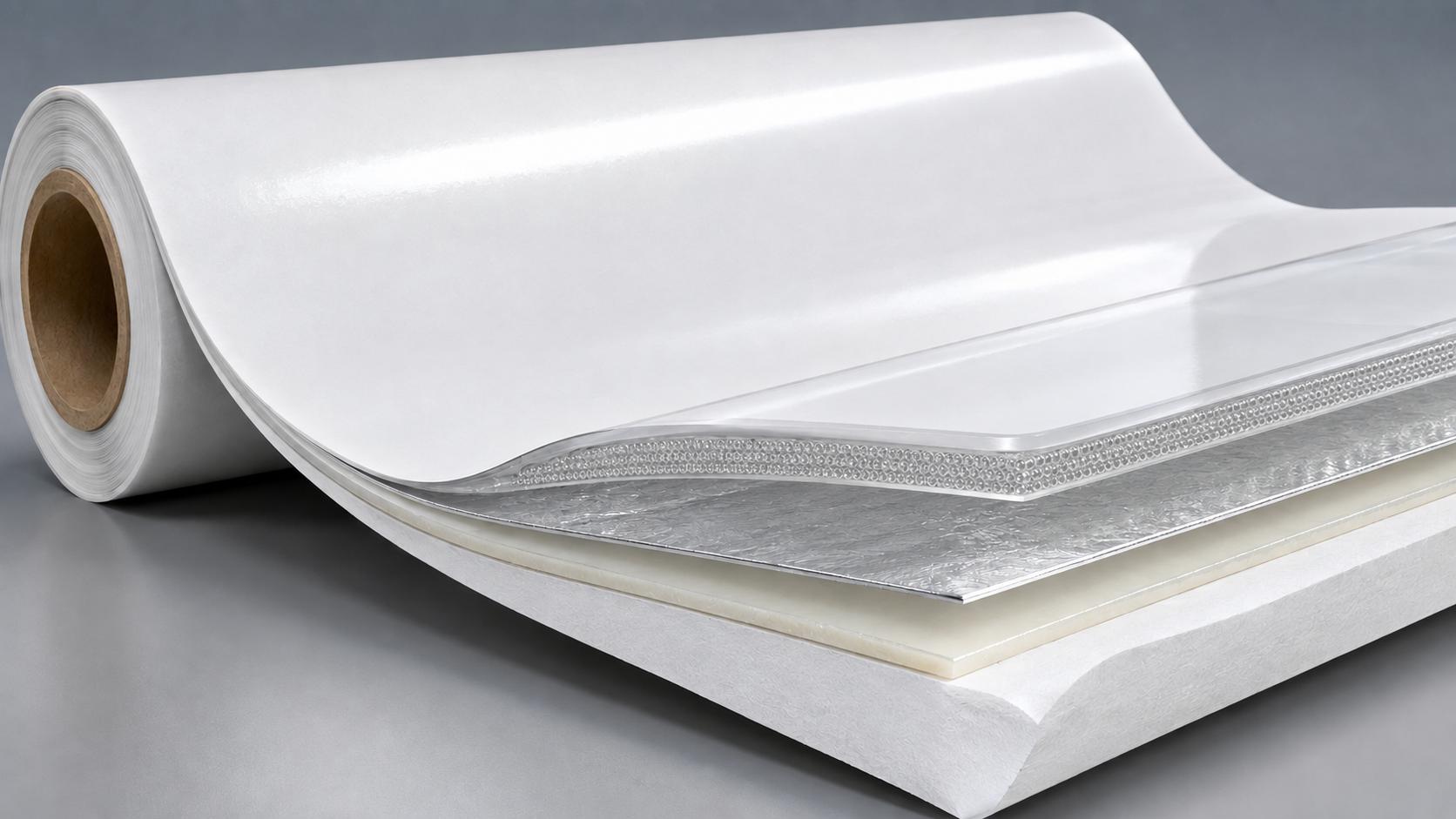
Reflective Sheeting Is a Multilayer System
A typical self-adhesive reflective sheeting includes:
A surface film or printable coating
A glass bead or microprismatic optical layer
A bonding, sealing, or reflective layer
A pressure-sensitive adhesive
A release liner
Some commercial products use a combined construction, such as a PET support with a printable PVC or acrylic surface. This is why two suppliers can both call a product “PET reflective sheeting” while recommending different printing methods.
When comparing quotations, ask the supplier to identify the face material, reflective technology, printable treatment, adhesive type, liner, total thickness, and approved printing methods.
Do not make a purchasing decision from the material name alone.
The Material Name Does Not Define the Reflective Grade
PVC, PET, and acrylic are not the same as commercial grade, engineering grade, High Intensity Prismatic, or Diamond Grade. Material construction and reflective performance are related, but they are separate specifications.
For example, a PET film can be used in an economical glass-bead product or in a prismatic construction. Acrylic can be used in commercial glass-bead sheeting, engineering-grade products, high-intensity prismatic sheeting, or dedicated license plate film.
The required coefficient of retroreflection must therefore be confirmed separately from the face material.
Five Questions to Answer Before Selecting a Material
Before comparing price per roll, answer these five questions:
How will the material be printed or converted? Identify the printer, ink type, screen ink, heat-transfer system, plotter, die-cutting method, or embossing process.
Where will it be applied? A flat aluminum panel, plastic warning device, storefront board, or vehicle curve requires different handling and adhesive behavior.
How long must the finished product remain in service? Temporary advertising and regulated traffic signs have very different durability requirements.
What environment will it face? Consider ultraviolet exposure, heat, cold, rain, humidity, salt, chemicals, cleaning, and abrasion.
Does the finished product need to meet a standard? Traffic signs, vehicle markings, and license plates may require specific retroreflective values, colors, durability, or approved system components.
If any one of these answers is unclear, sample testing is more valuable than a general statement that a film is “printable” or “outdoor grade.”
PVC Reflective Sheeting: Best for Printable Graphics and Curved Surfaces
PVC reflective sheeting, often called reflective vinyl, is the most practical choice for many commercial printing and advertising projects.
Its flexibility makes it easier to handle on large-format printers and to apply to flat surfaces or simple curves.
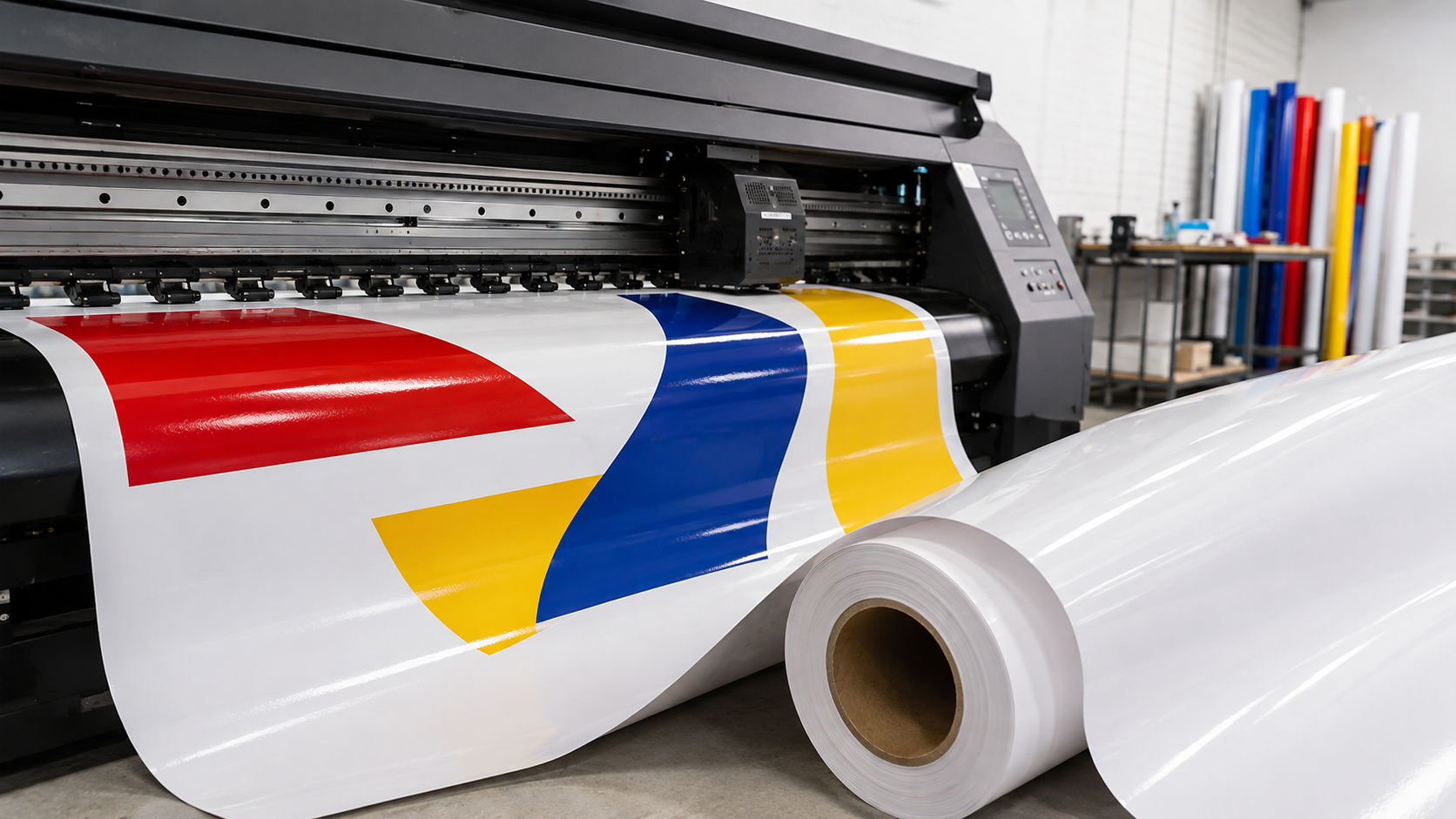
Advantages of PVC Reflective Vinyl
Flexible and easy to handle during printing and installation
Well suited to large-format commercial graphics
Good compatibility with eco-solvent and solvent printing when the correct printable surface is supplied
Compatible with selected latex systems when qualified by the manufacturer
Easier to apply to simple curves than semi-rigid PET
Competitive balance of printability, processing, and price
Suitable for short- to medium-term commercial signage
Typical applications include reflective advertising signs, retail storefront graphics, promotional boards, safety decals, construction communication signs, and commercial vehicle graphics.
Best Printing Methods for PVC Reflective Sheeting
Printable PVC reflective vinyl is commonly selected for:
Eco-solvent inkjet printing
Solvent inkjet printing
Compatible latex printing
Screen printing with an approved ink system
Printer profiles, heater settings, ink limits, curing time, and lamination must be tested because reflective media does not reproduce color in exactly the same way as ordinary white vinyl.
Heavy ink coverage can reduce nighttime reflection, and excessive heat can affect film flatness or the optical layer.
For a purpose-built commercial option, see ABLAZE PVC Reflective Vinyl for Printing and Signage.
Limitations of PVC Reflective Sheeting
PVC generally has lower dimensional stability than PET and may shrink or deform more under heat and long outdoor exposure.
It is not automatically suitable for full vehicle wraps or deep compound curves. Reflective constructions are typically thicker and less conformable than ordinary wrap vinyl.
UV inkjet compatibility should not be assumed. Some UV inks cure as a relatively rigid surface layer. When the finished graphic is bent, cut, or applied to a curve, the ink can crack or lose adhesion if the PVC surface and UV ink system were not designed to work together.
Choose PVC when printing flexibility and commercial efficiency are the main priorities, but use a product-specific technical data sheet rather than treating every PVC reflective film as interchangeable.
PET Reflective Sheeting: Best for Flat Signs, Cutting, and Screen Printing
PET is a polyester film with higher stiffness and dimensional stability than flexible PVC.
In reflective sheeting, that stability is valuable for flat sign manufacturing, plotter cutting, screen printing, and industrial identification.
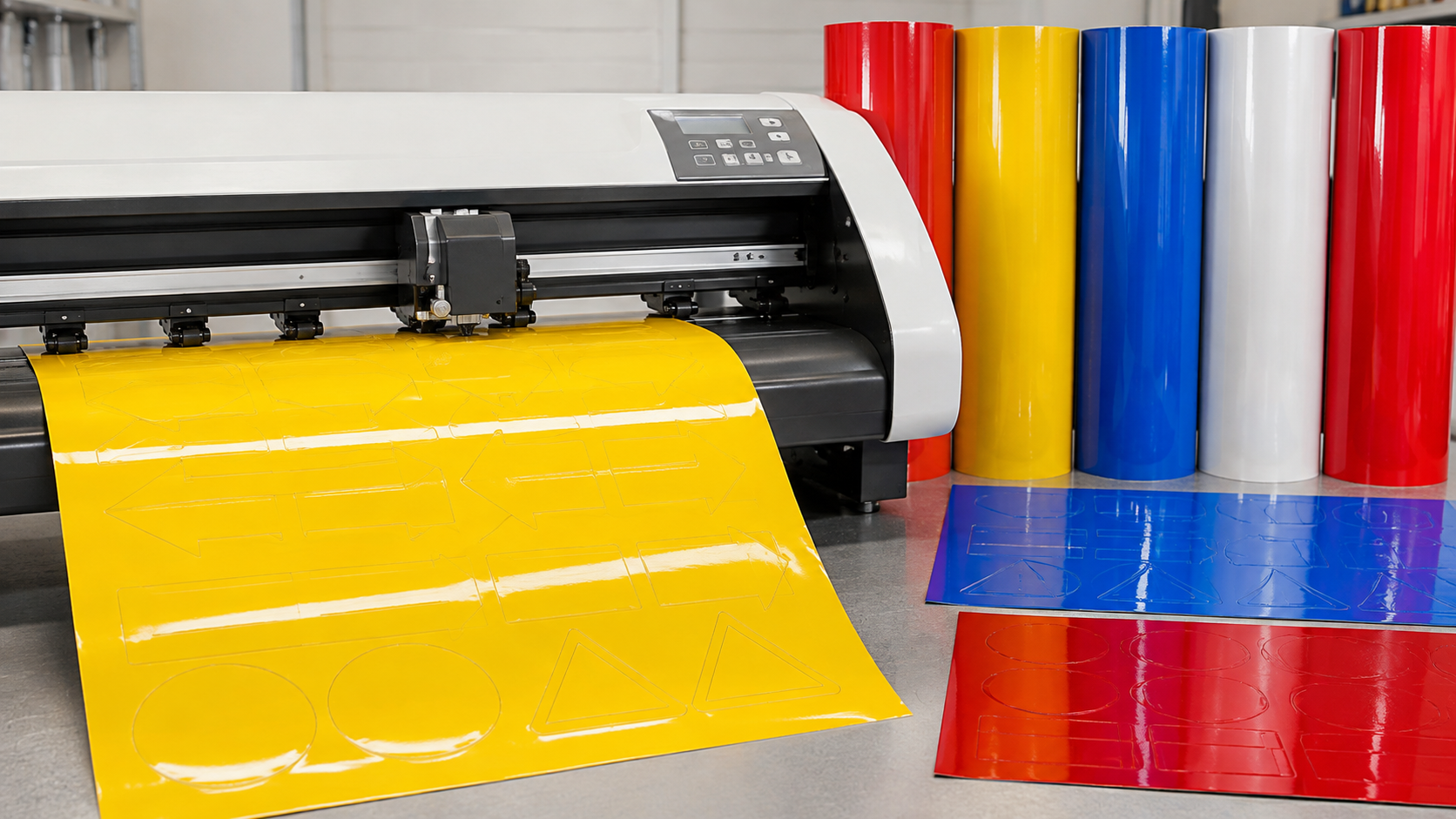
Advantages of PET Reflective Sheeting
Strong resistance to tearing
Stable dimensions during cutting and handling
Clean plotter-cut edges for letters, symbols, and warning graphics
Good flatness on rigid sign panels
Efficient option for commercial safety signage
Suitable for screen printing or heat-transfer systems when the surface is prepared for those processes
PET reflective sheeting is commonly used for cut graphics, flat safety boards, warning signs, temporary traffic communication, industrial labels, and commercial signage installed on clean rigid substrates.
Best Printing Methods for PET Reflective Sheeting
Standard PET glass-bead reflective sheeting is commonly recommended for:
Screen printing with compatible ink
Heat-transfer printing
Plotter cutting
Die cutting for flat labels or symbols, subject to product construction
Its semi-rigid structure helps maintain registration and flatness during repetitive production.
For projects using screen-printed spot colors, cut lettering, or standardized warning symbols, PET can offer an efficient combination of processing stability and cost.
See ABLAZE PET Glass Bead Reflective Sheeting for Signage and Printing for a PET product designed around flat-sign converting.
Why Standard PET Is Not Automatically UV Printable
Untreated PET can have low surface energy, which makes it difficult for some inks to form a durable bond.
UV ink may appear dry immediately after curing but still fail an adhesion test after 24 to 72 hours. Excessive curing heat can also affect the reflective construction and reduce brightness.
This does not mean that no PET reflective sheeting can be digitally printed. It means the exact product must have a qualified printable treatment or topcoat, and the supplier must approve the printer and ink route.
If the technical data sheet lists only screen printing, heat transfer, or cutting, do not assume that UV, solvent, eco-solvent, or latex ink will perform reliably.
Limitations of PET Reflective Sheeting
PET is less conformable than PVC, so it is not the preferred choice for curved vehicle panels or irregular substrates.
Strong tear resistance is useful for cutting and flat signs, but it can be a disadvantage where the manufacturing process requires controlled tearing, stamping, or embossing.
PET weatherability also depends heavily on its UV stabilization, top layer, optical construction, adhesive, and installation environment.
A PET label alone is not proof of a particular outdoor life or traffic-sign classification.
Acrylic Reflective Sheeting: Best for Weather Resistance, UV Printing, and Specialized Processing
Acrylic reflective sheeting uses PMMA or an acrylic surface construction.
It is generally selected when weather resistance, optical stability, UV printing, screen printing, or specialized converting is more important than the lowest initial material cost.
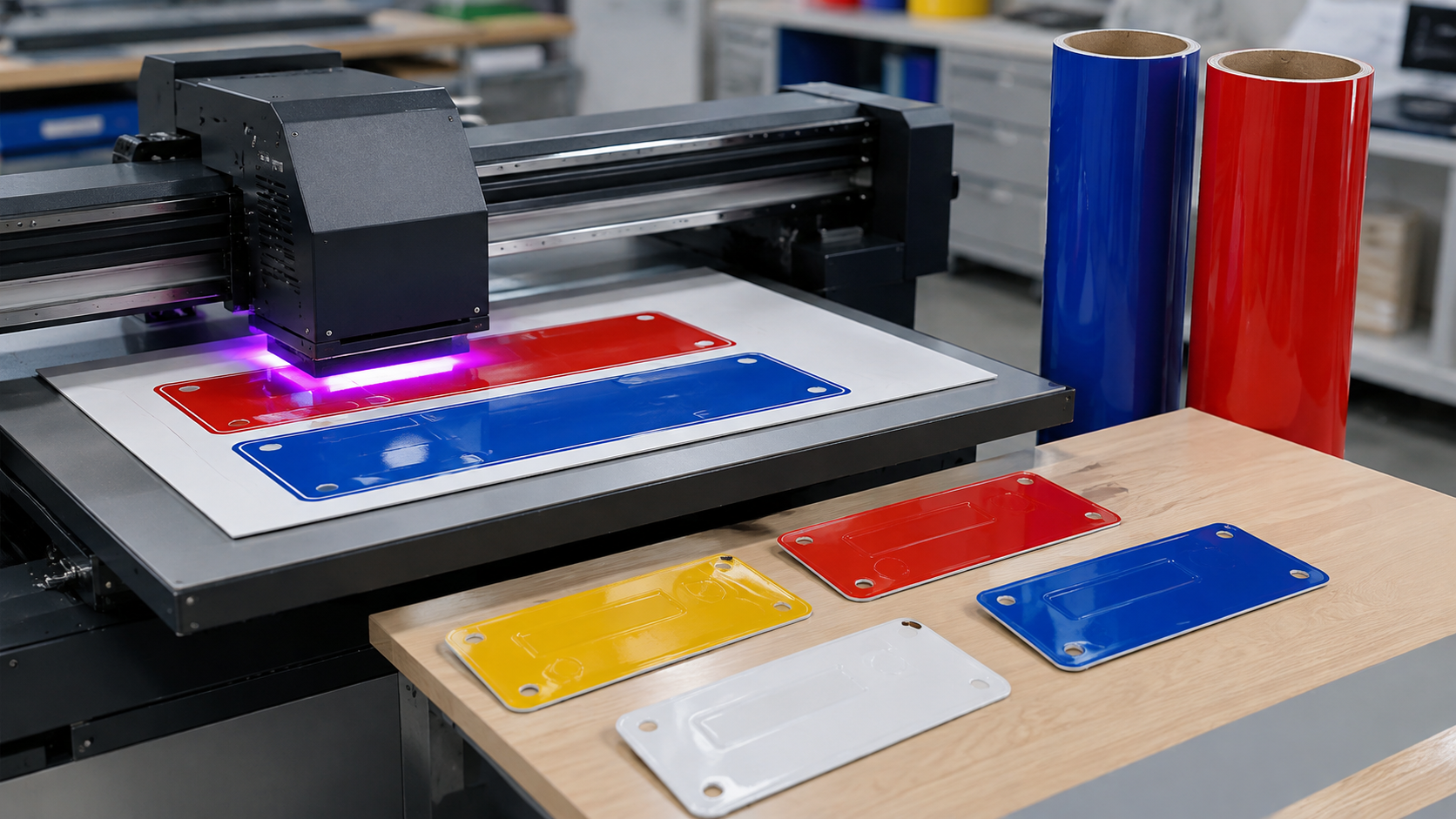
Advantages of Acrylic Reflective Sheeting
Strong resistance to ultraviolet exposure and outdoor weathering
Good optical clarity and color stability
Compatible with UV printing when supplied with the correct surface construction
Suitable for screen printing with approved inks
Good dimensional stability on appropriate substrates
Suitable grades can support punching, stamping, or embossing
Useful for premium commercial signs and identification systems
Typical applications include UV-printed reflective signs, screen-printed outdoor signs, motorcycle or e-bike identification plates, house-number signs, license plate materials, and other products requiring good weatherability and controlled converting behavior.
For commercial UV and screen-printing applications, see ABLAZE Acrylic Glass Bead Reflective Sheeting.
Best Printing Methods for Acrylic Reflective Sheeting
Acrylic reflective sheeting is commonly selected for:
UV inkjet printing on an approved printable grade
Screen printing
Specialized thermal or transfer systems when specifically qualified
Punching, stamping, or embossing with process-matched grades
UV printing is often chosen because cured ink can form a sharp, detailed image on a suitable acrylic surface.
However, lamp power, carriage speed, ink thickness, and surface treatment still need to be tested. “Acrylic” is not a substitute for a printer compatibility statement.
Limitations of Acrylic Reflective Sheeting
Acrylic reflective film is generally more expensive than commercial PET or PVC products.
It is also easier to tear or fracture than PET and is less suitable than PVC for applications that require high conformability over complex curves.
Not every acrylic reflective sheet is suitable for license plates or regulated traffic signs. Those applications require a dedicated product whose reflective values, color, adhesive, processing performance, and durability match the applicable national or project standard.
Printing Compatibility: Eco-Solvent, Solvent, Latex, UV, Screen, and Heat Transfer
The following matrix is a practical starting point for ABLAZE commercial glass-bead product selection.
Always confirm the exact product code and run a sample with your own printer and ink.
Production method | PVC reflective sheeting | Standard PET reflective sheeting | UV-printable acrylic reflective sheeting |
|---|---|---|---|
Eco-solvent inkjet | Recommended for printable grades | Not recommended unless specially top-coated | Product-specific; not the default choice |
Solvent inkjet | Recommended for printable grades | Not recommended unless approved | Product-specific |
Latex inkjet | Compatible grades only | Not recommended unless approved | Product-specific |
UV inkjet | Use only if specifically approved | Standard untreated PET is not recommended | Recommended for approved UV-printable grades |
Screen printing | Compatible ink and surface required | Recommended | Recommended |
Heat transfer | Product-specific | Commonly suitable | Product-specific |
Plotter cutting | Good | Excellent | Good with correct blade settings |
Punching or embossing | Product-specific | Usually not preferred | Suitable product grades available |
Why Surface Treatment Matters More Than the Resin Name
Ink bonds to the outermost surface, not to the material name printed on a carton.
Corona treatment, primer, ink-receptive coating, surface energy, contamination, storage conditions, and aging can all change print performance.
This is why one PVC reflective product may print cleanly with eco-solvent ink while another does not, or why one acrylic grade accepts UV ink while an untreated grade fails.
Product compatibility must be defined at the product-code level.
Why Ink Can Peel from Reflective Sheeting
Common causes include:
The film was designed for cutting rather than printing
Surface energy is too low for the ink
Dust, oil, moisture, or silicone contaminated the face
Ink limits are too high
UV curing is too strong or too weak
The print was laminated before the ink fully cured or outgassed
The ink and laminate have different flexibility from the reflective film
The finished graphic was bent beyond the approved surface geometry
Test adhesion after the full curing period, not only immediately after the material leaves the printer.
For a broader explanation of printable constructions and digital print processes, read our Printable Reflective Sheeting for Digital Printing Buying Guide.
Which Reflective Sheeting Is Best for Each Signage Application?
Printed Advertising and Storefront Signs
For full-color graphics printed with eco-solvent or solvent equipment, PVC reflective vinyl is usually the most practical option.
It combines printability, flexibility, and commercial pricing.
Acrylic becomes attractive when the shop uses a qualified UV printer and the project requires better weather resistance. PET is better suited to cut or screen-printed graphics than to ordinary full-color digital printing.
Vehicle Graphics and Fleet Markings
PVC is generally the first material to evaluate for flat vehicle sides and simple curves.
However, reflective vinyl is not automatically a wrap film. Confirm the approved curve, rivet, corrugation, application temperature, laminate, and removal requirements.
For emergency fleets or regulated vehicle markings, use a dedicated vehicle-grade reflective system.
The correct product must satisfy the applicable marking standard and should be tested as a complete combination of film, ink, laminate, and adhesive.
Flat Safety Signs and Industrial Labels
PET is a strong candidate for flat panels, cut symbols, and screen-printed warning messages because it remains stable during converting and resists tearing.
PVC is useful when flexible installation is more important, while acrylic is preferred when weatherability or UV printing drives the specification.
Traffic Signs and Regulated Road Projects
Do not choose traffic-sign sheeting by PET, PVC, or acrylic alone.
Start with the required reflective grade and local standard, then confirm the approved imaging method, substrate, adhesive, orientation, and warranty system.
ASTM D4956, for example, covers retroreflective sheeting used for traffic control signs but does not itself specify the inks, overlays, or imaging methods used to create the finished sign.
Project buyers must therefore verify both the sheeting performance and the complete sign-making system.
For flat aluminum panels and medium-term road-safety applications, an engineering-grade PET reflective sheeting may be appropriate.
Higher-speed or higher-risk roads may require High Intensity Prismatic or Diamond Grade products rather than a commercial glass-bead film.
License Plates and Embossed Identification Products
Acrylic reflective constructions are commonly used for license plate film because suitable grades can combine weather resistance, retroreflection, printing, stamping, and embossing performance.
However, ordinary advertising-grade acrylic is not a license plate material.
License plate projects should specify the relevant national standard, substrate metal, embossing depth, printing or hot-stamping process, reflective color, security requirements, and plate life.
See ABLAZE Reflective Sheeting for License Plates for a dedicated material system.
Material, Reflective Technology, and Grade Are Different Decisions
One of the most common purchasing mistakes is treating the face polymer as the main indicator of nighttime brightness. It is not.
Retroreflective performance depends primarily on the optical construction, including the type and arrangement of glass beads or microprisms, the reflective or air-backed layer, observation angle, entrance angle, color, and manufacturing consistency.
Glass Bead vs Microprismatic Technology
Glass-bead reflective sheeting uses microscopic glass spheres to return light toward its source.
It is widely used in commercial advertising, engineering-grade signs, industrial safety markings, and economical reflective graphics.
Microprismatic reflective sheeting uses engineered prism cells.
It can provide higher brightness and different angular performance, making it suitable for demanding traffic signs and high-visibility safety applications.
Acrylic is frequently used in higher-performance prismatic products, but the word “acrylic” alone does not guarantee a specific ASTM type, brightness, or service life.
Why the Brightest Material Is Not Always the Right Material
Higher reflectivity can improve nighttime visibility, but it may also add cost without solving the project’s main production requirement.
A digitally printed storefront sign may benefit more from reliable ink adhesion and correct color density than from a highway-grade optical system.
Conversely, a regulated road sign cannot be downgraded to commercial reflective vinyl simply because the film prints well.
Select the required visibility class first for safety-critical work, then choose a material construction and imaging process that meet the production and installation needs.
Adhesive, Release Liner, and Laminate: Three Specifications Buyers Often Miss
The face film receives most of the attention, but three other components often determine whether the project succeeds.
Adhesive: Confirm whether the adhesive is permanent or removable, acrylic- or rubber-based, solvent- or water-based, and intended for aluminum, painted metal, plastic, or another substrate. Ask about initial tack, final bond, application temperature, and resistance to moisture or edge lifting.
Release liner: Liner weight and stability affect printing, plotter cutting, feeding, and curling. A stable PE-coated paper can improve large-format handling, while the release force must match the cutting and weeding process.
Laminate or clear coat: Printed outdoor graphics may require a matched protective layer for ultraviolet, abrasion, chemical, and washing resistance. The laminate must be optically suitable, flexible enough for the application, and approved for the selected ink and reflective film.
A mismatched laminate can cause curling, edge lift, cracking, or loss of warranty.
How to Test a Reflective Sheeting Sample Before Ordering
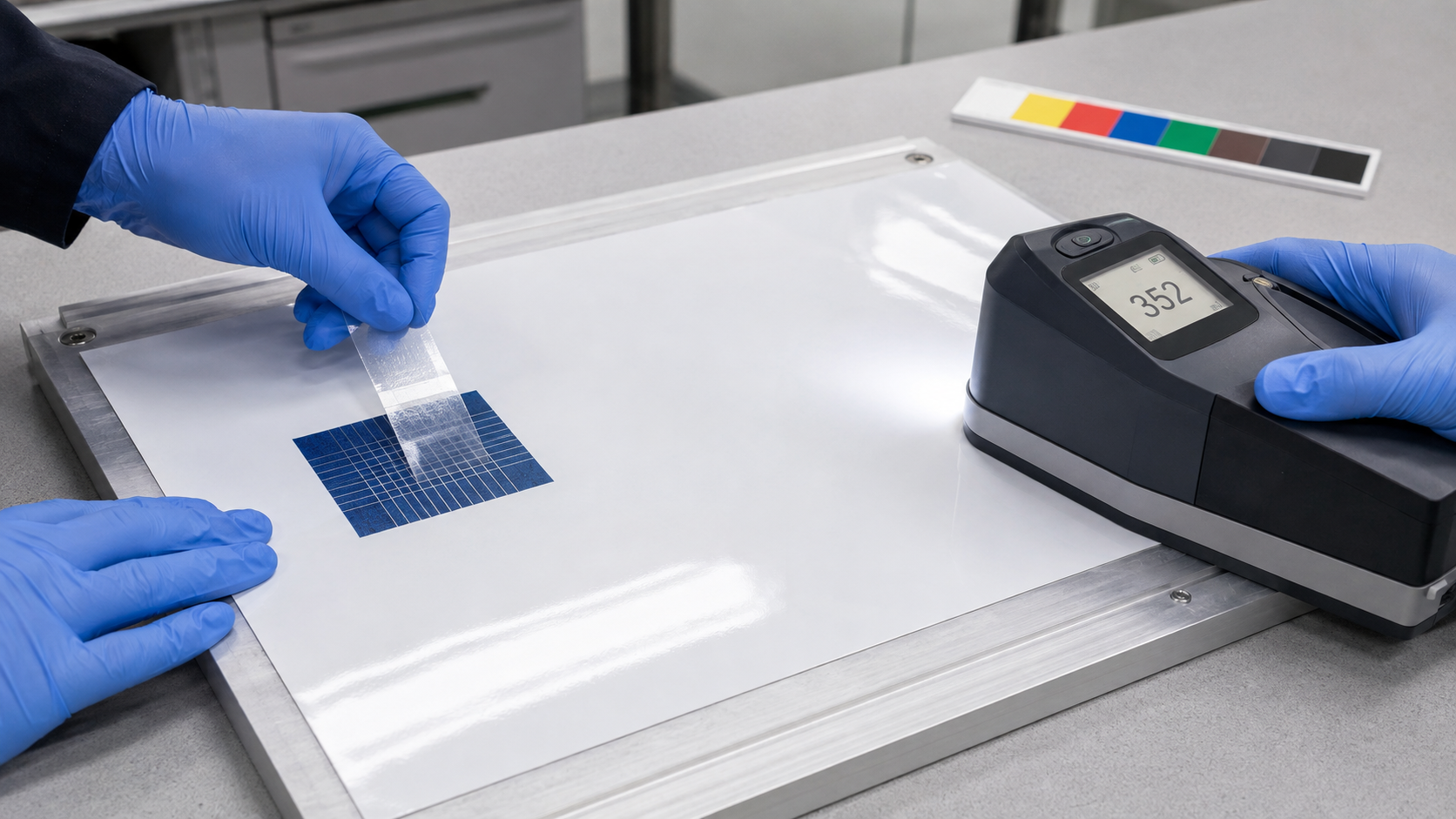
Use a sample from the same product code, color, width, and construction planned for the order. Then test it as a complete production system.
Print a representative file. Include solid colors, gradients, small text, heavy ink areas, and unprinted reflective areas.
Use normal production settings. Record the printer model, ink series, profile, heater or lamp settings, pass count, and production speed.
Allow full curing or outgassing. Follow the ink manufacturer’s recommended time before judging adhesion or laminating.
Check ink adhesion after 24 to 72 hours. Use a documented tape or cross-hatch method appropriate to your production control.
Inspect day and night appearance. Printed colors can look different under daylight and retroreflected headlight illumination.
Measure retroreflection if the project has a minimum requirement. Test the relevant observation and entrance angles, not only a single visual flashlight check.
Apply to the real substrate. Test aluminum, painted metal, plastic, or the intended vehicle panel after proper cleaning.
Evaluate converting. Cut, weed, transfer, bend, punch, emboss, or laminate exactly as production requires.
Run an environmental test. Where appropriate, expose the sample to water, heat, cold, cleaning chemicals, abrasion, or accelerated weathering.
Retain a control sample and settings. This makes future batch approval and troubleshooting much easier.
A passing print test is more meaningful than a generic “printable” claim because it reflects your actual printer, ink, climate, design, and production process.
Purchase Price vs Total Project Cost
PET often has the lowest initial cost in commercial reflective ranges, PVC provides a practical mid-range printing solution, and acrylic generally carries a higher price.
However, roll price is only one part of the project cost.
Calculate total cost using:
Printable area and expected waste
Printer speed and failed-print rate
Cutting, weeding, and transfer labor
Need for laminate or clear coat
Installation time
Risk of ink failure, shrinkage, cracking, or edge lift
Required replacement interval
Warranty or compliance exposure
A cheaper film that creates repeated ink-adhesion failures can cost more than a higher-priced product qualified for the printer.
A premium acrylic film may be unnecessary for a temporary promotion, while a low-cost PVC film may be a poor choice for a long-life identification system.
The best value is the lowest-cost material that reliably meets the complete performance specification.
Final Selection Guide: Choose PET, PVC, or Acrylic in 30 Seconds
Choose PVC reflective sheeting if:
You print with eco-solvent or solvent ink
You need full-color advertising graphics
The application includes flat surfaces or simple curves
Flexibility and production efficiency are priorities
The project is commercial rather than a regulated long-life traffic application
Choose PET reflective sheeting if:
The sign is flat and rigid
You need stable plotter cutting or screen printing
Tear resistance is important
You are producing cut lettering, safety signs, or industrial labels
You want an economical material for a compatible flat-sign process
Choose acrylic reflective sheeting if:
You use an approved UV or screen-printing system
Outdoor weather resistance is a major priority
The process includes punching, stamping, or embossing
You are producing premium outdoor signs or identification products
A dedicated acrylic construction is required for license plates or higher-performance applications
If the application is a regulated traffic sign, emergency vehicle marking, or license plate, start with the applicable standard—not the polymer name.
Information to Send Your Reflective Sheeting Supplier
To receive an accurate recommendation, provide:
Final application and country of use
Required standard or retroreflective value
Indoor or outdoor service environment
Flat, curved, corrugated, riveted, or embossed surface
Substrate material and coating
Printer brand and model
Ink brand and type
Required printing, cutting, punching, or stamping method
Laminate or clear-coat requirement
Expected service life
Roll width, length, color, and quantity
Packaging, private-label, and documentation requirements
This information allows the supplier to recommend a specific construction instead of guessing from a broad request such as “printable reflective film.”
Frequently Asked Questions
Which Is Better: PET, PVC, or Acrylic Reflective Sheeting?
PVC is generally better for commercial digital printing and simple curves, PET for flat signs, plotter cutting, and screen printing, and acrylic for approved UV printing, weather resistance, and specialized identification products.
The best material depends on the complete application rather than one property.
Is PET Reflective Sheeting Printable?
Yes, but the printing method must match the surface treatment.
Standard PET glass-bead reflective sheeting is commonly used for screen printing and heat transfer. Do not assume it is compatible with UV, solvent, eco-solvent, or latex printing unless the exact product is top-coated and approved for that ink system.
Can PVC Reflective Vinyl Be Printed with UV Ink?
Only if the specific PVC reflective product and UV ink system are approved together.
UV ink can form a rigid layer that may crack or peel when flexible PVC is bent. Eco-solvent or solvent printing is usually the more common route for commercial PVC reflective vinyl.
Why Does UV Ink Peel from PET Reflective Sheeting?
Common causes include low surface energy, lack of a printable topcoat, contamination, incorrect curing, and excessive heat.
The print can appear dry immediately but fail an adhesion test after 24 to 72 hours.
Is Acrylic Reflective Sheeting Always More Reflective Than PET or PVC?
No.
The polymer does not determine brightness by itself. Retroreflectivity depends on the glass-bead or microprismatic optical construction, color, grade, observation angle, entrance angle, and manufacturing quality.
Which Reflective Sheeting Is Best for Curved Surfaces?
PVC reflective vinyl is usually the best of the three for flat surfaces and simple curves because it is more flexible.
For compound curves, rivets, or corrugations, use a product specifically approved for vehicle graphics or conformable applications.
Which Material Should Be Used for Traffic Signs?
Choose traffic-sign sheeting according to the required standard, reflective grade, road environment, and approved imaging system.
PET, PVC, or acrylic alone does not establish compliance. Commercial advertising film should not be substituted for regulated road-sign material without approval.
Does Printed Reflective Sheeting Need Lamination?
It depends on the film, ink, expected outdoor life, and exposure to abrasion or chemicals.
Some printed systems require a matched overlaminate or clear coat, while others may be approved without one. Follow the technical data for the complete film-and-ink system.
Can the Same Reflective Film Be Used for Signage and License Plates?
Usually not.
License plate film is a specialized material designed for defined retroreflectivity, color, adhesion, printing, stamping or embossing, and durability requirements.
Ordinary advertising-grade reflective film should not be treated as a license plate product.
Conclusion
PET, PVC, and acrylic reflective sheeting solve different production problems.
PVC offers the most practical route for printable commercial graphics and simple curves.
PET provides dimensional stability, tear resistance, and efficient flat-sign converting.
Acrylic provides strong weatherability and supports qualified UV, screen-printing, and specialized identification processes.
The material name is only the first decision. Reflective technology, grade, topcoat, adhesive, liner, ink, laminate, substrate, and applicable standard must work as one system.
If you are unsure which material matches your project, send ABLAZE your printer model, ink type, application surface, required durability, standard, roll size, and order quantity.
Our technical team can recommend a suitable construction and arrange sample testing before bulk production.

