


Photoluminescent safety signs absorb light during normal conditions and release it as a visible glow when the surrounding light fails. They are widely used for emergency exits, escape routes, stairways, fire equipment, tunnels, factories and public facilities.
However, a statement such as “complies with ISO 16069,” “DIN 67510 tested” or “ISO Class C” is not enough to specify a product correctly. These standards address different parts of the safety-sign process, and none of them automatically proves legal approval in every country.
Quick Answer: What Is the Difference Between ISO 16069, ISO 17398 and DIN 67510?
ISO 16069:2017 covers the design and application of a safety way guidance system, including the selection, layout, installation and maintenance of its visual components.
ISO 17398:2004 provides a performance-related system for classifying safety signs, including their expected service environment, materials, photometric properties, fixing method, surface and durability.
DIN 67510-1:2020-05 defines the measurement, classification and producer marking of phosphorescent pigments and products.
In simple terms:
DIN 67510-1 helps describe how a photoluminescent material or product performs under a defined test.
ISO 17398 helps classify the performance and durability of a safety sign.
ISO 16069 helps turn suitable components into a correctly planned and maintained guidance system.
The three standards complement one another, but they are not interchangeable.
Photoluminescent Standards at a Glance
Standard | Current published edition or status* | Main question answered | Main level of application | What it does not prove by itself |
|---|---|---|---|---|
ISO 16069 | ISO 16069:2017; confirmed as current by ISO in 2023 | How should a visual safety way guidance system be planned, laid out, installed and maintained? | Installed guidance system | That one roll of film, one sign or one laboratory value makes the complete installation compliant |
ISO 17398 | ISO 17398:2004 remains the current published edition; a revision is under development | How should a safety sign’s performance, construction and durability be classified and specified? | Safety sign or finished sign product | Correct route design, local building-code approval or compliance of an entire installation |
DIN 67510-1 | DIN 67510-1:2020-05 is current | How should phosphorescent pigments and products be measured, classified and marked by the producer? | Pigment, material or phosphorescent product | ISO 16069 system compliance, approval under local law or performance of a different finished construction |
Standards are revised periodically. Always confirm the edition cited by the contract, local authority or project specification before purchasing or testing.
Why These Three Standards Are Related but Not Interchangeable
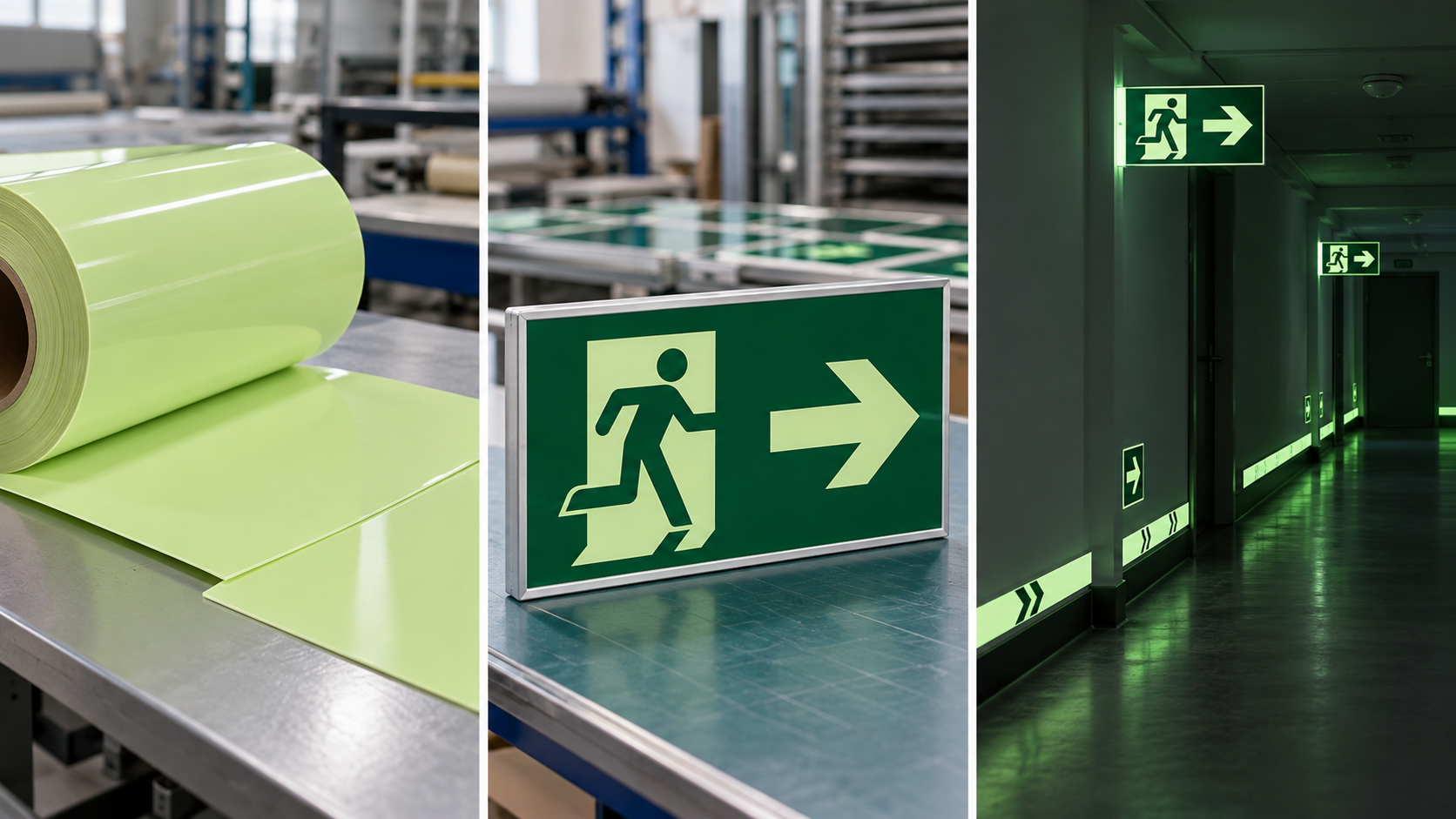
A photoluminescent escape route contains more than luminous film. It can include printed exit signs, directional arrows, door-frame markings, stair strips, handrail markers, obstacle markings and low-location guidance lines.
These components must receive enough light during normal operation, remain visible after a blackout and form a continuous, understandable escape route.
That creates three different questions:
How bright and durable is the material or finished sign?
Does the printed and assembled sign retain the required performance?
Has the complete system been designed and installed correctly for the building?
One test report rarely answers all three questions.
A high luminance result for unprinted film does not confirm the legibility of a heavily printed sign. A Class C sign does not confirm that arrows are placed correctly at every change of direction. A well-designed route does not compensate for material that receives insufficient charging light.
This is why buyers should identify the required standard, product construction, test conditions and system responsibility before approving a sample.
What Does ISO 16069 Cover?
ISO 16069:2017 is titled Graphical symbols — Safety signs — Safety way guidance systems (SWGS). It describes principles for the design and application of the visual components used to create a safety way guidance system.
The standard contains general principles for both electrically powered and phosphorescent components. It addresses subjects such as:
Environment of use
Selection of suitable components and materials
System layout and continuity
Installation
Inspection and maintenance
Performance under the intended lighting conditions
ISO 16069 Applies to a Complete Safety Way Guidance System
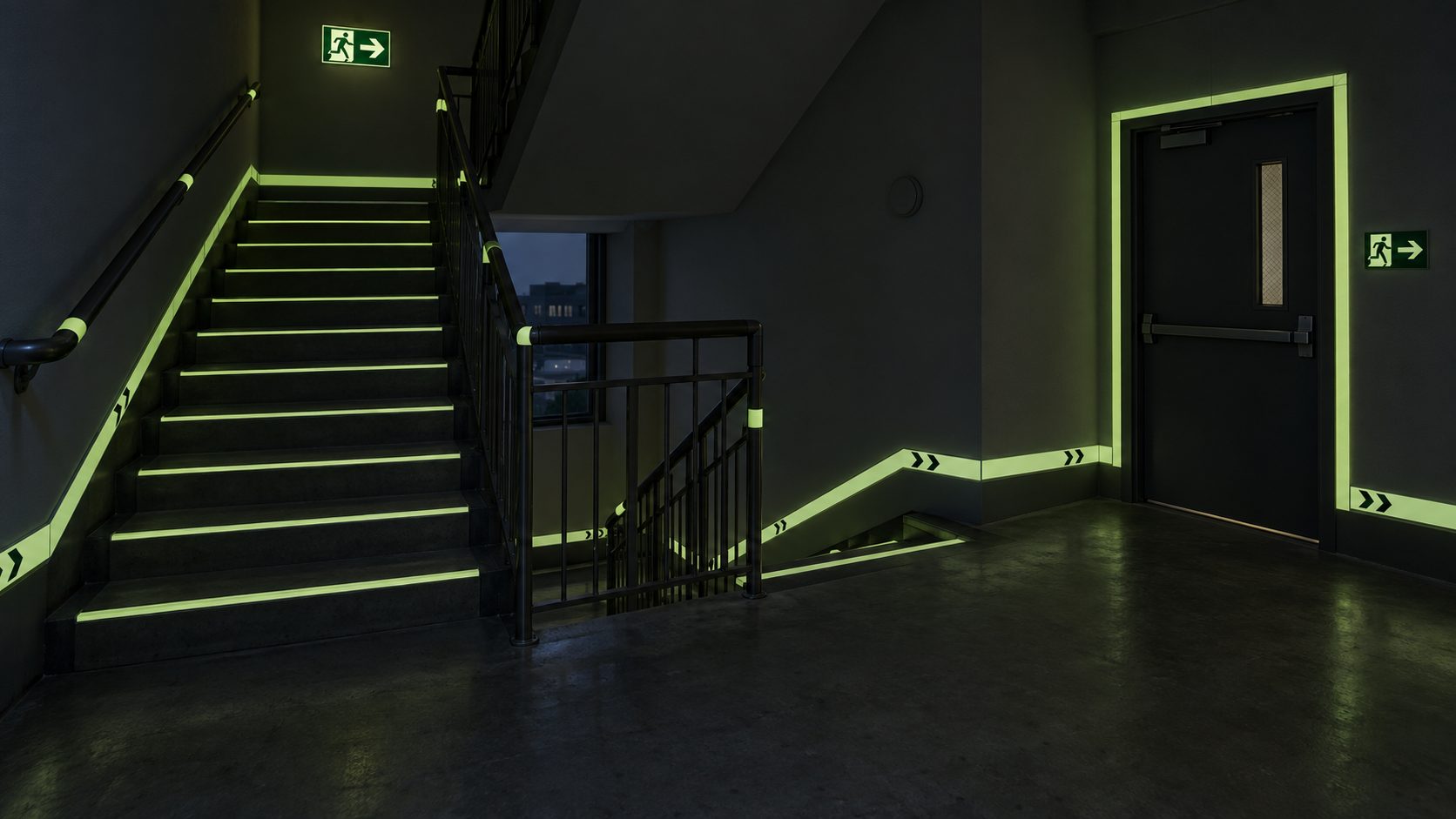
The important word is system.
A safety way guidance system should help occupants identify and follow a safe route when normal visual conditions are disrupted.
In practice, the specification may need to address:
Route direction and changes of direction
Exits and final exits
Stairs, landings, ramps and level changes
Door frames and opening mechanisms
Obstacles and hazards
Fire-fighting and emergency equipment locations
High-location and low-location visual information where required
Continuity of guidance along the escape route
Inspection and replacement procedures
A bright photoluminescent sign installed in the wrong position does not create an effective guidance system. Likewise, a correctly positioned sign may fail during a blackout if the local lighting never charges it adequately.
For an overview of system applications, see ABLAZE’s photoluminescent emergency and evacuation guidance solutions.
What ISO 16069 Does Not Prove
ISO states that ISO 16069 does not perform a project’s risk assessment. Different buildings, occupant profiles and hazards can require different system layouts. The final design remains the responsibility of the people appointed to assess and design the project.
The standard also does not, by itself:
Certify a raw roll of photoluminescent film
Replace local fire or building regulations
Approve the finished installation for every jurisdiction
Cover tactile or audible guidance components
Cover high-mounted emergency escape route lighting as a lighting-system design standard
Apply to ships governed by International Maritime Organization requirements
Marine projects may require standards and approvals such as SOLAS, IMO resolutions, ISO 15370 or applicable MED certification. A general ISO 16069 statement should not be substituted for those requirements.
Why Charging Light, Layout and Maintenance Matter
Photoluminescent material must absorb sufficient light before it can provide useful afterglow.
A laboratory result produced under controlled excitation may not be reproduced in a dim corridor, shaded stairwell or location where energy-saving controls switch the lights off for long periods.
An ISO 16069-oriented project should therefore consider:
The actual light source
Illuminance at the installed surface
Charging duration
Distance from the light source
Obstruction by furniture or doors
Cleaning and surface contamination
Physical damage
Future changes to the building
Inspection and replacement intervals
The practical lesson is simple: system performance depends on both the tested component and the installed environment.
What Does ISO 17398 Cover?
ISO 17398:2004 is titled Safety colours and safety signs — Classification, performance and durability of safety signs.
It provides a performance-related classification system that allows manufacturers, suppliers and purchasers to define what a safety sign is made from, how it is illuminated or made visible, how it is fixed, where it is expected to be used and how its performance should be documented.
ISO 17398 Classifies Safety Sign Performance and Durability
The standard considers more than afterglow brightness. Its classification and product-description framework includes areas such as:
Expected service environment
Principal material of manufacture
Photometric properties
Means of illumination
Fixing method
Surface characteristics
Performance and durability information
Product marking and test documentation
This makes ISO 17398 more useful than a vague claim that a sign “glows for eight hours.” It gives the buyer and supplier a common language for specifying a safety sign at the time of delivery.
ISO 17398 Photoluminescent Classes A–D
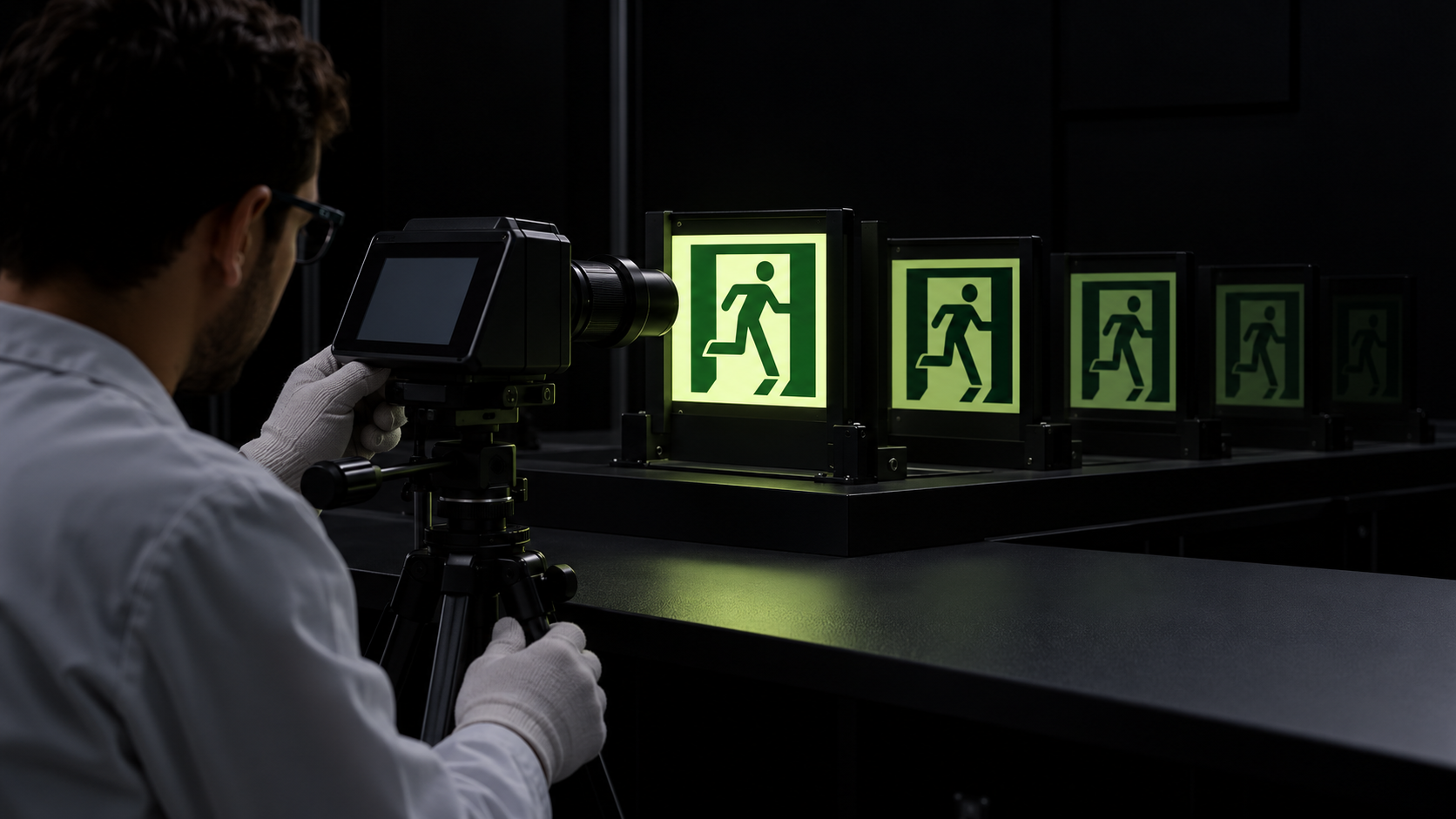
For phosphorescent safety signs, ISO 17398:2004 defines four luminance-decay subclasses. When combined with the photometric classification “P,” they may be written as PA, PB, PC and PD.
ISO 17398 class | Minimum at 2 min (mcd/m²) | Minimum at 10 min (mcd/m²) | Minimum at 30 min (mcd/m²) | Minimum at 60 min (mcd/m²) |
|---|---|---|---|---|
Class A | 108 | 23 | 7 | 3 |
Class B | 210 | 50 | 15 | 7 |
Class C | 690 | 140 | 45 | 20 |
Class D | 1,100 | 260 | 85 | 35 |
These are minimum values at every listed time point. A product does not demonstrate Class C merely by exceeding 140 mcd/m² at 10 minutes. It should meet the complete Class C decay profile under the required test procedure.
Buyers should also distinguish between:
A typical laboratory result
A declared minimum value
A result from one specimen
A classification supported by the complete test report
A test on raw film
A test on the printed and laminated finished sign
For a detailed explanation of luminance units, activation conditions and 10-, 60- and 90-minute values, read Photoluminescent Film Luminance: 10, 60 and 90-Minute Test Values.
Are Classes E, F and G Part of ISO 17398?
The base classification table in ISO 17398:2004 contains Classes A to D.
Classes E, F and G may appear in industry literature as higher-performance extensions developed or promoted by industry organizations. They should not be presented simply as original ISO 17398:2004 classes without identifying the separate classification scheme, its thresholds and its test conditions.
If a supplier claims “ISO Class G,” ask:
Which document defines Class G?
What edition or industry scheme is being used?
What are the required values at every test point?
What excitation and measurement conditions were used?
Does the report cover the exact supplied construction?
Current Status of ISO 17398
At the time of writing, ISO 17398:2004 remains the current published International Standard. ISO records it as scheduled for revision, and a second edition is under development.
A committee draft is not the same as a published replacement. Unless a project contract specifically requires a draft or another agreed document, buyers should identify the currently applicable published edition and monitor the revision process for future changes.
What Does DIN 67510 Cover?
DIN 67510 is a German standards series for phosphorescent pigments and products.
In international quotations, the phrase “DIN 67510” is often used without a part number or edition, which creates avoidable ambiguity.
DIN 67510-1:2020-05 Is the Current Measurement Standard
DIN 67510-1:2020-05 is titled Phosphorescent pigments and products — Part 1: Measurement and marking at the producer.
Its scope includes the measurement and classification of phosphorescent pigments and products used for applications such as:
Emergency escape route marking
Hazard-area marking
Buildings and underground transport routes
Aviation and shipping applications
Equipment, fittings and utensils
Work and safety clothing
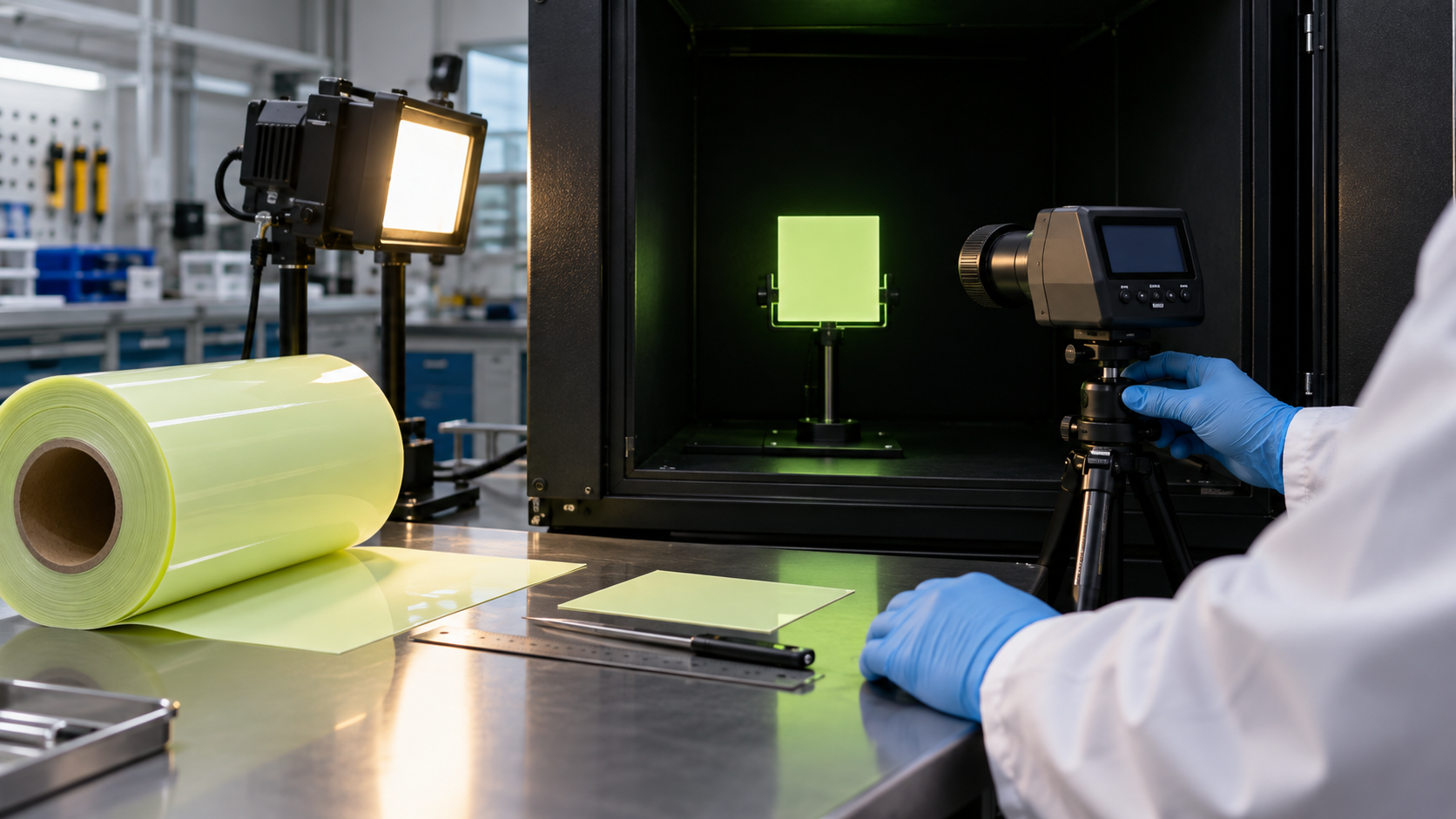
A useful DIN 67510-1 report should identify the specimen, preconditioning, excitation conditions, measurement times, luminance values, decay information and applicable classification or marking.
Why the Exact DIN Part and Edition Matter
The statement “meets DIN 67510” is incomplete because different parts and editions have existed.
Two common problems are:
Supplier literature still referring to DIN 67510-1:2009-11 instead of the current 2020-05 edition.
Supplier literature referring to DIN 67510-4:2008-02, even though DIN lists that document as withdrawn and replaced by DIN 67510-1:2020-05.
An old report is not automatically useless. It may still provide valuable product history or be accepted by a particular contract.
However, buyers should not assume that a test under a withdrawn edition is identical to a test required by the latest specification.
Write the full reference on the inquiry and purchase order:
DIN 67510-1:2020-05
Why DIN and ISO Test Results Cannot Automatically Be Converted
DIN 67510 and ISO 17398 both discuss photoluminescent performance, and reports often show 10- and 60-minute luminance. That does not make every DIN result directly equivalent to an ISO class.
Before comparing two reports, verify:
Light source and spectral distribution
Illuminance at the sample surface
Excitation duration
Dark preconditioning
Ambient temperature
Measurement instrument and geometry
Measurement times
Decay threshold and calculation method
Raw material or finished-sign construction
Typical values or guaranteed minimums
Two products can show the same 10-minute value but have been charged under different conditions. Comparing those numbers without checking the test method can lead to the wrong purchasing decision.
ISO 16069 vs ISO 17398 vs DIN 67510: Side-by-Side Comparison
Topic | ISO 16069:2017 | ISO 17398:2004 | DIN 67510-1:2020-05 |
|---|---|---|---|
Main focus | Safety way guidance system design and application | Safety sign classification, performance and durability | Measurement, classification and producer marking of phosphorescent pigments and products |
Typical user | Building safety designer, fire engineer, facility manager, installer | Sign manufacturer, specifier, purchaser, test laboratory | Material producer, product manufacturer, laboratory, purchaser |
Main object evaluated | Complete visual guidance system and its components in use | Safety sign or sign product | Phosphorescent pigment or product |
Photoluminescent luminance | Used as part of system and component performance | A–D decay subclasses use 2-, 10-, 30- and 60-minute values | Values and decay behavior measured under the specified DIN procedure |
Layout and placement | Yes, central to the standard | No complete escape-route layout design | No complete escape-route layout design |
Material and construction description | Relevant for component selection | Central to product classification | Central to the test specimen and producer marking |
Durability | Considered when selecting and maintaining the system | A core part of sign performance classification | Focuses on measurement and classification; additional requirements depend on the specified product and project |
Local approval | Does not replace it | Does not replace it | Does not replace it |
Can one report prove all three? | No | No | No |
How the Standards Work Together in a Real Safety Sign Project
Consider a printed photoluminescent exit sign installed as part of a low-location escape route.
Step 1: Define the Legal and Project Requirements
The designer identifies the country, building type, authority having jurisdiction, local fire code, occupant risk, escape-route design and required standards.
Step 2: Select and Test the Material
The photoluminescent film or product is selected according to the required luminance, construction, printability, adhesion, durability and applicable test method.
DIN 67510-1 may be one of the requested measurement references.
Step 3: Produce and Verify the Finished Sign
The film is printed, cut, laminated or mounted to its final substrate.
ISO 17398 may be used to specify the safety sign’s photometric class, material, fixing method, surface, expected environment and durability.
Step 4: Design and Install the Guidance System
The finished components are positioned to create a continuous and understandable route.
ISO 16069 may guide the visual system’s planning, layout, installation and maintenance.
Step 5: Verify the Installed Conditions
The project team confirms that the installed components:
Receive adequate charging light
Remain unobstructed
Point in the correct direction
Are visible from the required viewing positions
Can be inspected, cleaned and maintained
This workflow explains why a material supplier, sign converter, system designer, installer and building owner can each hold a different part of the compliance responsibility.
Material Compliance vs Finished-Sign Compliance vs System Compliance
1. Material-Level Evidence
A material test shows how the identified photoluminescent film or sheet performed under stated conditions.
The report should be connected to an exact model, construction, batch or test specimen.
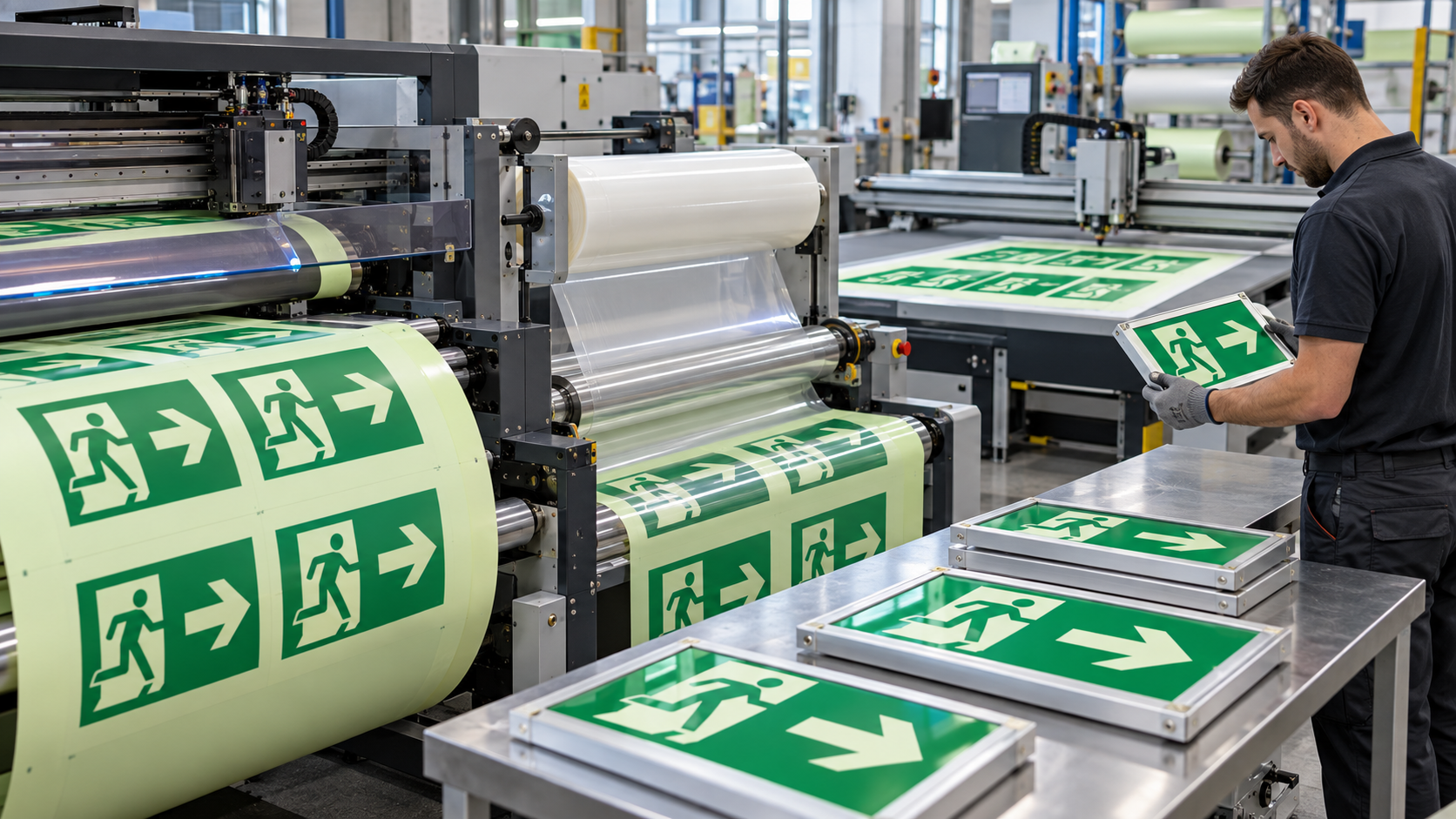
2. Finished-Sign Evidence
A finished-sign test evaluates the actual printed, laminated, mounted or coated construction.
This matters because opaque ink, clear films, surface coatings and graphic coverage can change charging and light emission.
3. System-Level Evidence
System compliance evaluates how signs and markings work together after installation.
Direction, continuity, viewing position, lighting, maintenance and the building’s risk assessment all matter.
4. Jurisdictional Approval
The relevant authority, code, contract or certification scheme determines what evidence is legally accepted.
An ISO or DIN test report does not automatically become a permit, product listing or approval for every market.
The safest wording is specific:
Tested to [standard and edition] on [identified construction] under [stated conditions], with the following results.
Avoid unsupported wording such as:
ISO certified photoluminescent film for every emergency-exit project.
What Should a Photoluminescent Test Report Include?
Before accepting a performance or compliance claim, check the report for the following information.
Item | What to verify | Why it matters |
|---|---|---|
Standard | Full standard number, part and edition | Prevents confusion between current, superseded and withdrawn documents |
Product identity | Model, material, thickness, color, adhesive, batch and specimen dimensions | Connects the report to the material being purchased |
Finished construction | Printing, ink coverage, laminate, coating and substrate | Raw-film data may not represent the finished sign |
Preconditioning | Dark conditioning and environmental preparation | Residual charge can make a result artificially high |
Excitation | Lamp type, spectrum or color temperature, lux and charging time | Afterglow depends strongly on how the material is charged |
Measurement | Instrument, calibration, geometry, timing and unit in mcd/m² | Supports repeatability and valid comparison |
Results | Individual values, averages, minimum values and all required time points | One selected high result does not prove the complete class |
Classification | Exact class and the scheme used | Prevents “equivalent” claims without complete evidence |
Durability | Tests relevant to the declared environment and finished product | Initial brightness alone does not establish service performance |
Laboratory | Laboratory identity, report number, date and accreditation scope where required | Helps establish traceability and credibility |
Production control | Lot traceability, retained samples and acceptance criteria | Connects a type test to the delivered order |
If a report hides the activation conditions or does not identify the specimen, its published luminance values cannot be compared reliably with another supplier’s data.
Copy-Ready Specification for Buyers and Sign Manufacturers
The following wording can be adapted for an inquiry, quotation or purchase order:
The supplier shall identify the exact photoluminescent product model, construction, thickness and batch. Testing shall be performed to [standard, part and edition]. The report shall state dark preconditioning, excitation source, illuminance at the sample surface, excitation duration, measurement equipment and individual luminance results at all required time points. Values shall be declared as guaranteed minimums or typical results. Where the film will be printed, laminated, coated or mounted, the required finished construction shall also be tested. Any ISO 17398 class shall be supported by the complete class profile, not one measurement point. The installed safety way guidance system shall be designed and verified separately to ISO 16069:2017 and all applicable local fire, building and workplace-safety requirements.
Add project-specific requirements for:
Fire performance
Slip resistance for floor applications
Abrasion and cleaning resistance
Chemical resistance
Indoor or outdoor exposure
UV and weathering
Adhesive and substrate compatibility
Sign design and pictograms
Local product listing or certification
On-site illumination and acceptance testing
Which Standards Apply to Different Applications and Markets?
Application | Standards or requirements to investigate | Important caution |
|---|---|---|
Indoor safety sign manufacturing | ISO 17398, DIN 67510-1, ISO 7010, ISO 3864 and local rules | Test the printed and laminated construction where required |
Building evacuation guidance | ISO 16069 plus local fire and building codes | A film or sign test does not approve the complete route |
Factory and warehouse safety | ISO 17398, applicable workplace rules and ISO 16069 for escape guidance | Check chemicals, dust, heat, cleaning and available charging light |
Tunnels and underground facilities | Project-specific SWGS rules, ISO 16069 and local transport or fire requirements | Charging light, smoke conditions, continuity and long evacuation times are critical |
Marine and offshore | IMO/SOLAS requirements, ISO 15370, MED or other project approvals | ISO 16069 is not intended for ships governed by IMO regulations |
North American egress marking | Adopted building or fire code, ASTM E2072/E2073, UL 1994 or other required listings | ISO or DIN performance does not automatically satisfy the authority having jurisdiction |
Decorative glow graphics | Customer specification and truthful product data | Do not market decorative material as life-safety compliant without evidence |
ISO 7010 and ISO 3864 answer additional questions that the three main standards do not fully address.
ISO 7010 provides registered safety signs, while the ISO 3864 series covers design principles, safety colors and related properties. Escape and evacuation plan signs may also involve ISO 23601.
Common Photoluminescent Standards Claims Buyers Should Question
“Certified to ISO 16069”
Ask whether the claim covers a material, a finished component or an installed safety way guidance system.
Request the certification body, certification scheme, report and exact scope. ISO publishes standards but does not itself certify products.
“DIN 67510 Approved”
Ask for the part, edition, test report, specimen identity and test conditions.
“DIN 67510” alone is not a complete specification.
“ISO Class C Equivalent”
Ask for results at 2, 10, 30 and 60 minutes.
Exceeding one or two thresholds does not prove the complete ISO 17398 Class C profile.
“Glows for 10 Hours”
Ask for measured luminance over time and the defined end-of-decay threshold.
A barely visible glow in a completely dark room is not the same as useful safety-sign luminance.
“The Raw Film Passed, So the Printed Sign Passes”
Printing and lamination can reduce the luminous area, change optical transmission and affect durability.
Test the required finished construction.
“Higher Class Is Always Better”
A higher luminance class may provide more performance margin, but correct selection also depends on local rules, charging conditions, graphic design, service environment and cost.
The right grade is the one that meets the complete project requirement with suitable evidence.
“One Standard Covers Every Country”
International standards support common specifications, but national regulations, adopted codes, certification schemes and authorities having jurisdiction can add or replace requirements.
How ABLAZE Supports Photoluminescent Film Projects
ABLAZE is a brand of Changzhou Zhenghe New Material Technology Co., Ltd.
We manufacture and supply glow-in-the-dark photoluminescent film for cutting, printing, sign conversion, emergency guidance and industrial safety applications.
Before recommending a construction, our team encourages buyers to define:
Target country and application
Required standard and edition
Required luminance values or class
Available charging light
Raw-film or finished-sign testing
PET, PVC or acrylic construction
Printing, cutting and lamination process
Adhesive and installation substrate
Indoor, outdoor or high-wear environment
Required reports, listings or certifications
ABLAZE can provide product information, samples and project-specific discussions for sign manufacturers, safety-product distributors and OEM customers.
Any performance or compliance statement should be tied to the exact product, test conditions and supporting report rather than applied generally to every photoluminescent construction.
For industrial facilities, see our industrial safety and hazard marking solutions.
To discuss samples, testing requirements or a quotation, contact Changzhou Zhenghe New Material Technology Co., Ltd..
Frequently Asked Questions
What is the main difference between ISO 16069 and ISO 17398?
ISO 16069 covers the design and application of a complete safety way guidance system. ISO 17398 classifies the performance, construction and durability of safety signs.
A sign can have ISO 17398 performance data without proving that the installed route meets ISO 16069.
Does a DIN 67510 test report prove ISO 16069 compliance?
No.
A DIN 67510-1 report can provide relevant photoluminescent performance data, but ISO 16069 also addresses system planning, component selection, layout, installation and maintenance. Separate project-level verification is required.
Is Class C always the minimum for a photoluminescent safety sign?
No universal class applies to every country and application.
Class C is frequently specified or recommended for professional safety uses, but the legally required level must come from the applicable code, project document or authority having jurisdiction.
What values define ISO 17398 Class C?
Under ISO 17398:2004, Class C requires minimum luminance of:
690 mcd/m² at 2 minutes
140 mcd/m² at 10 minutes
45 mcd/m² at 30 minutes
20 mcd/m² at 60 minutes
The product should meet all four values under the required test procedure.
Are Classes E, F and G official ISO 17398:2004 classes?
The base ISO 17398:2004 table contains Classes A, B, C and D.
Higher classes may belong to an extended industry classification. The supplier should name the separate scheme and provide its thresholds and test conditions.
Does ISO 17398 use a 90-minute luminance value?
The ISO 17398 A–D classification table uses 2-, 10-, 30- and 60-minute values.
A 90-minute value may be required by another test method, building code or project specification, but it is not part of the ISO 17398 A–D table.
Is DIN 67510-4 still current?
No.
DIN lists DIN 67510-4:2008-02 as withdrawn and replaced by DIN 67510-1:2020-05. Always verify the exact document required by the project before rejecting or accepting an older report.
Does tested photoluminescent film make the finished sign compliant?
Not automatically.
Ink coverage, clear laminate, coatings, substrate, adhesive and fabrication can change optical and durability performance. Regulated applications may require testing of the exact finished construction.
Can DIN and ISO luminance values be compared directly?
Only when the standards, editions, excitation, preconditioning, measurement method, specimen construction and data type are equivalent, or when a valid comparison method has been established.
The same 10-minute value can represent different test conditions.
Do ISO and DIN standards replace local fire codes?
No.
They provide recognized technical methods and requirements, but local legislation, adopted building and fire codes, certification schemes and the authority having jurisdiction determine legal acceptance.
Final Takeaway
ISO 16069, ISO 17398 and DIN 67510 address different layers of photoluminescent safety performance:
DIN 67510-1 measures and classifies phosphorescent pigments and products.
ISO 17398 classifies the performance and durability of safety signs.
ISO 16069 guides the design and application of the complete safety way guidance system.
The best purchasing decision does not begin with the highest advertised brightness or the longest claimed glow time.
It begins with the target market, applicable standard and edition, actual charging environment, exact finished construction and evidence required by the project.
If you are sourcing photoluminescent film for emergency signs, evacuation guidance or industrial marking, contact ABLAZE with your required standard, luminance level, printing process and application details.
Our team can help you identify an appropriate material construction and prepare samples for evaluation.
RELATED NEWS

Traffic Sign Retroreflectivity: ASTM E1709 Field Guide | ABLAZE
Quick answer: Use a portable sign retroreflectometer with the specified measurement geometry, take multiple readings from each retroreflective color, and compare the results with the applicable minimum maintained retroreflectivity levels. For U.S. traffic signs, the key reference is Section 2A.22 an

Photoluminescent Safety Sign Standards Explained: ISO 16069, ISO 17398 and DIN 67510
Photoluminescent Safety Sign Standards Explained: ISO 16069, ISO 17398 and DIN 67510Last updated: September 2026Photoluminescent safety signs absorb light during normal conditions and release it as a visible glow when the surrounding light fails. They are widely used for emergency exits, escape rout