


When evaluating a new reflective sheeting supplier, buyers often ask for a sample first.
But how much material is actually enough?
A small sheet may be fine for checking color and surface appearance. It may not be enough to test a printer, plotter, laminator or real sign-making process.
The practical answer is:
The sample size should match the test you plan to perform.
There is no single sample size that works for every reflective sheeting project.
When Is an A4 or A3 Sample Enough?
A small sheet is useful for a first evaluation.
An A4- or A3-size piece can normally help you check:
Surface appearance
Color
Reflective structure
Basic flashlight comparison
RA spot measurement, if the instrument and test method allow it
Thickness
Release liner
Initial adhesive behavior
Basic application to a small substrate
This type of sample is useful when your first question is simply:
“Is this material worth testing further?”
It is also cheap and easy to send by international courier.
However, a small sheet cannot tell you everything about a complete roll.
It cannot properly show:
Roll winding quality
Full-width coating consistency
Edge quality
Telescoping
Long-distance liner behavior
Printer feeding
Large-format cutting
Production waste
So an A4 sample should normally be treated as a screening sample, not final production approval.
When Do You Need a Larger Sample?
If the reflective sheeting will be printed, cut, laminated or applied to actual products, request enough material to run the real process.
For many workshop trials, a larger sheet or several linear meters are more useful than a small hand sample.
For example:
Test | Practical Sample Requirement |
|---|---|
Color and surface check | A4–A3 may be enough |
Small adhesion test | Several small pieces |
RA comparison | Small controlled specimens may be enough |
Plotter cutting | Enough material for test cuts and real graphics If plotter cutting is part of your production process, run the sample using the same cutter and normal production settings. |
Screen printing | Enough for several print passes |
Digital printing | Enough to load and run the actual printer |
Lamination | Enough for stable feeding and finished-sample checks |
Application to sign blanks | Enough to cover the real substrate |
Curved plastic parts | Enough to test the actual component |
Production approval | Full-width material or pilot roll preferred |
These are practical starting points, not universal standards.
The equipment itself often determines how much sample is necessary.
A printer may need additional material just for loading, feeding and calibration before the actual test image begins.
Why Production Testing Needs More Than a Small Piece
Imagine a buyer receives a 300 × 300 mm reflective sample.
The material looks good.
The color is correct.
The adhesive sticks to a small aluminum panel.
The buyer then orders 100 rolls.
During production, they discover:
The liner curls during plotter cutting
The roll does not feed smoothly through the printer
Edge quality varies across the width
Printing behaves differently near one side of the roll
Long graphics weed differently from small test shapes
None of these problems would necessarily appear on a small sheet.
That is why sample approval should happen in stages.
For the complete approval procedure, follow our reflective sheeting quality testing checklist before placing a bulk order.
A sensible process is:
small sample → larger process sample → pilot production material → bulk order
Your existing quality-testing process follows the same principle: the approved material should be tested using the actual printing, cutting, laminating and application system planned for production.
When Should You Ask for a Full-Width Pilot Roll?
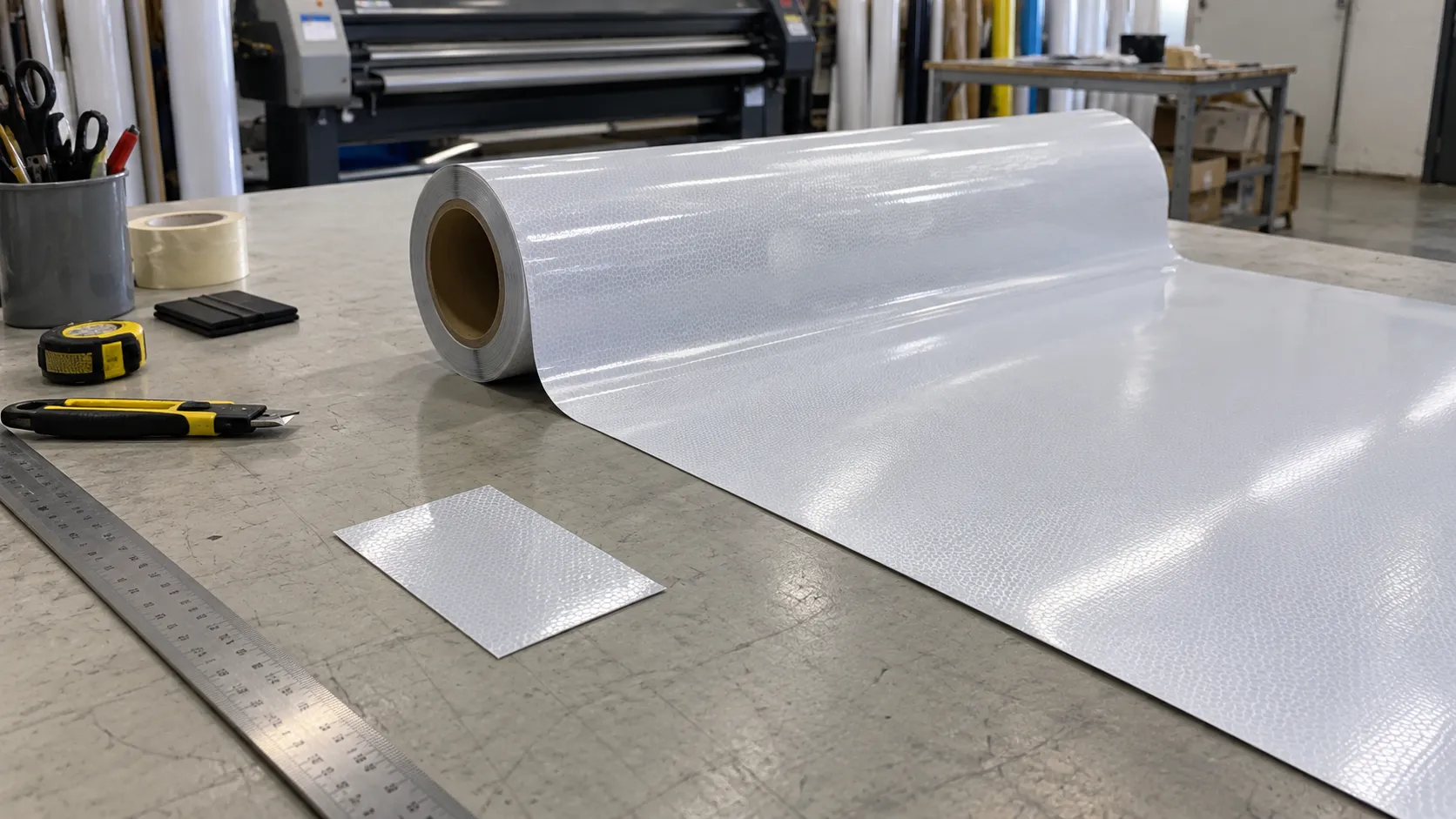
For a large order or a new production process, a full-width pilot roll is much more meaningful than a small sheet.
The product TDS should also be reviewed before deciding what needs to be confirmed during the trial.
This is especially useful when you need to evaluate:
Actual roll width
Roll tension
Winding quality
Core size
Edge condition
Release liner consistency
Printer feeding
Plotter tracking
Laminator feeding
Large graphics
Roll-to-roll production
Batch consistency
Your current TDS guide already makes the distinction clearly: use a small sample for preliminary evaluation and full-width material for production testing.
The pilot roll does not necessarily need to be a full commercial order.
The purpose is to reproduce the real manufacturing process before committing to bulk quantity.
Match the Sample to the Final Application
Sample size also depends on where the reflective sheeting will eventually be used.
For a flat aluminum traffic sign, you may want enough material to produce one complete sign face.
For a plastic traffic barrier, test a piece large enough to cover the real curved section.
For screen printing, produce the real printed color and allow normal curing.
For license plate material, a few small pieces are not enough to prove embossing, hot stamping and repeated production performance.
A representative sample should answer:
“Will this material work in our actual production process?”
not only:
“Does this sample look good on the table?”
Keep Part of the Approved Sample
Do not use every piece of an approved sample during testing.
Keep one clean, unused reference piece.
Record:
Supplier
Product code
Color
Batch number
Date
Construction
Test result
This becomes a golden sample for future comparison.
When the next shipment arrives, you can compare the new material with both your written specification and the approved physical reference.
That is much more useful than trying to remember what the first sample looked like several months later.
FAQ
Is an A4 reflective sheeting sample enough before a bulk order?
It is enough for preliminary checks, but usually not enough to approve printing, converting or complete roll performance.
How much sample should I request for printing?
Request enough material to load the actual printer, establish normal settings and produce several representative test areas. The exact quantity depends on the machine and print process.
Do I need a pilot roll for every order?
Not necessarily. A pilot roll is most useful when qualifying a new supplier, new product construction, new printer or high-volume project.
Final Thoughts
There is no universal “correct” reflective sheeting sample size.
Use the smallest sample that can realistically reproduce the test you need.
A practical sequence is:
A4/A3 sample → larger process sample → full-width pilot material → bulk production
Small samples are good for screening.
Production approval should use material that is large enough to behave like the real roll you intend to buy.
RELATED NEWS
What Size Reflective Sheeting Sample Is Enough for Testing?
An A4 reflective sheeting sample may be enough for basic appearance and material checks, but printing, cutting and production trials usually need more material. Learn how much sample to request before a bulk order.

Hit, Stacked, Hosed Down, Put Back Out: Reflective Sheeting for Cones, Drums and Work-Zone Devices
Hit, Stacked, Hosed Down, Put Back Out: Reflective Sheeting for Cones, Drums and Work-Zone DevicesA permanent sign spends its life bolted to a post. A traffic cone spends its life being struck, nested, thrown into a truck and pressure-washed. The sheeting has to be specified for the life the device