


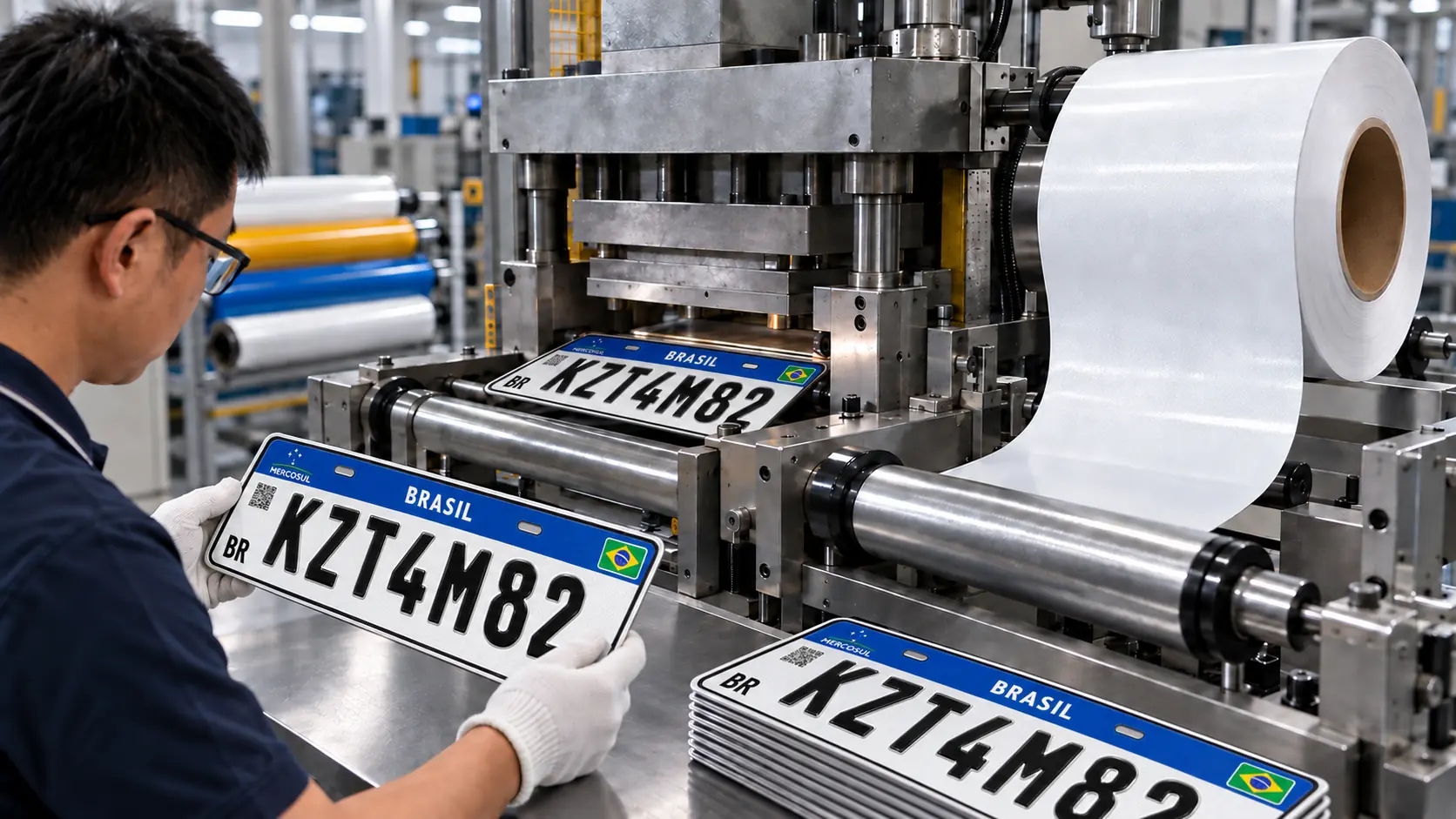
A reflective film can look bright, smooth and well bonded while it is still flat, yet crack, whiten, lift or reject hot-stamping foil after it is converted into a license plate.
The reason is simple: embossed license plate production does not test only the reflectivity of the material. It forces the reflective sheeting, pressure-sensitive adhesive and aluminum substrate to behave as one laminated system under localized deformation, pressure and short-duration heat.
The right material must therefore do four things:
Stretch around the embossed characters without cracking or separating.
Remain bonded to the aluminum at character edges, sidewalls and borders.
Tolerate the hot-stamping process without shrinking, softening or damaging the reflective construction.
Accept the selected pigment foil across a stable range of temperature, pressure and production speed.
This guide explains how to evaluate these requirements through elongation data, adhesion testing, thermal compatibility and actual production trials.
ABLAZE is the reflective material brand of Changzhou Zhenghe New Material Technology Co., Ltd. We manufacture glass-bead reflective sheeting for professional license plate production, including materials developed for aluminum lamination, mechanical embossing, hot stamping, roller coating, screen printing and project-specific security features.
Quick Answer: What Makes License Plate Sheeting Suitable for Embossing and Hot Stamping?
License plate reflective sheeting is suitable for embossing and hot stamping when the complete laminated construction can be formed and colored without unacceptable cracking, whitening, delamination, shrinkage, foil-transfer defects or loss of required optical performance.
Buyers should verify five areas:
Property | What It Must Achieve | What to Request or Test |
|---|---|---|
Elongation and flexibility | Follow the embossed character geometry without splitting | Tensile data with the test method and direction, followed by actual embossing trials |
Adhesion to aluminum | Keep the film bonded during forming, heating and outdoor service | Defined peel test, failure mode and post-emboss/post-heat adhesion |
Heat resistance | Survive short hot-stamping exposure without permanent damage | Thermal process trial using the actual machine, foil and line speed |
Surface compatibility | Allow clean foil release and bonding only on raised characters | A temperature-pressure-speed process matrix |
Finished-plate performance | Retain readability, reflectivity, color and durability | Tests required by the destination market or project specification |
There is no universal elongation percentage, peel value or hot-stamping temperature that proves suitability for every plate production line. The decisive evidence is repeatable performance using the buyer’s actual aluminum, dies, machine and foil.
Why Can Reflective Sheeting Pass Flat-Sheet Inspection but Fail During Plate Conversion?
A flat-sheet inspection normally evaluates appearance, color, thickness, retroreflectivity and perhaps adhesion to a smooth panel. Embossing and hot stamping create additional stresses that are not visible in those results.
During embossing, the aluminum and applied sheeting are forced into the shape of letters, numbers and borders. The reflective material experiences concentrated strain around:
Sharp character corners
Narrow strokes
Sidewalls
Small radii
Deep embossing
Closely spaced characters
The transition between raised and flat areas
During hot stamping, the raised character faces are exposed to heat and pressure while moving against a pigment foil. The face film and surface coating must accept the foil, but the background must remain clean. At the same time, the adhesive must resist movement and the optical construction must remain intact.
A general-purpose traffic sign film may perform well on a flat sign and still be unsuitable for this conversion sequence. Plate manufacturers should source dedicated license plate reflective sheeting and approve it as part of the complete production system.
Start With the Finished License Plate System, Not One Film Specification
The correct sheeting cannot be selected from elongation or heat-resistance data alone. Selection should begin with the finished plate requirement and work backward through the production process.
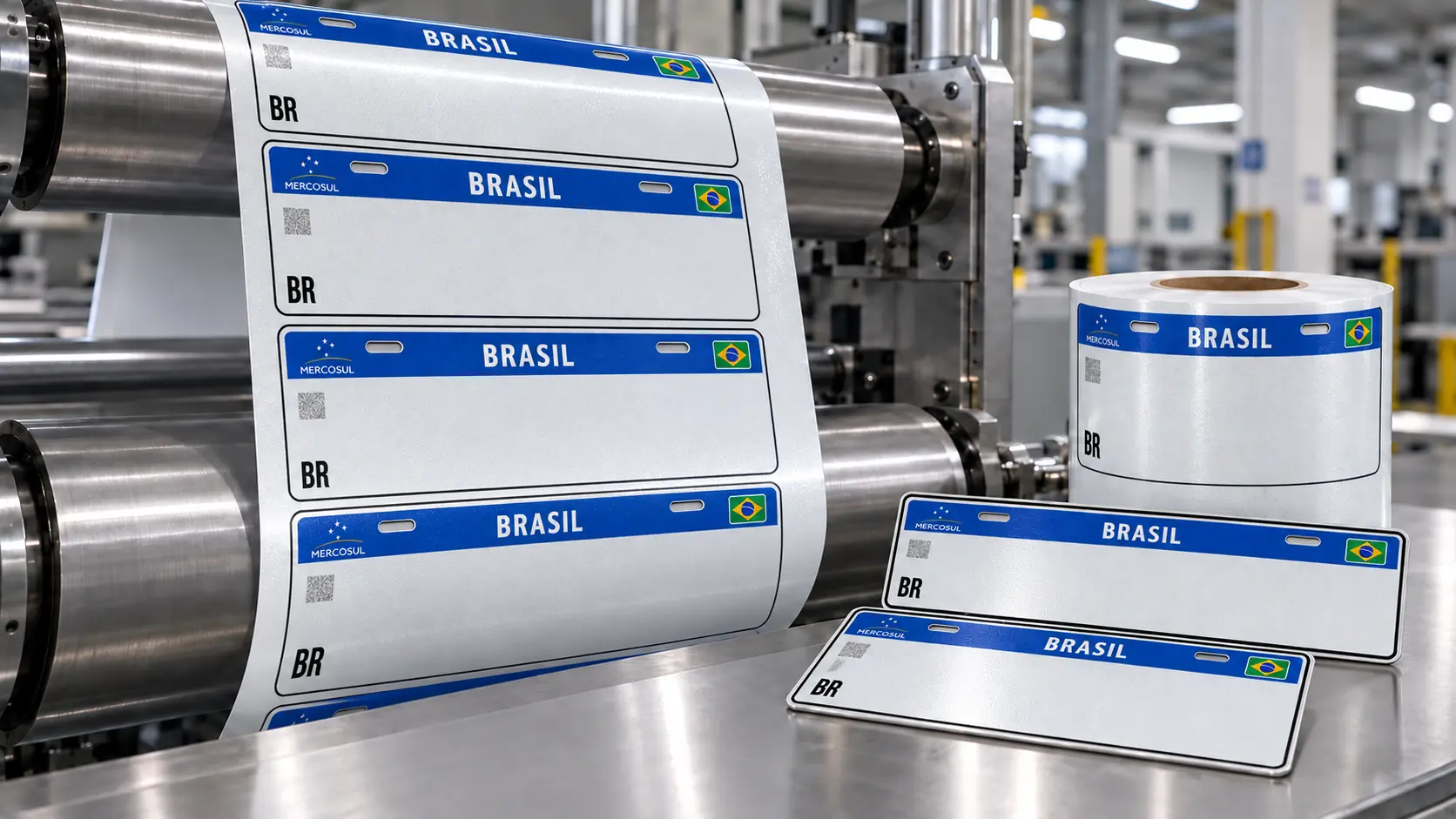
Confirm the Target Standard and Finished Plate Construction
Before requesting samples, define:
Destination country and issuing authority
Applicable standard, regulation or tender specification
Passenger vehicle, truck, trailer, motorcycle or special plate
Plate dimensions and aluminum thickness
Background color and required color tolerance
Minimum coefficient of retroreflection at specified angles
Embossed character height, stroke width and geometry
Hot stamping, roller coating or another coloring process
Security watermark, serial number, hologram or other feature
Required outdoor service period
Finished-plate test and approval procedure
ISO 7591 is an important international reference for retroreflective registration plates, but national regulations and tender documents may add or change requirements. Compliance must be evaluated for the applicable finished plate, not assumed from a generic raw-film claim.
For a broader standards and sourcing overview, read our License Plate Reflective Sheeting Buying Guide.
Match the Sheeting to the Aluminum, Tooling, Machine and Foil
Ask the supplier to evaluate the complete combination:
Reflective sheeting model and production batch
Aluminum alloy, temper, thickness and surface treatment
Cleaning and lamination method
Time between lamination and embossing
Embossing press and die set
Character depth, radius and clearance
Plate and workshop temperature
Hot-stamping machine
Pigment or security foil
Stamping pressure, temperature and speed
Any printing or security layer already present on the surface
Changing one part can change the result. A harder aluminum temper may require more forming pressure. A sharper die radius can concentrate strain. A different topcoat can require another foil or process window. A film that runs well with one hot-stamping foil is not automatically compatible with every foil.
How Much Elongation Does Embossable License Plate Sheeting Need?
There is no single minimum elongation percentage that applies to every license plate design.
Elongation data is useful for screening materials, but it does not reproduce the localized, multidirectional deformation of a laminated plate during embossing. Buyers should use tensile data to compare controlled samples and then confirm embossability on production equipment.
What Does Elongation at Break Measure?
Elongation at break describes how much a test specimen lengthens before it breaks under a defined tensile-test method. It is commonly expressed as a percentage of the original gauge length.
For example:
Elongation at break (%) = increase in gauge length at break ÷ original gauge length × 100
For thin films and sheets, suppliers may reference methods such as ISO 527-3 or ASTM D882. A reported percentage is meaningful only when the document also states the test method and conditions.
Why Does a High Elongation Value Not Guarantee Good Embossing?
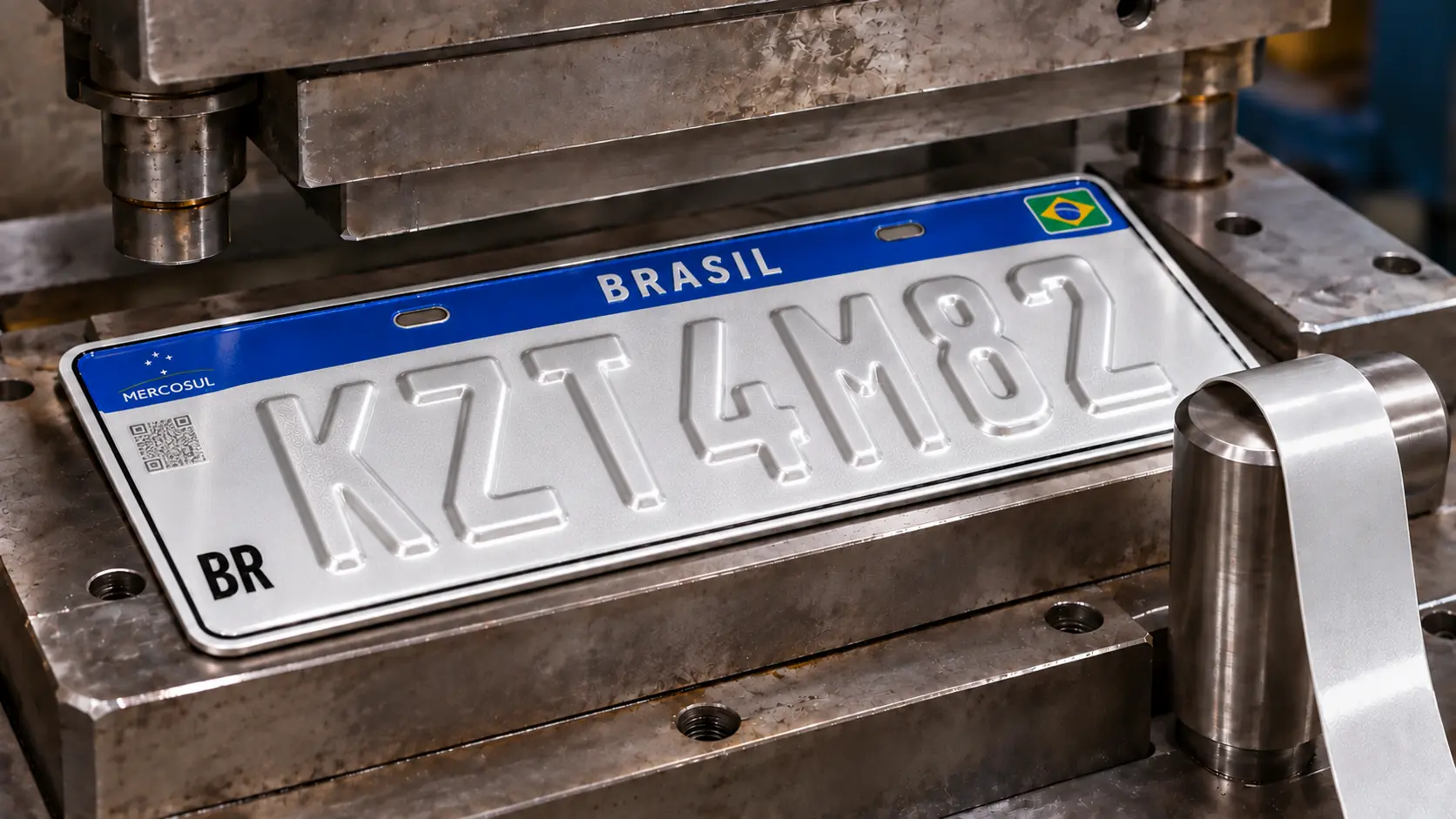
Embossability depends on more than the maximum stretch of one film strip.
License plate reflective sheeting is a multilayer construction that may include:
An acrylic or other face film
Surface treatment or printable coating
Embedded glass beads
Focusing and reflective layers
Bonding resins
Pressure-sensitive adhesive
A release liner that is removed before lamination
The layers must deform together. A face film may have high elongation while another layer cracks, separates or loses optical uniformity. A soft film may stretch easily but show excessive whitening, dimensional recovery or poor character definition. A strong film may have an acceptable break value but crack early at a sharp die corner.
Embossing is also different from a uniaxial tensile test:
Tensile testing stretches a prepared strip mainly in one direction.
Embossing creates localized strain in several directions.
The film is bonded to aluminum during embossing.
Stress is concentrated at corners, radii and sidewalls.
Tooling, temperature and aluminum temper affect the result.
For these reasons, higher elongation does not automatically mean better license plate film.
Which Tensile-Test Details Must Be Reported?
When a supplier provides elongation or tensile-strength data, ask for:
Exact material construction tested
Whether the liner was removed
Whether the result represents the face film or complete reflective construction
Test method and revision
Specimen width and gauge length
Crosshead or test speed
Conditioning temperature and humidity
Film thickness
Machine-direction result
Cross-direction result
Average, minimum and sample count
Break location and failure appearance
Do not compare values produced by different test methods or specimen conditions as if they were equivalent.
You can use our guide on how to read a reflective sheeting technical data sheet to standardize supplier comparisons.
How Should Actual Embossing Performance Be Evaluated?
The most useful embossing test is a converted plate made with the intended production system.
Include the most demanding features in the trial:
Sharpest permitted character corner
Narrowest character stroke
Deepest embossing condition
Border or rim forming
Small motorcycle-plate characters, if applicable
Characters located near punched holes or plate edges
Coldest expected production condition
Inspect the character face, edge, sidewall, radius and surrounding background under both normal and magnified viewing.
Look for:
Visible cracks
Microcracks
Whitening or stress marks
Splitting at corners
Lifted edges
Adhesive separation
Bubbles
Surface distortion
Damaged security marks
Non-uniform retroreflective appearance
Do not approve a material based on one easy character or one visually acceptable plate. The trial must demonstrate repeatability across the plate, machine width, tooling set and an adequate pilot production run.
How Should License Plate Sheeting Adhesion to Aluminum Be Tested?
Good elongation cannot compensate for poor adhesion. During embossing, the film tries to move relative to the aluminum. If the bond is weak or uneven, the film may lift around characters even when the face film itself does not break.
Surface Preparation Comes Before Adhesive Strength
Peel data is relevant only when the aluminum surface and application process are controlled.
The production aluminum should be:
Clean and dry
Free from rolling oil, fingerprints, dust and oxidation
Chemically treated or conversion coated when required by the system
Compatible with the adhesive
Flat and within the specified thickness tolerance
Conditioned to the recommended lamination temperature
The lamination line should control:
Nip pressure
Web tension
Alignment
Speed
Air removal
Roller cleanliness
Stretch introduced during application
A contamination problem can look like an adhesive formulation failure. Therefore, retain a cleaned control panel and record the exact preparation procedure.
Initial Adhesion Is Different From Developed Adhesion
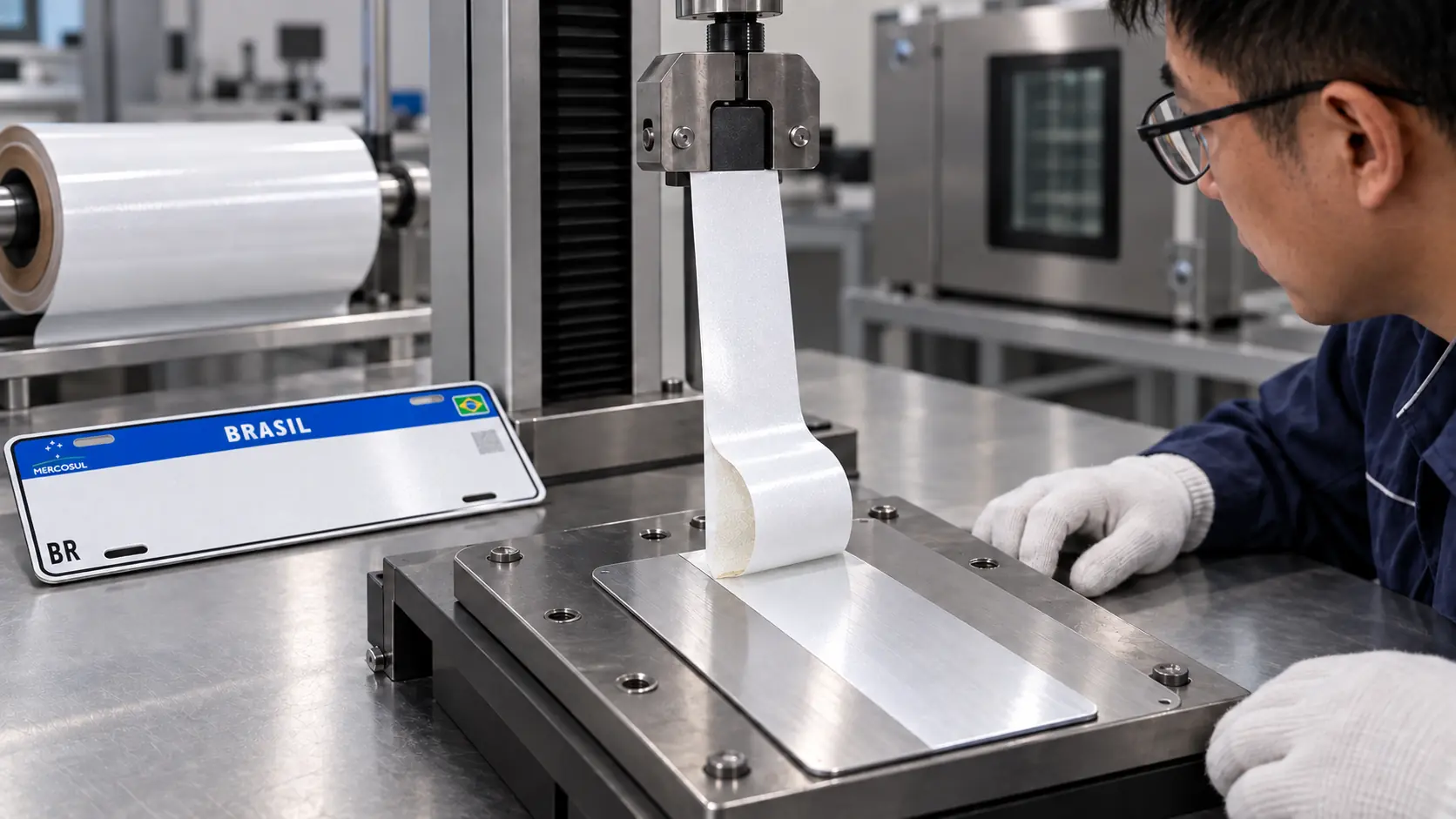
Pressure-sensitive adhesive normally develops its bond after application. A test performed immediately after lamination may not represent the adhesion available when plates are embossed later.
The qualification plan should define:
Initial adhesion after lamination
Adhesion after an agreed dwell period
Adhesion at the actual time plates enter embossing
Adhesion after embossing
Adhesion after hot stamping
Adhesion after environmental conditioning
For internal comparison, many manufacturers record results immediately and again after defined intervals such as 24 or 72 hours. The selected timing must match the production schedule and be stated in the test report.
Test Adhesion Before and After Embossing and Heat
A standard peel test on flat aluminum provides a useful baseline, but it is not enough.
Evaluate:
Flat laminated aluminum before conversion.
Material next to embossed character edges.
Material after hot stamping and cooling.
Material after temperature or humidity conditioning.
Plate edges, holes and formed borders.
A defined 180-degree or 90-degree peel method may be used where specimen geometry allows. The report should include:
Aluminum type and surface treatment
Cleaning procedure
Sample width
Application pressure
Dwell time
Peel angle
Peel speed
Test temperature
Average force and range
Failure mode
ISO 8510-2 describes a 180-degree peel approach for a flexible adherend bonded to a rigid adherend. The project method should still be agreed upon for the actual sheeting and plate construction.
Record the Failure Mode, Not Only the Peel Number
Two specimens can produce similar peel force but fail in different ways.
Possible observations include:
Clean adhesive release from the aluminum
Adhesive transfer to the aluminum
Cohesive failure inside the adhesive
Separation within the reflective construction
Face-film tearing before adhesive release
Aluminum coating or surface-treatment failure
The failure mode helps identify the real limitation. A high numerical result caused by the film tearing may show that the bond is stronger than the film, but it does not provide the same information as a stable adhesive peel. A low result with surface contamination does not prove that the adhesive formulation is weak.
For more detail on substrate preparation and peel-test conditions, see our Reflective Sheeting Adhesive Guide.
What Does Heat Resistance Mean for License Plate Hot Stamping?
Heat resistance and hot-stamping compatibility are related, but they are not the same property.
Service Temperature Is Not Hot-Stamping Temperature
A service-temperature range describes the temperatures an installed material can experience during its intended use after bonding. Hot stamping exposes the top surface to a much higher temperature for a much shorter time under pressure.
Therefore:
A service-temperature value does not specify a safe hot-stamping setting.
A high service-temperature claim does not prove foil compatibility.
A film may survive brief process heat that is far above its continuous service temperature.
The actual temperature inside the laminate can differ from the machine setpoint.
Buyers should ask for both long-term service-temperature information and a validated hot-stamping process recommendation.
Temperature, Pressure and Contact Time Work Together
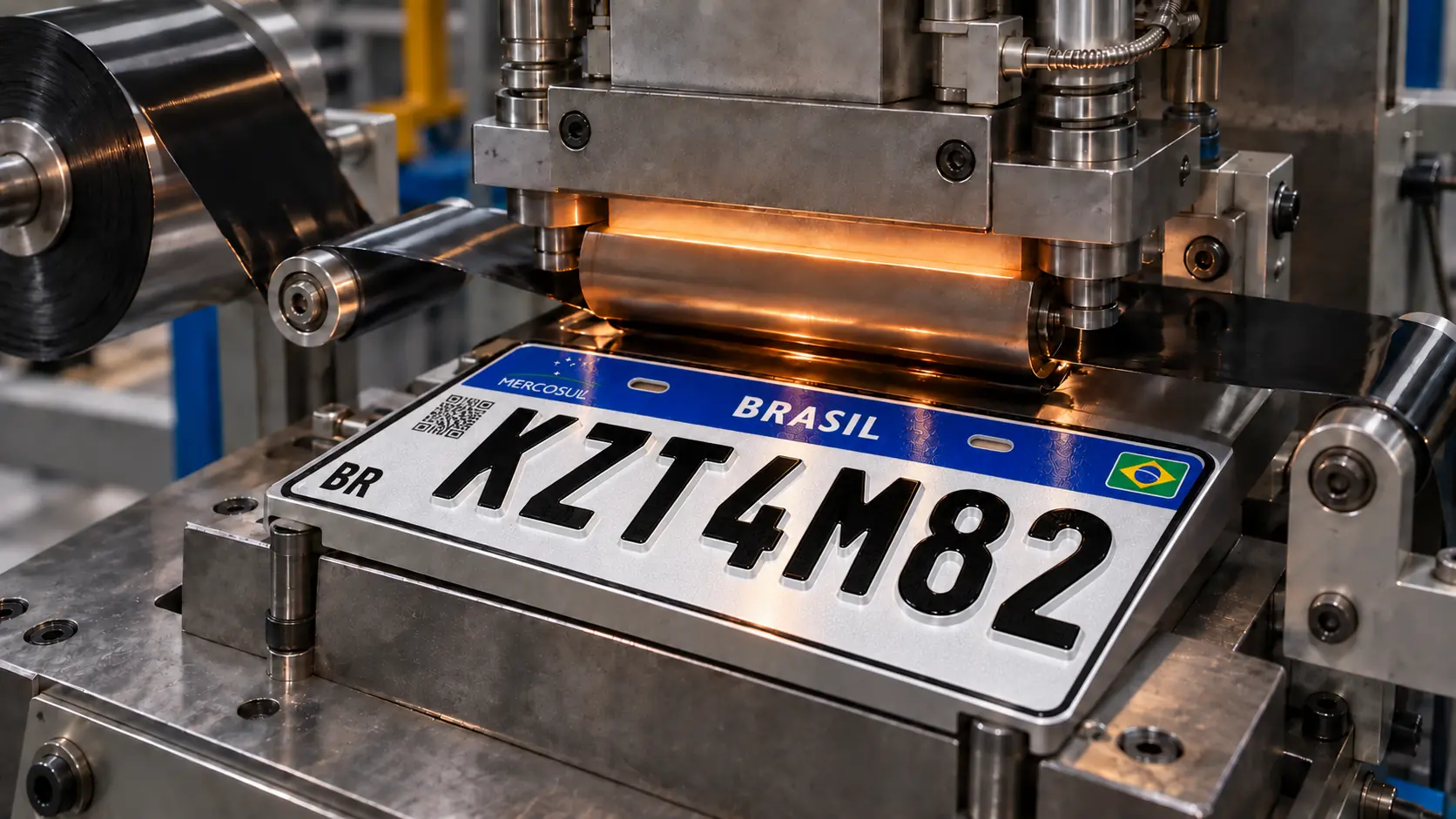
Hot stamping transfers a pigment layer from a carrier foil to the raised characters. The result depends on:
Machine set temperature
Actual roller or die surface temperature
Pressure
Contact time
Line speed
Foil tension
Character height and flatness
Sheeting surface chemistry
Foil release and bonding layers
Ambient and plate temperature
Increasing temperature is not always the correct response to incomplete transfer. The root cause may be low character height, insufficient pressure, excessive speed, contamination, uneven tooling or an incompatible foil.
Too little process energy can cause:
Incomplete transfer
Pinholes
Weak foil adhesion
Pale or uneven color
Missing areas at character edges
Too much process energy can cause:
Blurred character edges
Foil pickup on the reflective background
Surface gloss change
Film softening or deformation
Shrinkage
Damaged printed or security features
Adhesive movement or bubbles
Surface Chemistry Determines Foil Compatibility
The foil bonds to the outer surface of the reflective sheeting, not directly to the glass beads or aluminum. The face film, topcoat, print treatment and any protective layer therefore influence foil transfer.
This is why two license plate sheetings with similar reflectivity and elongation can have different hot-stamping behavior.
The selected foil should be qualified for:
Clean release from its carrier
Complete coverage of raised areas
No transfer onto the background
Sharp character edges
Correct color and opacity
Adhesion after cooling
Abrasion and cleaning resistance
Weather resistance
Compatibility with security inscriptions, if used
Hot-stamping compatibility should be stated for the exact foil series and sheeting surface whenever possible.
A Wide Process Window Is Safer Than One Successful Setting
A single plate made at one carefully adjusted temperature does not prove production stability.
A robust material combination should tolerate normal variations in:
Machine temperature
Line speed
Pressure
Plate temperature
Character geometry
Foil lot
Sheeting lot
The objective is to identify an operating window in which transfer remains acceptable, not a narrow sweet spot that fails whenever the line drifts slightly.
This distinction matters in mass production. A material that works only at one exact setting may create high scrap rates, frequent adjustments and inconsistent character quality.
How to Qualify License Plate Sheeting on Your Production Line
The following workflow helps separate material defects from equipment, foil and process problems.
Step 1: Freeze the Test Materials and Baseline Conditions
Record:
Sheeting product code, color, batch and roll position
Aluminum alloy, temper, thickness and surface treatment
Cleaning method
Lamination machine and settings
Embossing press and die identification
Hot-stamping machine
Foil brand, series, color and batch
Workshop temperature and humidity
Applicable acceptance specification
Measure baseline appearance, daytime color and retroreflectivity before conversion where required.
Step 2: Laminate the Sheeting to Production Aluminum
Use the actual line rather than a hand-applied laboratory sample.
Inspect for:
Bubbles
Wrinkles
Trapped contamination
Excessive stretch
Alignment error
Edge lift
Uneven bond
Allow the agreed dwell time before embossing. Keep control specimens for flat-panel adhesion testing.
Step 3: Run an Embossing Challenge
Use representative and difficult characters, borders and plate formats.
Vary only the factors included in the approved test plan, such as:
Nominal and upper production pressure
Normal and low material temperature
New and normally worn tooling
Different character geometries
Standard and maximum embossing depth
Inspect immediately and then inspect again after the plate has rested. Some stress whitening, edge lifting or fine cracks become easier to see after recovery or conditioning.
Step 4: Build a Hot-Stamping Process Matrix
Begin with the machine and foil supplier’s recommended conditions.
Test a controlled range around the proposed production setting:
Factor | Lower Condition | Nominal Condition | Upper Condition |
|---|---|---|---|
Temperature | Within the qualified low end | Proposed production setting | Within the qualified high end |
Pressure | Lower approved pressure | Normal pressure | Higher approved pressure |
Speed or contact time | Faster or shorter | Normal | Slower or longer |
Do not change every variable randomly. Use a documented matrix so the team can identify which factor changes the result.
For each combination, record:
Coverage
Pinholes
Edge sharpness
Background pickup
Color density
Foil adhesion
Gloss or surface change
Plate distortion
Cycle stability
Step 5: Inspect Immediately and After Conditioning
Some failures appear only after the plate cools or after the adhesive and foil layers stabilize.
Inspect:
Immediately after stamping
After cooling
After the agreed room-temperature dwell
After temperature conditioning
After humidity or water exposure
After any required cleaning, chemical or abrasion test
Compare the results with an unstamped control and the approved visual standard.
Step 6: Test the Finished Plate
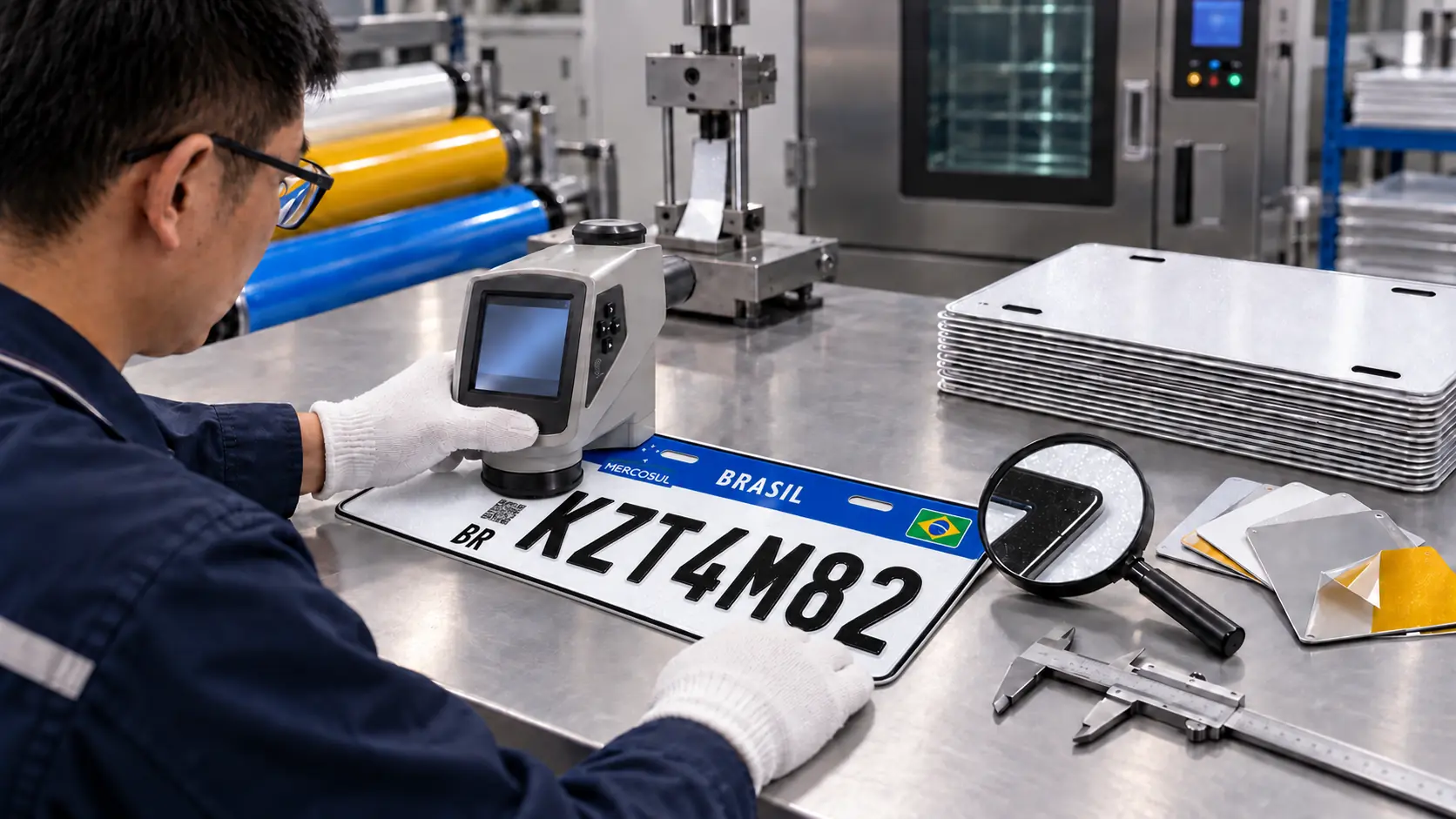
Depending on the target market, evaluate:
Plate dimensions and flatness
Embossing height and character legibility
Cracks, whitening and delamination
Hot-stamping coverage and adhesion
Daytime color
Coefficient of retroreflection at specified angles
Retained background reflectivity
Adhesion to aluminum
Impact and bending resistance
Water and humidity resistance
Temperature resistance or cycling
Cleaning, fuel and chemical resistance
Salt-mist resistance
Accelerated or natural weathering
Security-feature integrity
ANPR or camera readability, if required
The applicable national regulation or project specification determines the final test list and acceptance limits.
To understand the complete sequence from aluminum preparation to final inspection, see How License Plates Are Made.
Step 7: Approve a Golden Sample and Control Future Batches
After the trial succeeds:
Sign and retain representative finished plates
Photograph critical character details
Record approved machine settings and permitted ranges
Retain sheeting, foil and aluminum samples
Identify all material batches
Define incoming inspection requirements
Define change-notification rules
Confirm when requalification is required
Requalification may be necessary after a change in sheeting construction, adhesive, topcoat, foil, aluminum surface, die geometry, production speed or machine.
Acceptance Checklist for Embossing and Hot Stamping
Inspection Area | Acceptable Result | Warning or Rejection Signs |
|---|---|---|
Character face | Smooth, stable and fully formed | Surface distortion, bubbles or damaged graphics |
Character edge | Sharp and intact | Cracks, whitening, splits or lifted film |
Character sidewall | Continuous film and bond | Delamination, creases or optical damage |
Flat background | Clean and reflective | Foil pickup, heat marks, gloss change or shrinkage |
Foil coverage | Uniform color without voids | Pinholes, missing areas or pale density |
Foil edge | Clear, controlled boundary | Feathering, blur or transfer beyond the raised area |
Foil adhesion | Remains bonded after the agreed test | Peeling, transfer to tape or premature abrasion |
Film-to-aluminum bond | No lifting after forming and heat | Edge lift, bubbles or adhesive separation |
Retroreflectivity | Meets finished-plate requirement | Unacceptable loss or non-uniformity |
Security features | Correct, readable and undamaged | Distortion, wrong position or loss of authentication effect |
Acceptance limits should be written into the test plan. Terms such as “good embossing” or “strong adhesion” are too subjective for production approval.
Common Defects, Likely Causes and Corrective Actions
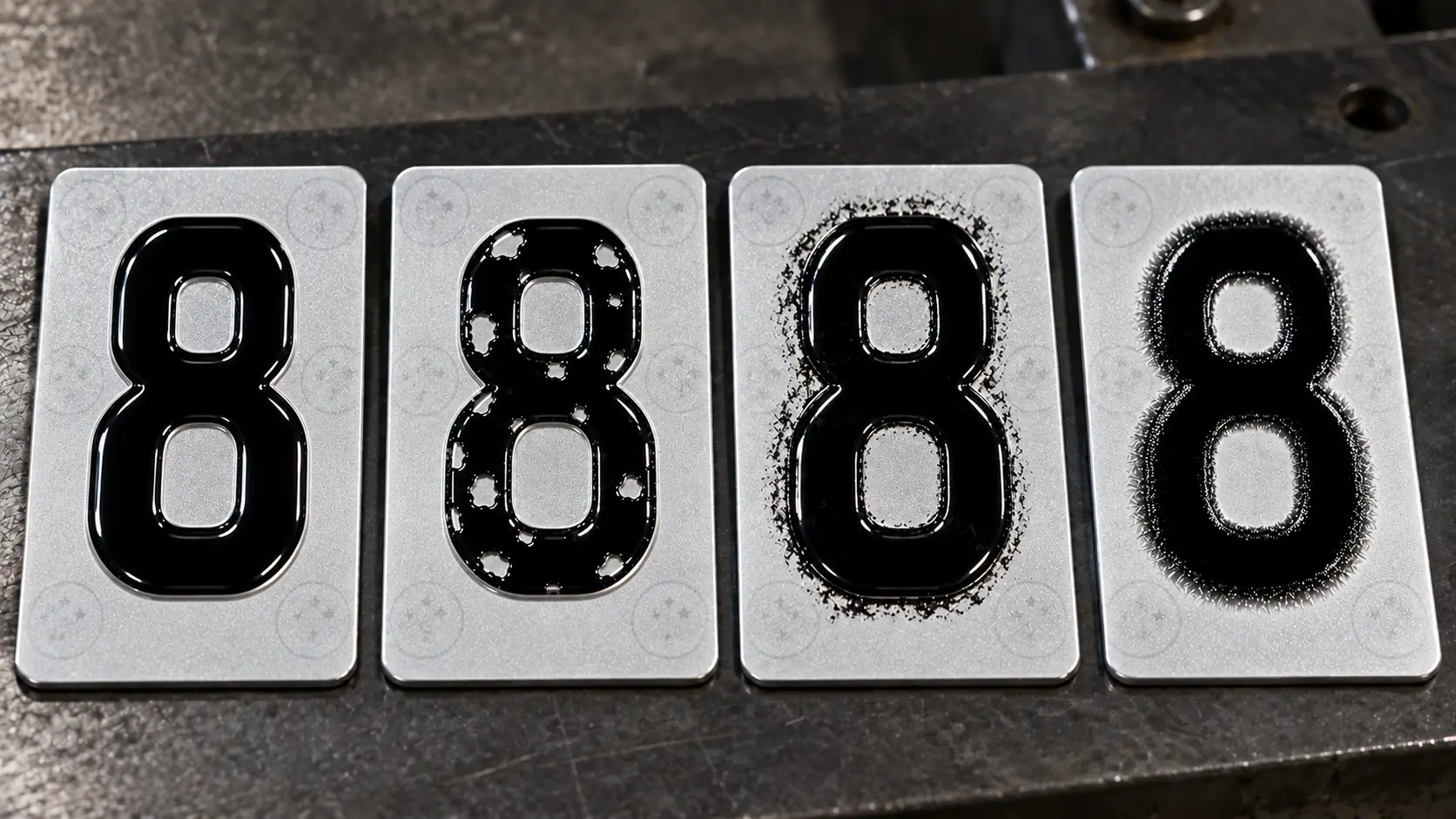
Defect | Likely Causes | Corrective Direction |
|---|---|---|
Cracks at character corners | Brittle construction, cold material, sharp radius or excessive embossing severity | Condition the material, inspect die geometry and qualify dedicated embossable sheeting |
White stress marks | Excessive localized strain, incompatible face construction or cold processing | Review embossing depth, radius, material temperature and film construction |
Film lifts around characters | Contaminated aluminum, insufficient developed adhesion or excessive deformation | Improve cleaning, allow the correct dwell and verify post-emboss adhesion |
Bubbles after hot stamping | Trapped contamination, adhesive movement, excessive heat or pressure | Improve lamination cleanliness and reduce excessive process energy |
Incomplete foil transfer | Low process energy, excessive speed, uneven character height or foil mismatch | Check tooling and pressure before increasing temperature; verify foil compatibility |
Pinholes in the color layer | Contamination, rough character face, insufficient transfer or unsuitable foil | Clean the system, inspect embossing and test another qualified foil |
Foil on the background | Excessive heat or pressure, insufficient character relief or unsuitable release behavior | Reduce transfer severity and verify embossing height |
Blurred character edges | Excessive temperature, pressure or dwell | Reduce the relevant setting and stabilize speed |
Foil peels after cooling | Surface contamination, incompatible bonding layer or insufficient process window | Test the exact foil/sheeting pair and evaluate adhesion after conditioning |
Background shrinkage or distortion | Excessive heat, unstable face film or residual application stress | Review application stretch, heat exposure and material construction |
Reduced nighttime appearance | Damaged optical layer, excessive deformation, contamination or background printing | Measure retroreflectivity on the finished plate and inspect the embossed zones |
Use the table as a diagnosis guide, not as proof that the film is always the root cause. Aluminum, dies, machine settings and foil can produce similar symptoms.
What Should Be Included in an RFQ for Embossable License Plate Sheeting?
Send suppliers enough information to evaluate the actual conversion process.
RFQ Item | Information to Provide |
|---|---|
Destination market | Country, authority and plate program |
Applicable requirements | Standard number, revision, tender or technical specification |
Plate type | Car, truck, trailer, motorcycle or special plate |
Plate construction | Embossed aluminum, border type and character-coloring method |
Aluminum | Alloy, temper, thickness, surface treatment and supplier |
Embossing | Machine, character height, depth, stroke, radius and die type |
Hot stamping | Machine, foil brand or series, pressure, temperature range and speed |
Reflective performance | Required color and RA values with measurement geometry |
Security | Watermark, logo, microtext, serial number, hologram or traceability |
Roll format | Width, length, core, winding direction and splice limits |
Documentation | TDS, batch data, test reports and change-control requirements |
Trial | Sample dimensions, pilot quantity and finished-plate test plan |
Commercial information | Annual volume, delivery schedule and packaging |
Also ask the supplier to state:
Whether elongation data is for the face film or complete construction
Test method and machine-direction/cross-direction results
Recommended aluminum surface
Minimum lamination temperature
Required dwell before embossing
Known compatible hot-stamping foils
Recommended process window
Post-emboss and post-heat inspection results
Whether changes to the adhesive, topcoat or construction require notification
Why Work With ABLAZE for License Plate Reflective Sheeting?
ABLAZE is the reflective material brand of Changzhou Zhenghe New Material Technology Co., Ltd., a professional reflective sheeting manufacturer in Changzhou, China.
Our team has practical experience supporting license plate reflective sheeting projects and production programs, including supply to plate programs in multiple Chinese provinces. This work requires more than producing a reflective roll. It requires control of:
Glass-bead optical construction
Acrylic/PMMA face-film performance
Adhesion to prepared aluminum
Embossing behavior
Hot stamping and roller coating
Color and retroreflectivity consistency
Security marks and customized printing
Batch traceability
Stable high-volume supply
ABLAZE HW8200 is an enclosed glass-bead license plate reflective sheeting developed for professional plate conversion. Project-specific colors, roll dimensions, security requirements and processing conditions can be discussed according to the target market.
Before recommending a material, we prefer to review the buyer’s plate standard, aluminum, embossing geometry, hot-stamping foil and machine conditions. Sample material should then be validated on the actual production line and tested as a finished plate.
Learn more about our license plate manufacturing material solutions, or contact ABLAZE to discuss samples and a production trial.
Frequently Asked Questions
What elongation is required for license plate reflective sheeting?
There is no universal percentage. The required deformation depends on character height, radius, stroke width, embossing depth, aluminum temper, material temperature and the complete multilayer sheeting construction. Use comparable tensile data for screening and then approve the material through actual embossing trials.
Is the sheeting with the highest elongation always the best for embossing?
No. Very high elongation does not guarantee layer integrity, character definition, dimensional stability, adhesion or retained reflectivity. The best material is the one that produces repeatable finished plates without cracking, whitening, lifting or unacceptable optical change.
Can ordinary engineering-grade reflective sheeting be used for embossed license plates?
Not automatically. A traffic-sign product may be designed to remain flat and may not have the face film, adhesive, topcoat or forming performance required for embossing and hot stamping. Use a plate-grade product qualified for the intended conversion process.
What is the correct hot-stamping temperature for license plates?
There is no universal setting. It depends on the foil, sheeting surface, machine, pressure, contact time, line speed, character height and plate temperature. Begin with the machine and foil supplier’s recommendations and then establish a documented operating window on the actual production line.
Does a high service-temperature rating prove hot-stamping compatibility?
No. Service temperature describes long-term use after application, while hot stamping is a short-duration surface process involving heat and pressure. Compatibility must be tested using the exact foil and production conditions.
Should adhesion be tested before or after embossing?
Both. Flat-panel adhesion establishes a baseline. Post-emboss, post-hot-stamp and post-conditioning checks show whether the bond survives the stresses that matter in license plate production.
Why does foil transfer well on one reflective sheeting but poorly on another?
Hot-stamping foil bonds to the sheeting’s outer face film or topcoat. Differences in surface chemistry, coating, gloss, contamination and heat response can change foil release and adhesion even when two materials have similar reflectivity.
Is one successful sample plate enough for approval?
No. One plate cannot demonstrate repeatability or process margin. Run a documented pilot using representative and difficult characters, multiple positions and controlled variations around the proposed production settings.
Does ISO 7591 certify the raw reflective sheeting?
ISO 7591 specifies provisions for retroreflective registration plates and includes finished-plate photometric, colorimetric and other tests. A raw-film claim alone does not prove that the buyer’s completed plate system meets the applicable national or project requirements.
What information should I send ABLAZE for sample evaluation?
Send the destination standard, plate dimensions, background color, aluminum alloy and thickness, embossing depth and character geometry, machine model, hot-stamping foil information, current operating conditions, required security features and estimated annual volume.
Conclusion
Choosing license plate reflective sheeting for embossing and hot stamping is not a matter of finding the largest elongation number or the highest heat-resistance claim.
The correct material must work as part of a complete system:
It must deform with the aluminum without cracking.
It must remain bonded around raised characters.
It must tolerate short process heat without permanent damage.
It must accept the selected foil across a stable production window.
It must retain the required appearance, readability, reflectivity and durability after conversion.
The safest qualification method is to compare fully defined technical data, run the material on the actual production line, test the finished plate and retain an approved golden sample.
Changzhou Zhenghe New Material Technology Co., Ltd. and the ABLAZE brand can support license plate manufacturers with glass-bead reflective sheeting samples, customized project requirements and production-line evaluation. Contact us with your plate specification and process details to begin a technical review.
RELATED NEWS

License Plate Sheeting for Embossing & Hot Stamping | ABLAZE
A reflective film can look bright, smooth and well bonded while it is still flat, yet crack, whiten, lift or reject hot-stamping foil after it is converted into a license plate.The reason is simple: embossed license plate production does not test only the reflectivity of the material. It forces the

Chevrons, Battenburg and Contour Marking: Specifying Reflective Livery for Emergency and Works Vehicles
Chevrons, Battenburg and Contour Marking: Specifying Reflective Livery for Emergency and Works VehiclesIn North America the rear chevrons slope downward and away from the centreline. In the United Kingdom they point upward. Both are correct, in their own jurisdiction — which tells you most of what y