


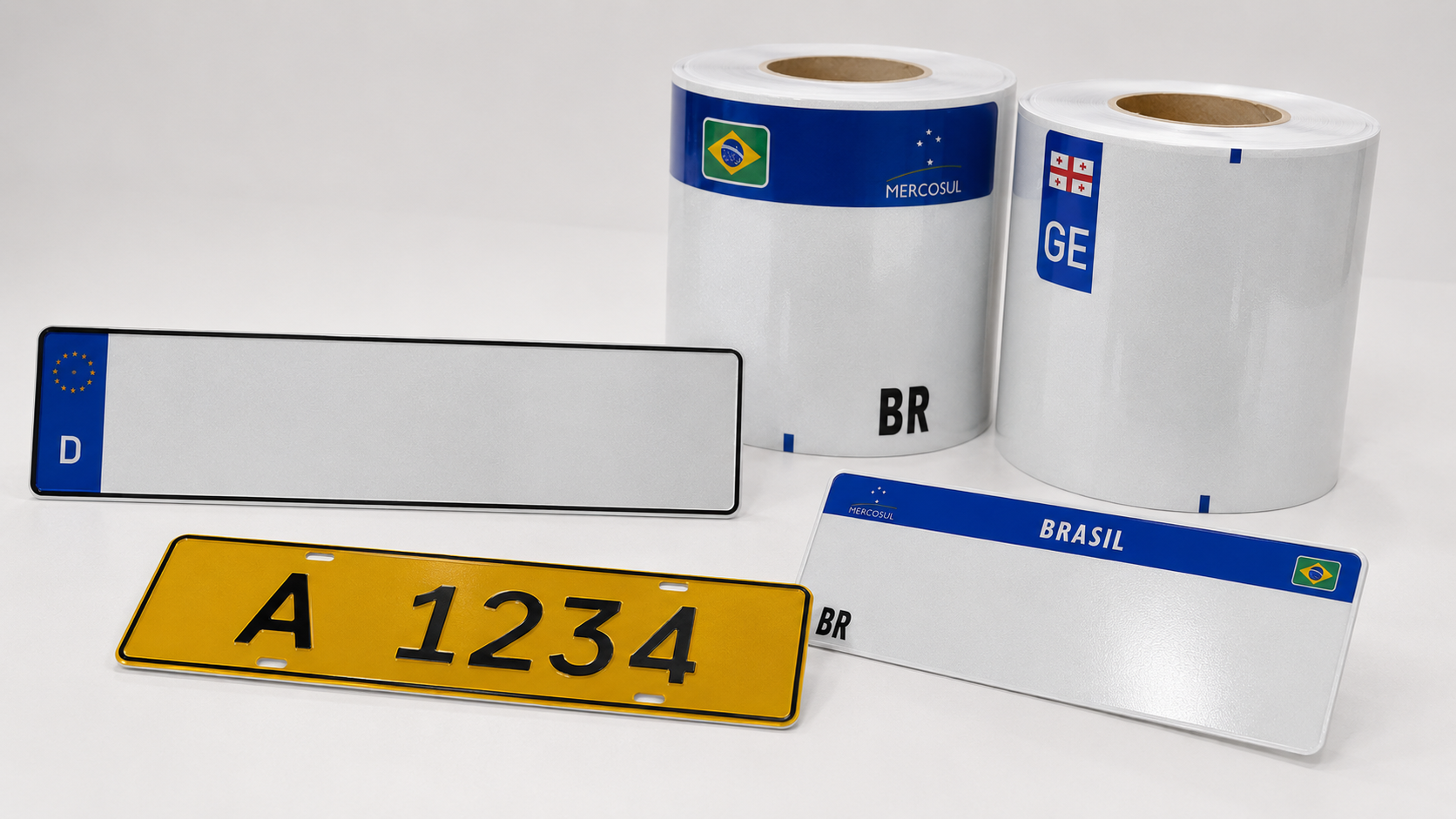
License plate reflective sheeting is not simply a reflective sticker applied to an aluminum plate. It is a functional component of a regulated vehicle identification system.
The material must maintain nighttime retroreflectivity, daytime color, adhesion and surface integrity after lamination, embossing, printing, hot stamping, exposure to weather and years of vehicle service. Where security is required, it may also need to carry embedded watermarks, official graphics, holographic elements, serial numbers or machine-readable codes.
For this reason, professional buyers should evaluate a complete license plate system—not only the price or brightness of an unprocessed roll.
Changzhou Zhenghe New Material Technology Co., Ltd., manufacturer of the ABLAZE® reflective material brand, supplies license plate reflective sheeting for professional plate manufacturers, distributors, authorized production centers and government procurement projects.
This guide explains how to evaluate license plate sheeting according to ISO 7591, printing and embossing compatibility, security requirements, finished-plate testing and long-term production cost.
Quick Answer: What Should Buyers Check Before Ordering License Plate Sheeting?
Before ordering license plate reflective sheeting, confirm the following ten points:
The destination country and applicable national license plate regulation
Whether ISO 7591 or another standard is referenced
Required background colors and color tolerances
Minimum retroreflectivity at the specified observation and entrance angles
Compatibility with the aluminum substrate
Embossing, hot stamping, roller coating or printing process
Required security and traceability features
Finished-plate durability and environmental tests
Batch consistency and production traceability
Test reports, approval documents and sample validation procedures
The most important principle is simple:
Approve the converted license plate system, not only the reflective sheeting roll.
The system may include the reflective film, aluminum blank, adhesive, ink, hot-stamping foil, security graphics, protective layer, embossing tooling and production conditions. A material that looks satisfactory in roll form can still fail after embossing, printing or outdoor exposure.
What Is License Plate Reflective Sheeting?
License plate reflective sheeting is a specialized retroreflective film used as the visible background of motor vehicle registration plates.
When vehicle headlights illuminate the plate, microscopic glass beads or prisms return part of the light toward the driver, enforcement officer or camera. This improves plate visibility and identification at night.
Unlike ordinary commercial reflective vinyl, license plate sheeting may need to withstand:
Lamination to corrosion-resistant aluminum
Punching and edge forming
Mechanical embossing of letters and numbers
Roller coating of raised characters
Hot stamping
Screen or digital printing
Laser marking
Outdoor UV exposure
Rain, humidity, road salt and washing
Fuel and cleaning chemicals
Repeated temperature changes
Long-term vehicle vibration and impact
Ordinary traffic sign film is generally designed to remain flat after application. License plate sheeting, however, often needs to stretch around embossed characters without cracking, whitening, lifting or separating from the aluminum.
Buyers who need a general introduction to optical structures can first read What Is Reflective Sheeting? Types, Uses and Buying Guide.
What Does ISO 7591 Require for Retroreflective Registration Plates?
ISO 7591:1982 is titled “Road vehicles — Retro-reflective registration plates for motor vehicles and trailers — Specification.”
It covers photometric and colorimetric properties, sampling and a series of physical and environmental tests for retroreflective registration plates.
One of the most important purchasing points is that ISO 7591 is written around the performance of representative finished plates. It should not be interpreted as a brightness specification for an isolated roll of reflective material.
Does ISO 7591 Apply to the Raw Sheeting or the Finished Plate?
ISO 7591 primarily evaluates the completed registration plate system.
The standard indicates that the retroreflective background of the finished plate should be flat and smooth. When reflective sheeting is used, it must form a durable bond with a corrosion-resistant substrate, resist impact and bending, and allow relief characters to be embossed.
The dimensions, shape, letters and numerals are also checked on the completed plate by the competent authority.
This distinction matters because finished-plate performance can be affected by:
Aluminum surface treatment
Lamination pressure
Embossing height and die clearance
Ink or foil coverage
Printed background graphics
Protective overlays
Contamination during production
Plate-forming operations
Storage and conditioning
A test report for raw film is useful, but it does not automatically prove that every plate manufactured from that film will comply with ISO 7591 or a national license plate regulation.
ISO 7591 Performance and Test Categories
The following table summarizes the main areas relevant to buyers.
Evaluation area | What the standard addresses | Why it matters to buyers |
|---|---|---|
Finished surface and substrate | Smooth retroreflective background, durable bonding to a corrosion-resistant substrate and embossability | Confirms that the material must work as part of a finished plate |
Retroreflectivity | Minimum coefficient of retroreflection at specified observation and entrance angles | Determines nighttime visibility under defined geometry |
Wet retroreflection | Performance under simulated rainfall | Helps assess plate visibility in rain |
Retroreflective uniformity | Control of visible brightness variation across the plate | Prevents patchy or inconsistent plate backgrounds |
Daytime and nighttime color | Chromaticity and luminance requirements | Helps maintain legally defined white or yellow backgrounds |
Temperature resistance | Resistance to sequential hot, normal and cold conditions | Screens for peeling, cracking, blistering and discoloration |
Adhesion | Bonding to the substrate after low-temperature conditioning | Reduces the risk of film separation |
Impact resistance | Resistance to localized impact at low temperature | Evaluates cracking and separation around an impact area |
Bending resistance | Ability to bend without cracking | Relevant to plate forming and mechanical deformation |
Water resistance | Resistance after water immersion and drying | Helps identify moisture-related deterioration |
Cleanability | Ability to remove oil and graphite contamination without surface damage | Important for real vehicle maintenance |
Fuel resistance | Resistance to specified fuel exposure | Relevant to vehicle operating environments |
Saline-mist resistance | Resistance to corrosion-related salt exposure | Important for coastal regions and winter roads |
Durability | Retention of color, luminance and retroreflectivity after specified exposure | Evaluates long-term optical stability |
ISO 7591 also specifies that wet retroreflectivity should retain a defined proportion of the dry values. Its durability evaluation checks whether retroreflectivity, color and luminance remain within specified limits after exposure.
For purchasing and approval, always consult the official standard and the applicable national regulation for the exact test geometry, limits, sample preparation and acceptance criteria.
Why National Regulations and Tender Specifications Still Matter
ISO 7591 does not replace the destination country’s vehicle registration rules.
National or project specifications may add requirements for:
Plate dimensions and shape
Character font and spacing
Aluminum alloy and temper
Background colors
National flags and official emblems
Security watermarks
Holographic elements
QR codes and serial numbers
Plate maker identification
Destructive removal behavior
Camera or ANPR readability
Government approval and homologation
Authorized supply-chain traceability
Therefore, the correct sourcing question is not only:
“Does the sheeting meet ISO 7591?”
A stronger question is:
“Can this exact sheeting, aluminum, printing and security system produce finished plates that meet the current specification and approval procedure of our destination market?”
Suppliers should not describe a product as “ISO 7591 certified” unless the exact product, color and tested plate construction are supported by appropriate current documentation.
Glass-Bead vs Microprismatic License Plate Sheeting
License plate reflective film can use glass-bead or microprismatic retroreflective technology.
Neither technology should be selected by brightness alone.
Factor | Enclosed glass-bead sheeting | Microprismatic sheeting |
|---|---|---|
Optical structure | Precision glass beads inside a resin construction | Geometrically formed microprisms |
Typical appearance | Smooth and visually uniform | Smooth surface with an internal prism pattern |
Retroreflectivity | Stable performance suitable for many conventional plate systems | Potentially higher brightness and different angular performance |
Embossing | Mature embossable constructions are widely available | Requires a grade specifically designed and qualified for embossing |
Printing | Suitable grades support screen printing, roller coating and hot stamping | Selected grades can support digital and conventional processes |
Cost | Often more economical | Normally higher material cost |
Best use | Conventional embossed plates and established production systems | High-performance or system-specific plate programs |
Do not assume that all glass-bead films behave alike or that every prismatic film can be embossed.
The face film, optical layer, resin system, adhesive, total thickness and production process all influence performance.
Material names such as acrylic, PET or PVC are also not sufficient purchasing specifications. Buyers should compare the complete construction and its intended application. For more information, see PET vs PVC vs Acrylic Reflective Sheeting.
How to Match Reflective Sheeting to Your Plate Manufacturing Process
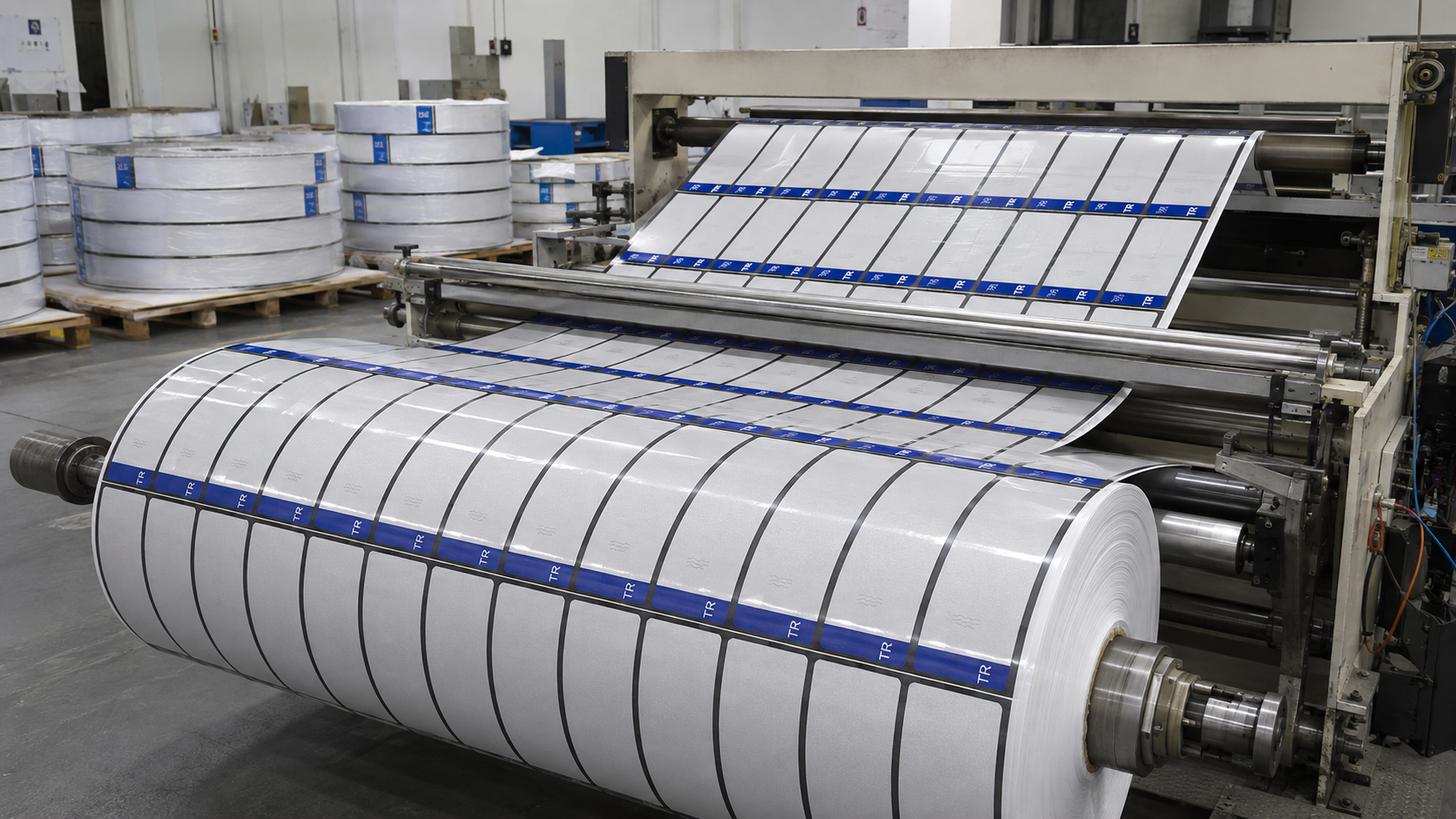
The correct sheeting must match the buyer’s actual plate manufacturing equipment.
A supplier should never approve compatibility only by saying that the film is “printable” or “embossable.” The specific process, machine, ink, foil and production conditions must be identified.
Lamination to Aluminum Plate Blanks
The adhesive must bond reliably to the specified aluminum surface and remain stable through downstream processing.
Before lamination, the aluminum should be:
Clean and dry
Free from oil, dust and oxidation
Compatible with the adhesive system
Flat and properly conditioned
Within the recommended processing temperature range
Buyers should confirm:
Aluminum alloy and temper
Surface treatment or coating
Plate thickness
Lamination temperature
Lamination speed and pressure
Time allowed for adhesive bonding
Edge-forming process
Storage conditions before embossing
Poor surface preparation can cause bubbles, edge lifting or long-term delamination even when the sheeting itself is properly manufactured.
Mechanical Embossing
Embossing stretches the film around raised letters, numbers and borders.
An embossable license plate film should resist:
Cracking at character corners
Surface whitening
Splitting around narrow shapes
Adhesive separation
Delamination
Loss of reflective uniformity
Permanent distortion outside the embossed area
Embossing results depend on the film as well as the aluminum temper, die clearance, character design, tooling condition, embossing pressure and processing temperature.
Run the trial with actual production dies. A hand-bent sample cannot represent the localized stress created by an industrial embossing machine.
Hot Stamping and Roller Coating
After embossing, raised characters are commonly colored by hot stamping or roller coating.
Hot stamping transfers a pigmented or security foil to the raised characters. It can provide:
Sharp character edges
High visual contrast
Consistent color
Fast production
Optional security inscriptions or diffractive effects
Roller coating applies compatible ink to raised areas. It is widely used in high-volume plate manufacturing, but ink viscosity, roller pressure, drying or curing conditions and surface compatibility must be controlled.
During validation, inspect for:
Missing foil or ink
Pinholes
Blurred character edges
Poor adhesion
Uneven density
Transfer outside raised characters
Cracking after cooling or bending
Screen Printing
Screen printing is useful for fixed graphics such as:
National names
State or provincial identifiers
Flags and coats of arms
Borders
Repeating logos
Official background designs
Certain UV or security features
The ink system must be qualified for the surface of the reflective sheeting.
Testing should include ink adhesion, curing, chemical resistance, color consistency, weathering and any effect on retroreflectivity.
Digital and Thermal Transfer Printing
Digital printing can support complex designs, short production runs and variable information. Depending on the plate system, it may be used for:
Full-color backgrounds
Jurisdiction graphics
Serial numbers
Barcodes or QR codes
Variable plate data
Temporary or specialized plates
However, “digital-printable” is not a complete specification.
Confirm:
Printer model
Ink or ribbon chemistry
Resolution
Color profile
Ink limits
Curing conditions
Required overlaminate
Expected outdoor durability
Effect on retroreflectivity
Compatibility with embossing or forming
The term “UV printing” is especially ambiguous. It can refer to UV screen printing or UV-curable digital inkjet printing. These are different processes and should be validated separately.
See Can You UV Print on Reflective Sheeting? and the Printable Reflective Sheeting Buying Guide for more detailed printing information.
Laser Marking and Variable Data
Laser marking may be used to add permanent numbers, codes or security information when the sheeting construction is specifically designed for it.
Buyers must confirm:
Which layer is affected by the laser
Required wavelength and power
Marking contrast
Marking speed
Effect on the face film
Effect on retroreflectivity
Resistance to abrasion and chemicals
Compatibility with the finished-plate specification
An unqualified laser setting can burn the face film, damage the optical layer or reduce durability.
Which Security Features Can Be Added to License Plate Sheeting?
A modern registration plate can function as both a vehicle identifier and a controlled security document.
Security features should be selected according to the threat level, verification method, production process and government requirements.
It is important to distinguish where each feature is created. Some features are embedded during sheeting manufacture, some are printed on the surface, and others are added during plate conversion or personalization.
Embedded Watermarks and Directional Security Marks
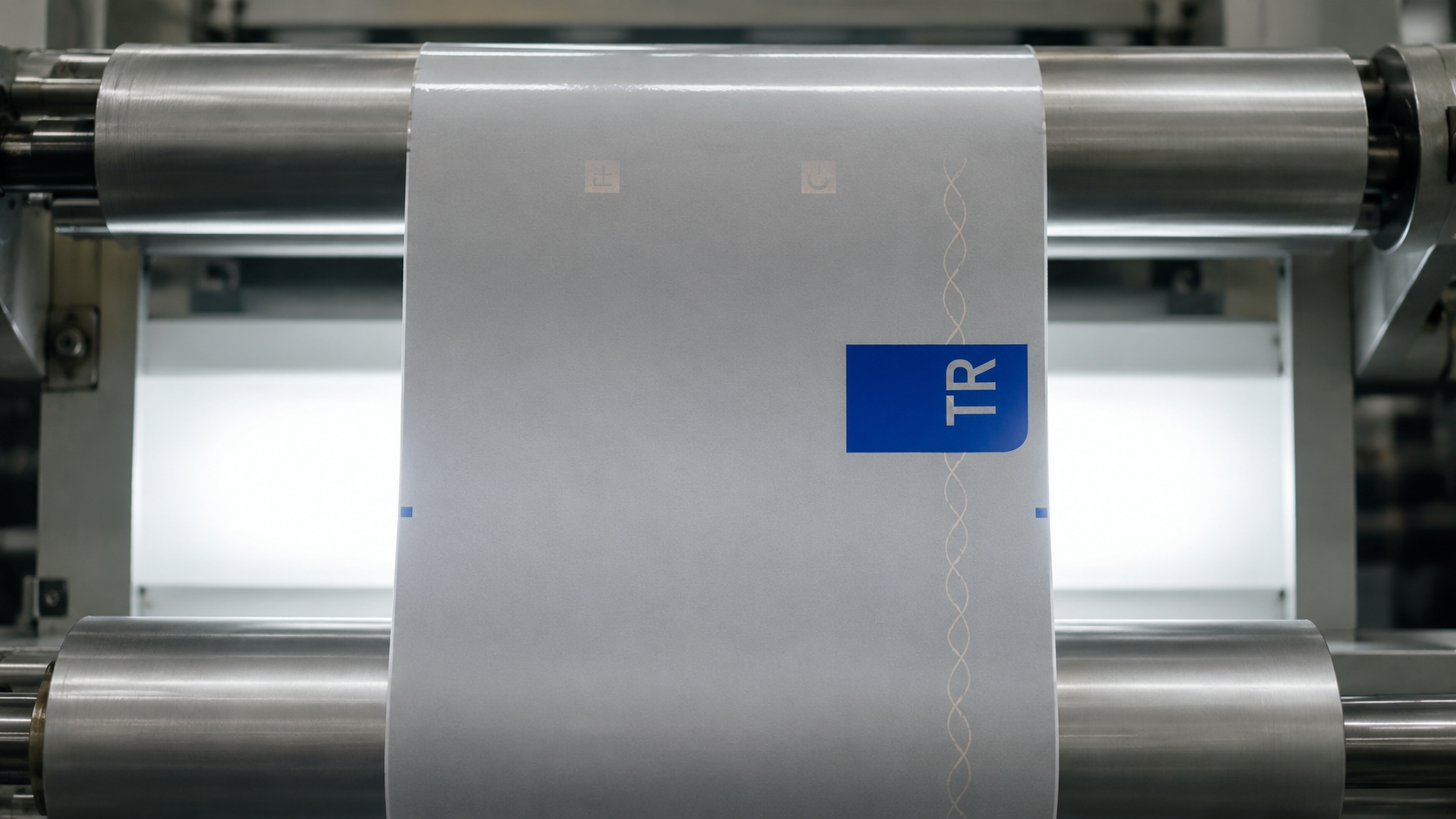
An embedded or buried watermark is incorporated into the sheeting construction during manufacturing.
Depending on its design, it may be:
Visible under normal light
Visible only from a defined angle
Visible under retroreflective illumination
Customized with a government emblem, name or logo
Linked to the supplier or production batch
Because the feature is inside the material, it is generally more difficult to reproduce with ordinary surface printing.
The RFQ should specify:
Watermark artwork
Size and repeat distance
Orientation
Viewing direction
Contrast
Approved master sample
Ownership and confidentiality of the design
Controls for obsolete or rejected material
Holographic and Inscribed Hot-Stamping Foils
Security hot-stamping foil can combine character coloring with additional optical features.
Options may include:
Repeating security text
Diffractive patterns
Rainbow effects
Microtext
Jurisdiction logos
Custom holographic images
The foil, embossing conditions and sheeting surface must be tested together. A high-security foil provides little value if transfer quality is inconsistent or if it can be removed without damaging the plate.
Microtext, UV Marks and Official Graphics
Surface printing can add overt or covert verification features such as:
Microtext
Fine-line patterns
Official coats of arms
UV-fluorescent marks
Optical-variable effects
Controlled color-shifting graphics
Hidden or low-contrast images
These features require defined inspection procedures. The buyer should state whether verification will be performed by the public, police officers, inspection centers or laboratory equipment.
Serial Numbers, QR Codes and Batch Traceability
Serial numbers and machine-readable codes support traceability but should not be confused with embedded anti-counterfeit features.
A QR code or 2D code may connect the plate to:
Vehicle registration data
Plate manufacturer identity
Production date
Batch number
Personalization center
Inspection history
Government verification database
The security of a code depends on the database, encryption, issuance control and verification system—not only on the printed image.
For material traceability, the buyer may also require batch identifiers in the liner, watermark pattern, packaging label or production records.
Tamper-Evident and Machine-Readable Features
Additional options may include:
Destructible layers
Irreversible removal effects
Machine-readable optical marks
Laser-reactive layers
Controlled retroreflective patterns
Protective overlays
Forensic identification features
The best security system normally combines several independent features instead of relying on one logo or QR code.
A practical structure may include:
An overt feature for rapid visual inspection
A covert feature for trained enforcement officers
A machine-readable or database-linked feature
A forensic or restricted feature for investigation
What Specifications Should Be Included in Your RFQ?
A clear RFQ reduces unsuitable quotations and makes supplier comparisons more meaningful.
RFQ item | Information to provide |
|---|---|
Destination market | Country, state, province or authority |
Applicable specification | Standard number, revision and tender document |
Plate type | Passenger vehicle, truck, trailer, motorcycle or special plate |
Plate construction | Embossed aluminum, flat printed plate or another system |
Aluminum substrate | Alloy, temper, thickness and surface treatment |
Reflective technology | Glass bead, microprismatic or performance-based requirement |
Color | White, yellow, blue or custom color with tolerance |
Retroreflectivity | Required values, units, observation angles and entrance angles |
Manufacturing process | Lamination, embossing, hot stamping, roller coating or printing |
Printing system | Screen, digital UV, thermal transfer, laser or another process |
Security features | Watermark, hologram, UV mark, microtext, serial number or QR code |
Outdoor life | Required service period and exposure conditions |
Roll specification | Width, length, core size, winding direction and splice limits |
Quality tolerance | Color, RA, thickness, width and visual defect tolerances |
Documentation | TDS, SDS, test reports, certificates and approval records |
Sample requirement | Roll sample, converted sample or pilot production quantity |
Commercial requirement | Trial quantity, annual forecast, lead time and packaging |
Do not compare quotations until suppliers confirm the same specification.
A low quotation for plain film cannot be compared directly with a quotation that includes customized watermarks, security printing, laboratory testing and controlled production traceability.
How to Test Samples Before a Bulk Order
A reliable supplier approval process should contain four stages.
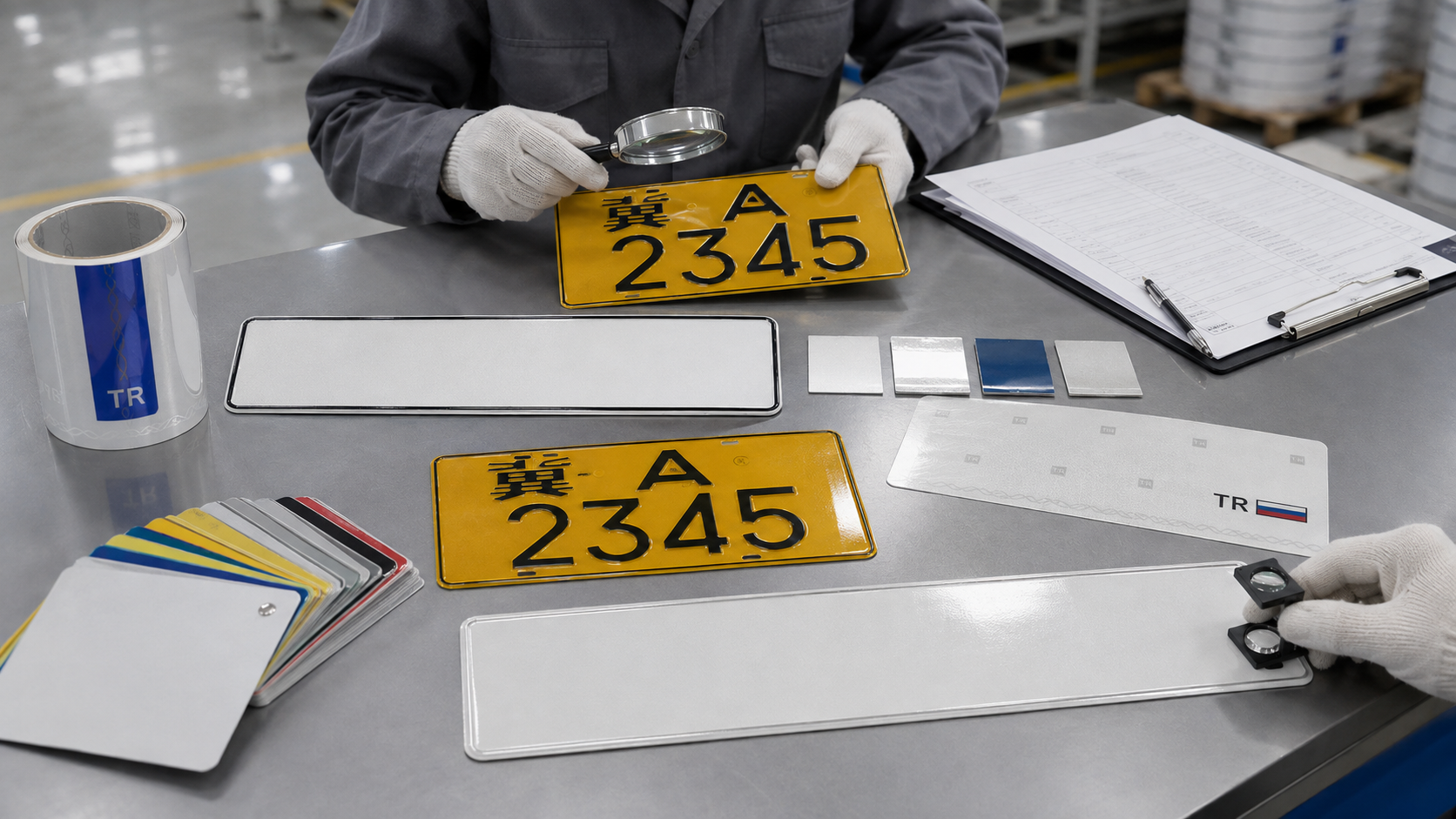
Stage 1: Document Review
Before requesting samples, review:
Technical data sheet
Safety data sheet
Applicable test reports
Product construction
Standard roll dimensions
Storage and shelf-life information
Recommended processing conditions
Printing and embossing guidance
Security-feature proposal
Batch traceability method
Confirm that reports identify the exact product model, color, test method and tested construction.
Stage 2: Incoming Material Inspection
Inspect the roll for:
Correct width and length
Surface smoothness
Color consistency
Visible contamination
Wrinkles or telescoping
Edge damage
Splices
Release-liner condition
Adhesive uniformity
Batch and packaging identification
Measure retroreflectivity using the specified geometry rather than comparing rolls with a flashlight or phone camera.
Stage 3: Production-Line Conversion Trial
Run the material through the actual production line.
Evaluate:
Liner removal
Lamination behavior
Air entrapment
Aluminum adhesion
Cutting and punching
Edge forming
Embossing quality
Hot-stamping or ink transfer
Printing adhesion
Character contrast
Production speed
Scrap rate
Produce enough plates to detect repeatability problems. One visually acceptable plate is not sufficient for production approval.
Stage 4: Finished-Plate Testing
The converted plate should be evaluated for:
Retroreflectivity and uniformity
Daytime and nighttime color
Embossing resistance
Adhesion
Impact and bending resistance
Water resistance
Temperature cycling
Chemical and fuel resistance
Salt-mist resistance
Accelerated weathering
Cleaning resistance
Security-feature verification
Camera or ANPR readability, if required
Photograph and record the samples before and after each test.
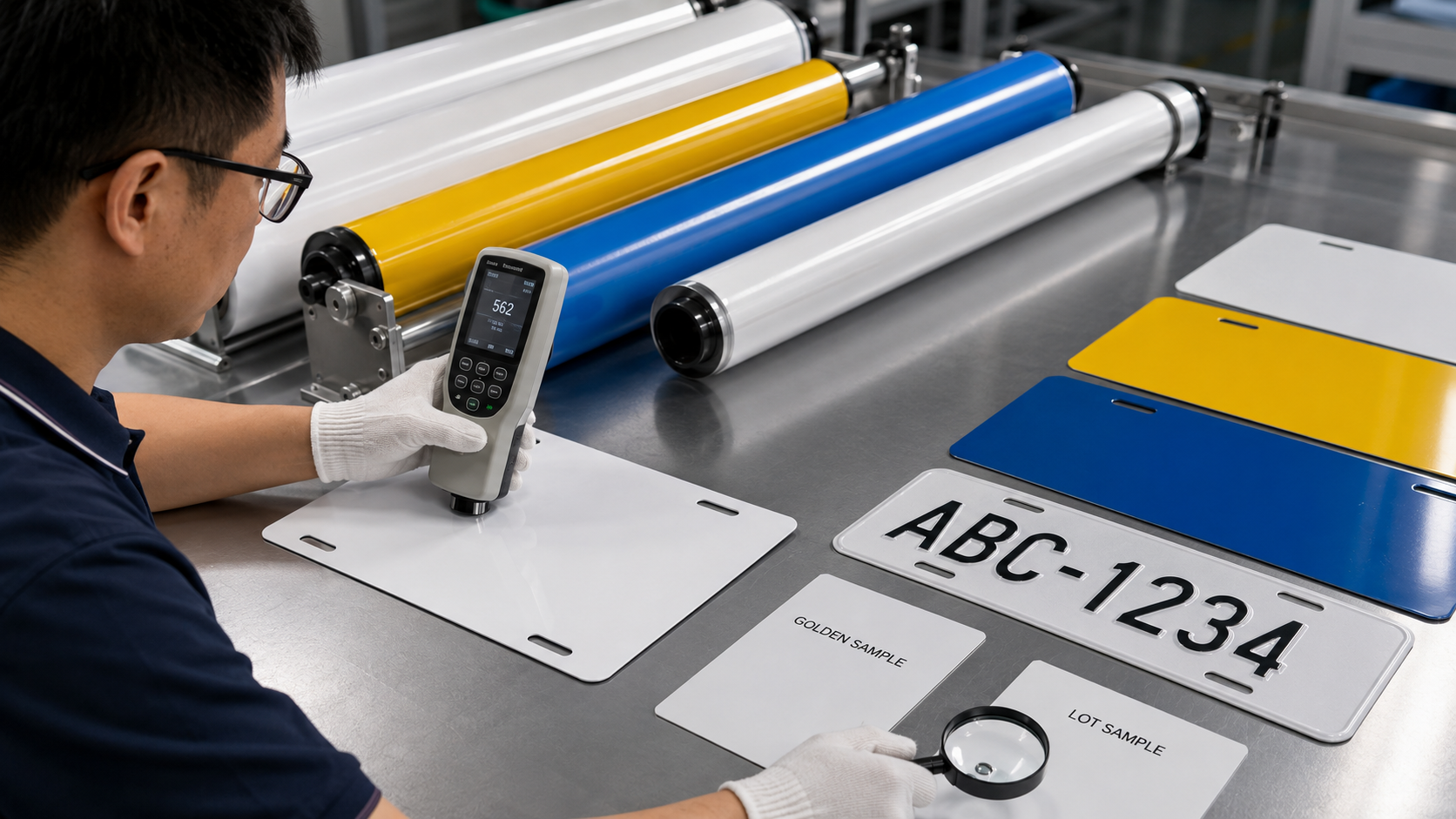
A signed golden sample should define the approved appearance and conversion quality. Retain reference samples from the approved batch for future comparison.
For a broader inspection workflow, see How to Test Reflective Sheeting Quality Before a Bulk Order.
How to Compare License Plate Sheeting Suppliers
The lowest price per square meter does not always produce the lowest plate cost.
A more useful comparison includes:
Material price
Usable yield
Slitting and edge loss
Embossing reject rate
Printing or hot-stamping reject rate
Production downtime
Rework and inspection labor
Security artwork and setup cost
Laboratory and approval expenses
Minimum order quantity
Lead time and inventory cost
Batch consistency
Warranty and technical support
Risk of field complaints or rejected plates
A small material saving can disappear quickly if the film causes cracking, poor foil transfer or inconsistent color during mass production.
When assessing a supplier, ask:
Has the supplier produced dedicated license plate sheeting before?
Can it maintain batch-to-batch color and RA consistency?
Can it support custom watermarks or security graphics?
Are controlled production records available?
Can samples be converted on the buyer’s actual equipment?
Can the supplier support third-party testing?
Are technical and commercial teams able to respond during trial production?
Can the supplier maintain stable supply for multi-year projects?
Common Buying Mistakes
Mistake 1: Buying Ordinary Reflective Vinyl for License Plates
A commercial reflective vinyl may look bright but fail during embossing, hot stamping or long-term vehicle exposure.
Mistake 2: Comparing RA Values Measured at Different Angles
Retroreflectivity values are meaningful only when the units, color, observation angle, entrance angle, orientation and test method are the same.
Mistake 3: Treating ISO 7591 as a Raw-Film Certificate
ISO 7591 is centered on representative finished registration plates. Raw-film data alone does not prove finished-plate compliance.
Mistake 4: Accepting the Word “Printable” Without Details
Always specify the printer, ink, ribbon, curing method and protective layer.
Mistake 5: Testing Only Flat Sheeting
Emboss, print and finish the material before approval.
Mistake 6: Adding Security Features Too Late
Watermarks and other embedded features may require custom manufacturing, artwork approval, tooling and minimum quantities.
Mistake 7: Ignoring Aluminum Compatibility
The same adhesive can perform differently on untreated, coated, oily or oxidized aluminum.
Mistake 8: Selecting the Lowest Initial Price
Evaluate usable plate cost, production stability and compliance risk—not only the roll quotation.
Why Choose ABLAZE License Plate Reflective Sheeting?
ABLAZE® is the reflective material brand of Changzhou Zhenghe New Material Technology Co., Ltd.
Our company has successfully won competitive tenders for motor vehicle license plate reflective sheeting in several Chinese provinces and supplies materials to multiple provincial plate production programs.
This experience gives our team practical knowledge of:
Government procurement requirements
Large-volume batch control
Color and retroreflectivity consistency
Aluminum lamination
Mechanical embossing
Roller coating
Hot stamping
Screen printing
Production traceability
Technical documentation
Long-term supply planning
ABLAZE HW8200 License Plate Reflective Sheeting uses an acrylic/PMMA face film and an enclosed glass-bead retroreflective structure developed for professional motor vehicle plate manufacturing.
The product is designed to support:
Lamination to properly prepared aluminum
Mechanical embossing
Hot stamping
Roller coating
Screen printing
Customized colors and roll dimensions
Project-specific security requirements
Standard roll sizes include 1.22 m × 45.7 m and 1.24 m × 45.7 m, with white, yellow and blue among the standard color options.
HW8200 is designed according to the applicable technical requirements of GA 666-2018. For projects referencing ISO 7591 or another national standard, the required test reports, colors, plate construction and approval procedures should be confirmed for the exact project before ordering.
Learn more about our complete license plate manufacturing reflective material solutions.
Frequently Asked Questions
Does ISO 7591 apply only to license plate reflective sheeting?
No. ISO 7591 specifies requirements for retroreflective registration plates and evaluates representative finished plates. The sheeting is an important component, but the substrate, characters, printing and conversion process also affect compliance.
Is an ISO 7591 test report enough for every country?
No. The destination country may require additional national approvals, plate dimensions, security elements, colors, fonts, traceability systems or homologation procedures.
Can ordinary traffic sign sheeting be used for license plates?
Not automatically. License plate film must be specifically evaluated for aluminum adhesion, embossing, hot stamping or printing and long-term vehicle exposure.
Can all reflective sheeting be embossed?
No. Embossability depends on the face film, optical construction, adhesive, thickness and production conditions. Test the material using the actual plate blank and embossing equipment.
Which is better for license plates: glass-bead or microprismatic sheeting?
The better choice is the construction that meets the required standard and works reliably with the plate manufacturing system. Glass-bead film is widely used in conventional embossed plates, while microprismatic film may provide different brightness and angular performance.
What is the best printing method for license plates?
There is no universal best method. Screen printing is suitable for fixed graphics, digital printing supports complex or variable designs, roller coating colors raised characters, and hot stamping can provide sharp characters and security foil effects.
Is a watermark the same as a QR code?
No. A watermark is generally integrated into or associated with the material structure, while a QR code is a printed machine-readable feature. QR-code security depends heavily on the connected database and issuance system.
Should retroreflectivity be tested before or after printing?
Both can be useful, but finished-plate performance is the final approval criterion. Printing, embossing, foil coverage and protective overlays can change the optical result.
How much material should be tested before a bulk order?
The trial quantity should be large enough to run the actual lamination, embossing and finishing equipment under normal production conditions. High-volume or regulated projects should include a pilot batch rather than only A4 samples.
What information is needed for an accurate quotation?
Provide the destination market, applicable standard, plate type, aluminum specification, color, roll size, manufacturing process, printing system, security features, expected annual volume and required documentation.
Request a License Plate Sheeting Sample and Technical Evaluation
Choosing license plate reflective sheeting should begin with the finished plate requirement.
Changzhou Zhenghe New Material Technology Co., Ltd. can help buyers evaluate the appropriate ABLAZE® material according to the destination market, aluminum substrate, plate production process, required retroreflectivity, printing system and security design.
For an accurate recommendation, send us:
Destination country
Applicable standard or tender specification
Plate type and dimensions
Aluminum specification
Required colors
Embossing and printing process
Security-feature requirements
Roll width and length
Trial quantity
Estimated annual volume
Contact ABLAZE to request material samples, technical data, test information and a project-specific quotation for your license plate manufacturing program.

